

Contents
Book summary
Thinking, Fast and Slow
by Daniel Kahneman
The Core Premise
Nobel laureate Daniel Kahneman's magnum opus synthesises decades of research on cognitive biases and heuristics into a unified framework. The central idea: the mind operates through two systems. System 1 is fast, intuitive, and automatic — it handles pattern recognition, emotional responses, and snap judgments. System 2 is slow, deliberate, and analytical — it handles complex calculations, logical reasoning, and careful evaluation. Most errors in judgment occur when System 1 handles a decision that requires System 2, or when System 2 is too lazy or depleted to override System 1's flawed intuition. Understanding this dual-process architecture transforms how you approach every decision.
This thread continues the same argument: Nobel laureate Daniel Kahneman's magnum opus synthesises decades of research on cognitive biases and heuristics into a unified framework. The central idea: the mind operates through two systems. Syste…
This thread continues the same argument: Nobel laureate Daniel Kahneman's magnum opus synthesises decades of research on cognitive biases and heuristics into a unified framework. The central idea: the mind operates through two systems. Syste…
This thread continues the same argument: Nobel laureate Daniel Kahneman's magnum opus synthesises decades of research on cognitive biases and heuristics into a unified framework. The central idea: the mind operates through two systems. Syste…
In this work the author, a recipient of the Nobel Prize in Economic Sciences for his seminal work in psychology that challenged the rational model of judgment and decision making, has brought together his many years of research and thinking in one book. He explains the two systems that drive the way we think. System 1 is fast, intuitive, and emotional; System 2 is slower, more deliberative, and more logical. He exposes the extraordinary capabilities, and also the faults and biases, of fast thinking, and reveals the pervasive influence of intuitive impressions on our thoughts and behavior. He reveals where we can and cannot trust our intuitions and how we can tap into the benefits of slow thinking. He offers practical and enlightening insights into how choices are made in both our business and our personal lives, and how we can use different techniques to guard against the mental glitches that often get us into trouble. This author's work has transformed cognitive psychology and launched the new fields of behavioral economics and happiness studies. In this book, he takes us on a tour of the mind and explains the two systems that drive the way we think and the way we make choices.
Thinking, Fast and Slow by Daniel Kahneman belongs on the short shelf of books that change how you notice decisions in the wild. Whether you agree with every claim or not, the frame it offers is portable: you can apply it in meetings, investing, hiring, and personal trade-offs without carrying the whole volume.
Many readers return to this book because it names patterns that felt familiar but unnamed. Naming is leverage: once you can point to a mechanism, you can design around it. One through-line is “System 1 vs System 2 thinking” and its implications for judgment under uncertainty.
If you are reading for execution, translate each chapter into a testable habit: one prompt before a big decision, one review question after a project, one constraint you will respect next quarter. Theory becomes useful when it shows up in calendars, not only in margins.
Finally, pair this book with opposing voices. The strongest readers stress-test the thesis against cases where the advice fails, note the boundary conditions, and keep a short list of when not to use this lens. That discipline is how summaries become judgment.
Long-form books reward spaced attention: read a chapter, sleep, then write a half-page memo titled “What would I do differently on Monday?” If you cannot answer with specifics, the idea has not yet landed.
Use Thinking, Fast and Slow as a conversation starter with peers who have different incentives. The disagreements often reveal which parts of the book are robust and which are fragile when power, risk, and time horizons change.
Key Ideas and Arguments
System 1 vs System 2 thinking. This idea shows up repeatedly in Thinking, Fast and Slow: separate the definition from the examples, then ask where the author's evidence is strongest and where anecdotes do most of the work. Consider writing a counterexample: a situation where applying the idea literally would misfire, and what guardrail you would add.
Anchoring bias. This idea shows up repeatedly in Thinking, Fast and Slow: separate the definition from the examples, then ask where the author's evidence is strongest and where anecdotes do most of the work. Consider writing a counterexample: a situation where applying the idea literally would misfire, and what guardrail you would add.
Loss aversion. This idea shows up repeatedly in Thinking, Fast and Slow: separate the definition from the examples, then ask where the author's evidence is strongest and where anecdotes do most of the work. Consider writing a counterexample: a situation where applying the idea literally would misfire, and what guardrail you would add.
Availability heuristic. This idea shows up repeatedly in Thinking, Fast and Slow: separate the definition from the examples, then ask where the author's evidence is strongest and where anecdotes do most of the work. Consider writing a counterexample: a situation where applying the idea literally would misfire, and what guardrail you would add.
Prospect theory. This idea shows up repeatedly in Thinking, Fast and Slow: separate the definition from the examples, then ask where the author's evidence is strongest and where anecdotes do most of the work. Consider writing a counterexample: a situation where applying the idea literally would misfire, and what guardrail you would add.
WYSIATI (What You See Is All There Is). This idea shows up repeatedly in Thinking, Fast and Slow: separate the definition from the examples, then ask where the author's evidence is strongest and where anecdotes do most of the work. Consider writing a counterexample: a situation where applying the idea literally would misfire, and what guardrail you would add.
Deeper Themes and Context
Thinking, Fast and Slow is not only a catalogue of claims; it is a stance on how to interpret success, failure, and ambiguity. Readers who engage charitably still ask: which recommendations are universal, which are culturally situated, and which require institutional support you do not have?
Comparing the book's prescriptions to your own context is part of the work. A strategy that assumes abundant capital, patient stakeholders, or long feedback loops will read differently if you are resource-constrained, early in a career, or operating under regulatory pressure. Translation beats transcription.
The book also invites you to notice what it does not say. Silences can be instructive: topics the author avoids, counterexamples that never appear, or metrics that are praised without definition. A serious reader keeps a missing-evidence note alongside a to-try note.
Historically, the most influential business and biography titles survive because they double as vocabulary. Teams that share a phrase from Thinking, Fast and Slow move faster only when they also share a definition and a worked example, otherwise they talk past each other with the same words.
How to Apply the Lessons
Connected Mental Models
Who Should Read This
Start here if you want a serious, book-length argument rather than a thread of bullet points. Thinking, Fast and Slow rewards readers who will sketch their own examples, argue back in the margins, and connect chapters to decisions they are facing this quarter.
It is also useful as a shared vocabulary for teams: a common chapter reference can shorten debate if everyone agrees what the term means in practice. If your team only shares the title, not the definition, expect confusion.
Skip or skim if you need a narrow tactical recipe with no theory; this summary preserves the ideas, but the book's value is often in the extended case material and the author's sequencing.
Analyst's Take
Test Yourself
Check your grasp of the book’s moves
A colleague quotes Thinking, Fast and Slow to justify a risky decision. What should you verify first?
You finished Thinking, Fast and Slow and want behaviour change this week.
Further Reading
Featured in
Why this matters next
Continue exploring


Free playbook
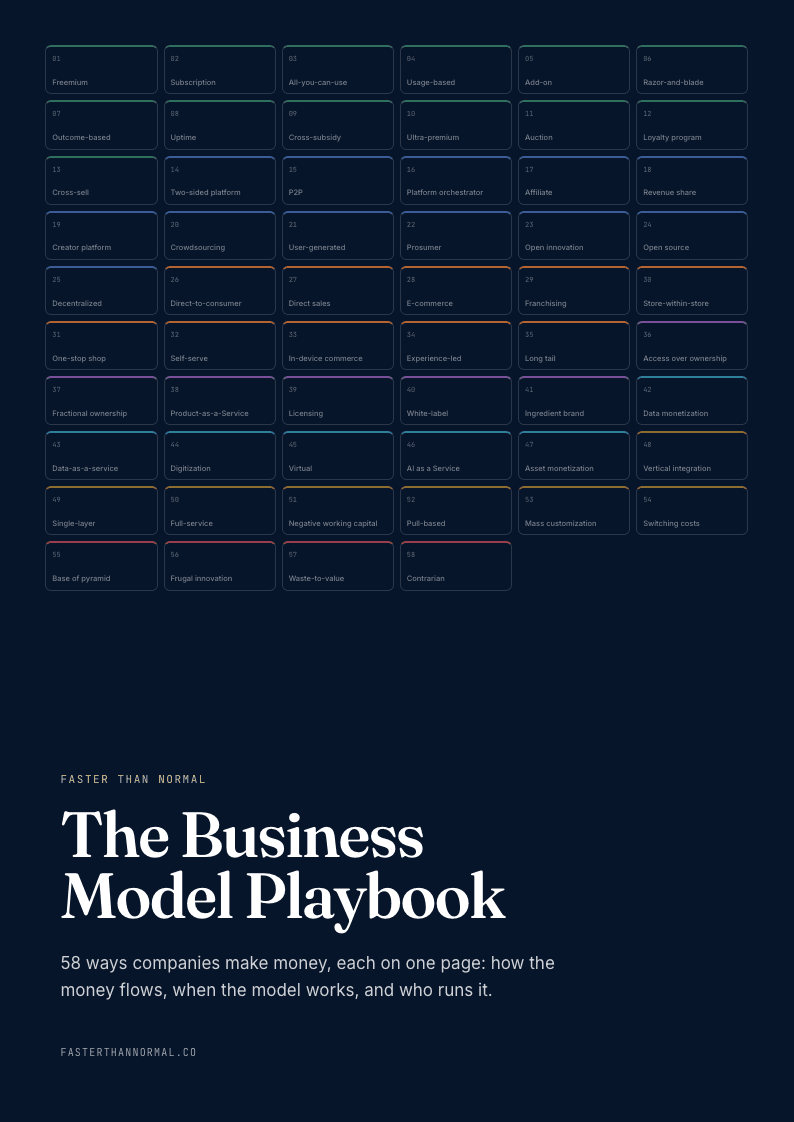
Get The Business Model Playbook
58 business models, one visual page each: how the money flows, the metrics that matter, and who runs it. Free when you join the Faster Than Normal email.
Free. No spam. Unsubscribe anytime.