

Contents
Book summary
$100M Offers
by Alex Hormozi
The Core Premise
Most entrepreneurs fail not because they can't build products, but because they can't craft irresistible offers that make customers feel stupid for saying no. Alex Hormozi discovered this truth while building and selling multiple companies worth over $100 million each, realizing that the difference between struggling businesses and unicorns often comes down to a single skill: offer creation. His framework transforms commoditized services into premium solutions that customers desperately want to buy.
Hormozi's Value Equation forms the mathematical foundation of irresistible offers: Value = (Dream Outcome × Perceived Likelihood of Achievement) / (Time Delay × Effort and Sacrifice). This isn't feel-good theory—it's a precise formula that explains why customers choose one solution over another. When Hormozi applied this to his gym turnaround business, he stopped selling "fitness coaching" and started offering "The 6-Week Body Transformation with a Bikini-Ready Guarantee." The dream outcome became specific and visual, the likelihood increased through the guarantee, and the time delay shrunk from vague "eventually" to six weeks. Revenue per location jumped from $10,000 to $50,000 monthly.
The Grand Slam Offer methodology operates through four levers that systematically eliminate customer objections. First, increase the dream outcome by making success tangible and specific rather than abstract. Second, boost perceived likelihood through risk reversal, social proof, and guarantees that transfer risk from customer to business. Third, compress time delay by creating urgency and demonstrating fast results. Fourth, minimize effort and sacrifice by removing obstacles and making the buying process effortless. Hormozi tested this framework across industries from software to supplements, consistently generating 10x to 50x improvements in conversion rates.
The Profit Equation—Profit per Customer = (Average Purchase Value × Gross Margin %) × (Number of Purchases × Churn Rate)—reveals why most businesses optimize the wrong variables. Instead of obsessing over traffic and conversion rates, winning companies engineer higher-value offers that customers gladly pay premium prices for. When Hormozi restructured his software company's offer from a $97 monthly subscription to a $3,000 annual package with additional services and guarantees, customer lifetime value increased 800% while acquisition costs stayed constant. The business became immediately profitable and scalable.
Implementing Hormozi's offer architecture requires abandoning traditional pricing strategies and embracing value-based positioning. Start with the Customer Avatar Exercise to identify specific pain points, then use the Problem-Solution Bridge to craft offerings that address root causes rather than symptoms. The Guarantee Generator framework creates risk-reversal mechanisms that actually increase profitability by forcing businesses to deliver exceptional results. Executive teams should treat offer creation as their highest-leverage activity, dedicating senior resources to continuously testing and optimizing value propositions rather than delegating this critical function to junior marketing staff.
$100M Offers by Alex Hormozi belongs on the short shelf of books that change how you notice decisions in the wild. Whether you agree with every claim or not, the frame it offers is portable: you can apply it in meetings, investing, hiring, and personal trade-offs without carrying the whole volume.
Many readers return to this book because it names patterns that felt familiar but unnamed. Naming is leverage: once you can point to a mechanism, you can design around it. One through-line is “The Value Equation: Value equals (Dream Outcome times Perceived Likelihood of Achievement) divided by (Time Delay times Effort and Sacrifice). This mathematical framework explains customer decision-ma” and its implications for judgment under uncertainty.
If you are reading for execution, translate each chapter into a testable habit: one prompt before a big decision, one review question after a project, one constraint you will respect next quarter. Theory becomes useful when it shows up in calendars, not only in margins.
Finally, pair this book with opposing voices. The strongest readers stress-test the thesis against cases where the advice fails, note the boundary conditions, and keep a short list of when not to use this lens. That discipline is how summaries become judgment.
Long-form books reward spaced attention: read a chapter, sleep, then write a half-page memo titled “What would I do differently on Monday?” If you cannot answer with specifics, the idea has not yet landed.
Use $100M Offers as a conversation starter with peers who have different incentives. The disagreements often reveal which parts of the book are robust and which are fragile when power, risk, and time horizons change.
Key Ideas and Arguments
The Value Equation: Value equals (Dream Outcome times Perceived Likelihood of Achievement) divided by (Time Delay times Effort and Sacrifice). This mathematical framework explains customer decision-making and provides four specific levers for increasing perceived value without changing the underlying product or service.. This idea shows up repeatedly in $100M Offers: separate the definition from the examples, then ask where the author's evidence is strongest and where anecdotes do most of the work. Consider writing a counterexample: a situation where applying the idea literally would misfire, and what guardrail you would add.
Grand Slam Offers: Irresistible propositions that make prospects feel stupid for saying no, created by maximizing dream outcomes, increasing likelihood perceptions, minimizing time delays, and reducing effort requirements. These offers typically convert 3-10x better than standard industry propositions.. This idea shows up repeatedly in $100M Offers: separate the definition from the examples, then ask where the author's evidence is strongest and where anecdotes do most of the work. Consider writing a counterexample: a situation where applying the idea literally would misfire, and what guardrail you would add.
Risk Reversal Guarantees: Strategic guarantee structures that transfer perceived risk from customer to business while actually reducing real business risk by forcing operational excellence. Hormozi's guarantee frameworks often increase conversion rates 20-40% while improving customer satisfaction.. This idea shows up repeatedly in $100M Offers: separate the definition from the examples, then ask where the author's evidence is strongest and where anecdotes do most of the work. Consider writing a counterexample: a situation where applying the idea literally would misfire, and what guardrail you would add.
The Profit Equation: A formula showing that profit per customer depends on average purchase value, gross margins, purchase frequency, and retention rates. This reveals why optimizing for higher-value offers typically outperforms optimizing for traffic volume.. This idea shows up repeatedly in $100M Offers: separate the definition from the examples, then ask where the author's evidence is strongest and where anecdotes do most of the work. Consider writing a counterexample: a situation where applying the idea literally would misfire, and what guardrail you would add.
Problem-Solution Bridge: A methodology for identifying the gap between customer pain points and desired outcomes, then engineering offers that address root causes rather than surface symptoms. This approach creates sustainable competitive advantages and premium pricing power.. This idea shows up repeatedly in $100M Offers: separate the definition from the examples, then ask where the author's evidence is strongest and where anecdotes do most of the work. Consider writing a counterexample: a situation where applying the idea literally would misfire, and what guardrail you would add.
Convergent and Divergent Problem-Solving: Convergent problems have known solutions that can be systematized and guaranteed, while divergent problems require ongoing expertise and creativity. Understanding this distinction determines appropriate pricing models and guarantee structures.. This idea shows up repeatedly in $100M Offers: separate the definition from the examples, then ask where the author's evidence is strongest and where anecdotes do most of the work. Consider writing a counterexample: a situation where applying the idea literally would misfire, and what guardrail you would add.
The Enhancement Process: A systematic method for taking core solutions and adding complementary services, tools, and guarantees that increase perceived value exponentially while maintaining reasonable delivery costs. This transforms commodities into premium offerings.. This idea shows up repeatedly in $100M Offers: separate the definition from the examples, then ask where the author's evidence is strongest and where anecdotes do most of the work. Consider writing a counterexample: a situation where applying the idea literally would misfire, and what guardrail you would add.
Scarcity and Urgency Mechanisms: Specific techniques for creating legitimate time pressure and limited availability that accelerate customer decision-making without resorting to manipulative tactics. These include seasonal launches, capacity constraints, and bonus deadlines.. This idea shows up repeatedly in $100M Offers: separate the definition from the examples, then ask where the author's evidence is strongest and where anecdotes do most of the work. Consider writing a counterexample: a situation where applying the idea literally would misfire, and what guardrail you would add.
Deeper Themes and Context
$100M Offers is not only a catalogue of claims; it is a stance on how to interpret success, failure, and ambiguity. Readers who engage charitably still ask: which recommendations are universal, which are culturally situated, and which require institutional support you do not have?
Comparing the book's prescriptions to your own context is part of the work. A strategy that assumes abundant capital, patient stakeholders, or long feedback loops will read differently if you are resource-constrained, early in a career, or operating under regulatory pressure. Translation beats transcription.
The book also invites you to notice what it does not say. Silences can be instructive: topics the author avoids, counterexamples that never appear, or metrics that are praised without definition. A serious reader keeps a missing-evidence note alongside a to-try note.
Historically, the most influential business and biography titles survive because they double as vocabulary. Teams that share a phrase from $100M Offers move faster only when they also share a definition and a worked example, otherwise they talk past each other with the same words.
How to Apply the Lessons
Connected Mental Models
Who Should Read This
Start here if you want a serious, book-length argument rather than a thread of bullet points. $100M Offers rewards readers who will sketch their own examples, argue back in the margins, and connect chapters to decisions they are facing this quarter.
It is also useful as a shared vocabulary for teams: a common chapter reference can shorten debate if everyone agrees what the term means in practice. If your team only shares the title, not the definition, expect confusion.
Skip or skim if you need a narrow tactical recipe with no theory; this summary preserves the ideas, but the book's value is often in the extended case material and the author's sequencing.
Analyst's Take
Test Yourself
Check your grasp of the book’s moves
A colleague quotes $100M Offers to justify a risky decision. What should you verify first?
You finished $100M Offers and want behaviour change this week.
Further Reading
Continue exploring


Free playbook
Get The Business Model Playbook
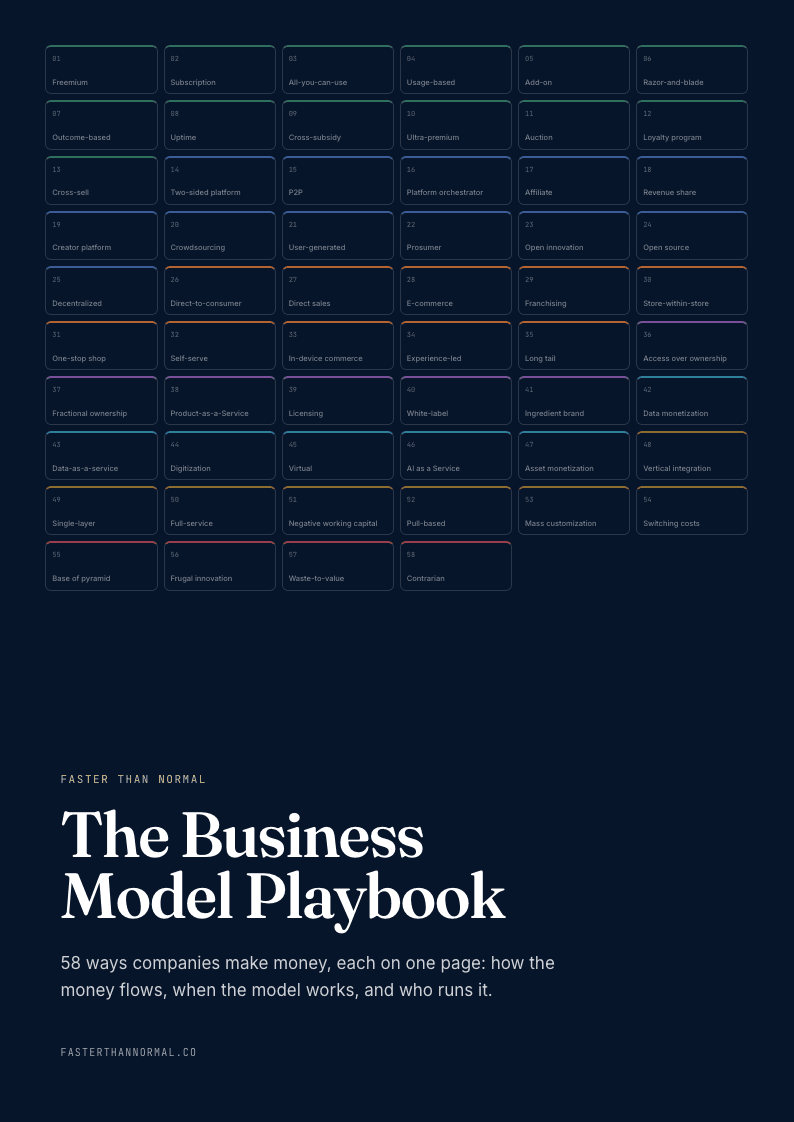
58 business models, one visual page each: how the money flows, the metrics that matter, and who runs it. Free when you join the Faster Than Normal email.
Free. No spam. Unsubscribe anytime.