

Contents
Book summary
American Colossus: The Triumph of Capitalism, 1865-1900
by H.W. Brands
The Core Premise
The Gilded Age wasn't gilded by accident—it was forged by a generation of industrialists who understood that massive capital concentration, not mere innovation, builds economic empires. H.W. Brands reveals how American capitalism's most explosive growth period emerged from a fundamental shift: entrepreneurs stopped competing on margins and started competing on scale, transforming the United States from an agricultural backwater into the world's industrial superpower in just thirty-five years.
Brands documents how figures like Andrew Carnegie and John D. Rockefeller didn't just build companies—they engineered entire market structures through what he calls "systematic consolidation." Carnegie's vertical integration strategy combined raw material control, manufacturing efficiency, and distribution networks into an unbreakable competitive advantage. When Carnegie bought iron ore mines in Minnesota, limestone quarries in Michigan, and coal fields in Pennsylvania, he wasn't diversifying—he was eliminating every possible supply chain vulnerability. Rockefeller took this logic even further with Standard Oil's horizontal integration, buying out competitors until he controlled 90% of American oil refining. These weren't monopolistic accidents; they were deliberate strategies to achieve market dominance through capital deployment rather than product differentiation.
The book's most striking insight concerns what Brands terms the "Infrastructure-Finance Feedback Loop"—the symbiotic relationship between railroad expansion and capital markets that accelerated American economic development. Railroad companies needed massive upfront capital, which drove innovations in corporate finance and securities markets. These improved financial instruments then enabled even larger infrastructure projects, creating a compounding effect that European competitors couldn't match. Jay Gould's railroad empire exemplifies this dynamic: by 1880, his companies controlled over 15,000 miles of track and had pioneered complex financial instruments like convertible bonds and preferred stock structures that became standard corporate tools.
Brands argues that the period's defining characteristic was "productive instability"—economic volatility that destroyed weak competitors while strengthening market leaders. The Panic of 1873 and subsequent six-year depression eliminated thousands of small manufacturers, but Carnegie Steel emerged stronger by acquiring distressed assets at basement prices. This pattern repeated across industries: economic downturns became consolidation opportunities for companies with sufficient capital reserves. The lesson extends beyond historical analysis—market turbulence consistently rewards organizations that maintain financial flexibility while their competitors struggle with overleveraging.
For modern executives, the book offers a masterclass in strategic patience and capital allocation. The Gilded Age titans succeeded not through quarterly optimization but through decade-long campaigns to dominate entire value chains. Their willingness to sacrifice short-term profits for long-term market control created sustainable competitive advantages that lasted generations. Brands demonstrates that American capitalism's greatest triumphs came from leaders who understood that true wealth creation requires building systems, not just products—a lesson particularly relevant as modern founders navigate platform economics and winner-take-all digital markets.
The years between the Civil War and the end of the nineteenth century saw the wholesale transformation of America from a land of small farmers and small businessmen into an industrial giant. Driven by unfathomably wealthy and powerful businessmen, armies of workers were harnessed to a new vision of massive industry. A society rooted in the soil became one based in cities. The capitalist revolution left not a single area or aspect of American life untouched. It roared across the South, wrenching that region from its feudal past and integrating the Southern economy into the national one. It burst over the West, dictating the destruction of Native American economies and peoples, driving the exploitation of natural resources, and making the frontier of settlement a business frontier as well. It crashed across the urban landscape of the East and North, turning cities into engines of wealth and poverty, opulence and squalor. It swamped the politics of an earlier era, capturing one major party and half of the other, inspiring the creation of a third party and determining the issues over which all three waged some of the bitterest battles in American history. American Colossus is an unforg…
American Colossus: The Triumph of Capitalism, 1865-1900 by H.W. Brands belongs on the short shelf of books that change how you notice decisions in the wild. Whether you agree with every claim or not, the frame it offers is portable: you can apply it in meetings, investing, hiring, and personal trade-offs without carrying the whole volume.
Many readers return to this book because it names patterns that felt familiar but unnamed. Naming is leverage: once you can point to a mechanism, you can design around it. One through-line is “Systematic Consolidation: The deliberate strategy of acquiring competitors and suppliers to achieve market dominance through structure rather than innovation. Carnegie's vertical integration eliminate” and its implications for judgment under uncertainty.
If you are reading for execution, translate each chapter into a testable habit: one prompt before a big decision, one review question after a project, one constraint you will respect next quarter. Theory becomes useful when it shows up in calendars, not only in margins.
Finally, pair this book with opposing voices. The strongest readers stress-test the thesis against cases where the advice fails, note the boundary conditions, and keep a short list of when not to use this lens. That discipline is how summaries become judgment.
Long-form books reward spaced attention: read a chapter, sleep, then write a half-page memo titled “What would I do differently on Monday?” If you cannot answer with specifics, the idea has not yet landed.
Use American Colossus: The Triumph of Capitalism, 1865-1900 as a conversation starter with peers who have different incentives. The disagreements often reveal which parts of the book are robust and which are fragile when power, risk, and time horizons change.
Key Ideas and Arguments
Systematic Consolidation: The deliberate strategy of acquiring competitors and suppliers to achieve market dominance through structure rather than innovation. Carnegie's vertical integration eliminated supply chain vulnerabilities while Rockefeller's horizontal integration captured 90% market share through strategic buyouts.. This idea shows up repeatedly in American Colossus: The Triumph of Capitalism, 1865-1900: separate the definition from the examples, then ask where the author's evidence is strongest and where anecdotes do most of the work. Consider writing a counterexample: a situation where applying the idea literally would misfire, and what guardrail you would add.
Infrastructure-Finance Feedback Loop: The reinforcing relationship between large-scale infrastructure projects and capital market development that accelerated American economic growth. Railroad expansion required new financial instruments, which then enabled even larger projects in a compounding cycle.. This idea shows up repeatedly in American Colossus: The Triumph of Capitalism, 1865-1900: separate the definition from the examples, then ask where the author's evidence is strongest and where anecdotes do most of the work. Consider writing a counterexample: a situation where applying the idea literally would misfire, and what guardrail you would add.
Productive Instability: Economic volatility that strengthens market leaders while eliminating weak competitors. The Panic of 1873 destroyed thousands of small manufacturers but allowed well-capitalized companies like Carnegie Steel to acquire distressed assets and expand market share.. This idea shows up repeatedly in American Colossus: The Triumph of Capitalism, 1865-1900: separate the definition from the examples, then ask where the author's evidence is strongest and where anecdotes do most of the work. Consider writing a counterexample: a situation where applying the idea literally would misfire, and what guardrail you would add.
Capital Deployment Strategy: Using financial resources to build competitive advantages through market structure control rather than product differentiation. Successful Gilded Age entrepreneurs focused on dominating entire value chains rather than optimizing individual business units.. This idea shows up repeatedly in American Colossus: The Triumph of Capitalism, 1865-1900: separate the definition from the examples, then ask where the author's evidence is strongest and where anecdotes do most of the work. Consider writing a counterexample: a situation where applying the idea literally would misfire, and what guardrail you would add.
Vertical vs Horizontal Integration: Two complementary approaches to market control—vertical integration captures the entire supply chain while horizontal integration eliminates competitors. Carnegie controlled raw materials through production; Rockefeller controlled competitors within the same industry.. This idea shows up repeatedly in American Colossus: The Triumph of Capitalism, 1865-1900: separate the definition from the examples, then ask where the author's evidence is strongest and where anecdotes do most of the work. Consider writing a counterexample: a situation where applying the idea literally would misfire, and what guardrail you would add.
Scale Economics Threshold: The point at which operational size creates insurmountable competitive advantages through cost structure and market access. Companies that crossed this threshold during the Gilded Age built decades-long market dominance.. This idea shows up repeatedly in American Colossus: The Triumph of Capitalism, 1865-1900: separate the definition from the examples, then ask where the author's evidence is strongest and where anecdotes do most of the work. Consider writing a counterexample: a situation where applying the idea literally would misfire, and what guardrail you would add.
Deeper Themes and Context
American Colossus: The Triumph of Capitalism, 1865-1900 is not only a catalogue of claims; it is a stance on how to interpret success, failure, and ambiguity. Readers who engage charitably still ask: which recommendations are universal, which are culturally situated, and which require institutional support you do not have?
Comparing the book's prescriptions to your own context is part of the work. A strategy that assumes abundant capital, patient stakeholders, or long feedback loops will read differently if you are resource-constrained, early in a career, or operating under regulatory pressure. Translation beats transcription.
The book also invites you to notice what it does not say. Silences can be instructive: topics the author avoids, counterexamples that never appear, or metrics that are praised without definition. A serious reader keeps a missing-evidence note alongside a to-try note.
Historically, the most influential business and biography titles survive because they double as vocabulary. Teams that share a phrase from American Colossus: The Triumph of Capitalism, 1865-1900 move faster only when they also share a definition and a worked example, otherwise they talk past each other with the same words.
How to Apply the Lessons
Connected Mental Models
Who Should Read This
Start here if you want a serious, book-length argument rather than a thread of bullet points. American Colossus: The Triumph of Capitalism, 1865-1900 rewards readers who will sketch their own examples, argue back in the margins, and connect chapters to decisions they are facing this quarter.
It is also useful as a shared vocabulary for teams: a common chapter reference can shorten debate if everyone agrees what the term means in practice. If your team only shares the title, not the definition, expect confusion.
Skip or skim if you need a narrow tactical recipe with no theory; this summary preserves the ideas, but the book's value is often in the extended case material and the author's sequencing.
Analyst's Take
Test Yourself
Check your grasp of the book’s moves
A colleague quotes American Colossus: The Triumph of Capitalism, 1865-1900 to justify a risky decision. What should you verify first?
You finished American Colossus: The Triumph of Capitalism, 1865-1900 and want behaviour change this week.
Further Reading
Continue exploring


Free playbook
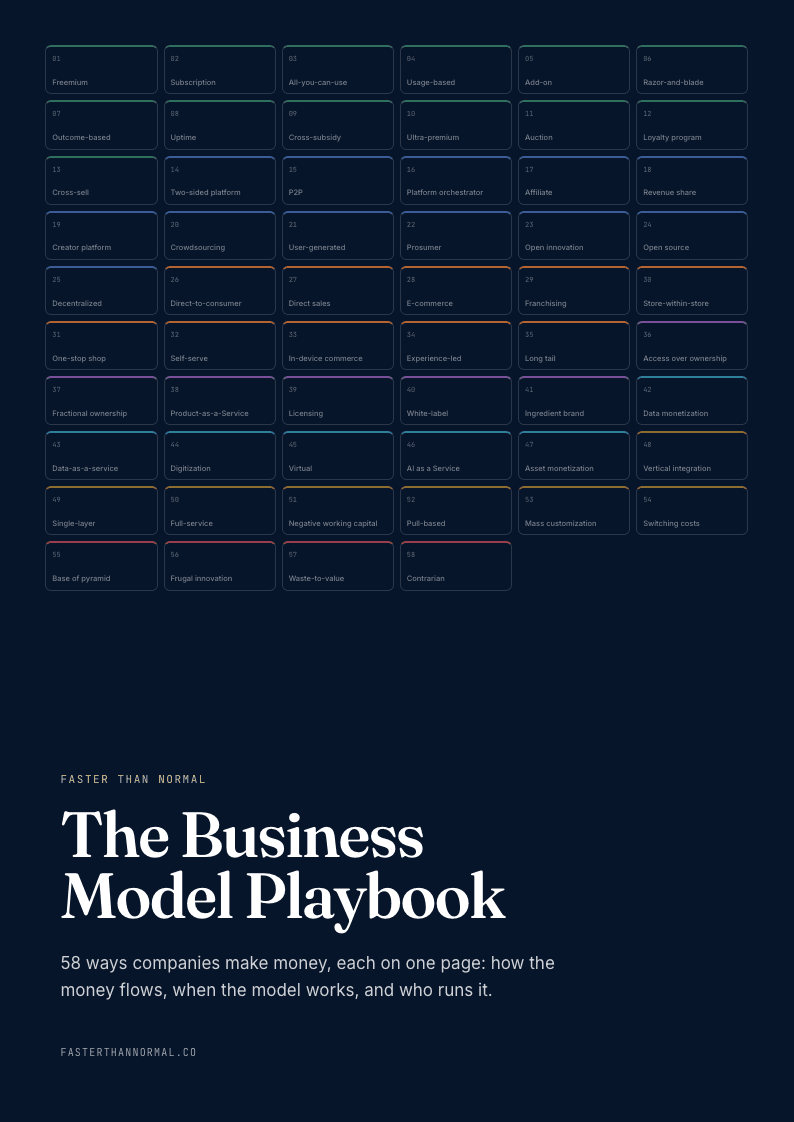
Get The Business Model Playbook
58 business models, one visual page each: how the money flows, the metrics that matter, and who runs it. Free when you join the Faster Than Normal email.
Free. No spam. Unsubscribe anytime.