

Contents
Book summary
$100M Leads
by Alex Hormozi
The Core Premise
Alex Hormozi dissects the lead generation engine that separates $10 million businesses from $100 million empires, revealing that most entrepreneurs fail not from lack of product quality but from their inability to systematically generate demand at scale. His central thesis demolishes the common belief that great products sell themselves—instead, he proves that businesses die from customer acquisition problems, not product problems. Hormozi's framework transforms lead generation from random marketing tactics into a predictable system he calls the "Lead Value Equation."
The Lead Value Equation forms the mathematical foundation of Hormozi's approach: Lead Value = (Offer Value x Audience Fit x Message Match) ÷ (Time Delay x Effort Required x Sacrifice). This formula reveals why most lead generation fails—businesses optimize for the wrong variables. Hormozi demonstrates through his portfolio company Gym Launch how they generated 47,000 leads in 90 days by obsessing over message match rather than audience size. While competitors focused on reaching more people, Gym Launch crafted messages that resonated so deeply with gym owners that response rates jumped from 2% to 23%. The company scaled from zero to $100 million by treating each variable in the equation as a lever to pull systematically.
Hormozi introduces the "Core Four" lead generation channels that drive predictable growth: Warm Outreach, Content, Cold Outreach, and Paid Ads. He argues most businesses fail because they randomly jump between channels instead of mastering one before adding others. His case study of Prestige Labs shows this principle in action—they achieved $50 million in revenue by perfecting cold email before touching any other channel. Hormozi's "Channel Mastery Framework" requires businesses to achieve consistent profitability in one channel for 90 consecutive days before expanding. This disciplined approach prevents the "shiny object syndrome" that kills most scaling efforts.
The book's most powerful insight centers on what Hormozi calls "Lead Magnets that Lead to Sales"—free offers engineered not just to capture attention but to create buying intent. Traditional lead magnets like ebooks and webinars fail because they attract browsers, not buyers. Hormozi redesigns lead magnets using his "Problem-Solution Bridge," where the free offer solves a small problem while exposing a larger one that requires the paid solution. His software company Allen used this principle to create a "Free Website Audit" that revealed security vulnerabilities, generating $30 million in cybersecurity sales. The audit solved the immediate problem of visibility while creating urgency around the bigger issue of protection. This approach transforms lead generation from a cost center into a profit driver, enabling businesses to outspend competitors while maintaining profitability.
You can get 2x, 10x, or 100x more leads than you currently are without changing anything about what you sell... This book contains the playbooks that took me from sleeping on my gym floor to owning a portfolio of companies that generate $200,000,000 per year in under a decade. Wanna know the biggest difference between those two time periods? How many leads I was getting. The problem is - most business owners don't know how to get leads. I wrote this book to solve your LEADS problem. Today, our companies generate 20,000+ new leads per day across sixteen different industries. And, they do it using the eight "never-go-hungry" playbooks inside. Once you see them, you can't unsee them. They're so powerful, they work without your permission. Inside you will find... ...The easiest way to get another five customers tomorrow ...The hook-retain-reward system to transforms content into leads ...The 6-part ad framework that gets more people - especially strangers - to want what you sell ...The one question that immediately turns any stranger (no matter how cold) into a hot lead ...The 7 direct referral methods responsible for 30% of my sales ...The affiliate playbook that gets hundreds of othe…
$100M Leads by Alex Hormozi belongs on the short shelf of books that change how you notice decisions in the wild. Whether you agree with every claim or not, the frame it offers is portable: you can apply it in meetings, investing, hiring, and personal trade-offs without carrying the whole volume.
Many readers return to this book because it names patterns that felt familiar but unnamed. Naming is leverage: once you can point to a mechanism, you can design around it. One through-line is “Lead Value Equation: The mathematical formula (Offer Value x Audience Fit x Message Match) ÷ (Time Delay + Effort Required + Sacrifice) that determines lead quality and conversion potential. Hormozi p” and its implications for judgment under uncertainty.
If you are reading for execution, translate each chapter into a testable habit: one prompt before a big decision, one review question after a project, one constraint you will respect next quarter. Theory becomes useful when it shows up in calendars, not only in margins.
Finally, pair this book with opposing voices. The strongest readers stress-test the thesis against cases where the advice fails, note the boundary conditions, and keep a short list of when not to use this lens. That discipline is how summaries become judgment.
Long-form books reward spaced attention: read a chapter, sleep, then write a half-page memo titled “What would I do differently on Monday?” If you cannot answer with specifics, the idea has not yet landed.
Use $100M Leads as a conversation starter with peers who have different incentives. The disagreements often reveal which parts of the book are robust and which are fragile when power, risk, and time horizons change.
Key Ideas and Arguments
Lead Value Equation: The mathematical formula (Offer Value x Audience Fit x Message Match) ÷ (Time Delay + Effort Required + Sacrifice) that determines lead quality and conversion potential. Hormozi proves that optimizing message match often outperforms expanding audience reach by 10x.. This idea shows up repeatedly in $100M Leads: separate the definition from the examples, then ask where the author's evidence is strongest and where anecdotes do most of the work. Consider writing a counterexample: a situation where applying the idea literally would misfire, and what guardrail you would add.
Core Four Channels: The only lead generation channels that scale to $100M—Warm Outreach, Content, Cold Outreach, and Paid Ads. Hormozi demonstrates that businesses must achieve 90-day profitability in one channel before adding others to avoid resource dilution.. This idea shows up repeatedly in $100M Leads: separate the definition from the examples, then ask where the author's evidence is strongest and where anecdotes do most of the work. Consider writing a counterexample: a situation where applying the idea literally would misfire, and what guardrail you would add.
Problem-Solution Bridge: A lead magnet design principle where the free offer solves a small problem while exposing a larger one requiring the paid solution. This creates buying intent rather than just capturing contact information.. This idea shows up repeatedly in $100M Leads: separate the definition from the examples, then ask where the author's evidence is strongest and where anecdotes do most of the work. Consider writing a counterexample: a situation where applying the idea literally would misfire, and what guardrail you would add.
Channel Mastery Framework: The systematic approach requiring consistent profitability in one lead channel for 90 consecutive days before expansion. Prestige Labs used this discipline to reach $50M revenue by perfecting cold email first.. This idea shows up repeatedly in $100M Leads: separate the definition from the examples, then ask where the author's evidence is strongest and where anecdotes do most of the work. Consider writing a counterexample: a situation where applying the idea literally would misfire, and what guardrail you would add.
Lead Velocity Rate: The measurement of qualified lead generation speed, calculated as the percentage increase in qualified leads month-over-month. Hormozi argues this metric predicts revenue growth better than traditional conversion metrics.. This idea shows up repeatedly in $100M Leads: separate the definition from the examples, then ask where the author's evidence is strongest and where anecdotes do most of the work. Consider writing a counterexample: a situation where applying the idea literally would misfire, and what guardrail you would add.
Message-Market Match Hierarchy: The prioritization framework showing that perfect message fit with a small audience outperforms mediocre messages with massive reach. Gym Launch proved this by achieving 23% response rates with precise messaging.. This idea shows up repeatedly in $100M Leads: separate the definition from the examples, then ask where the author's evidence is strongest and where anecdotes do most of the work. Consider writing a counterexample: a situation where applying the idea literally would misfire, and what guardrail you would add.
Deeper Themes and Context
$100M Leads is not only a catalogue of claims; it is a stance on how to interpret success, failure, and ambiguity. Readers who engage charitably still ask: which recommendations are universal, which are culturally situated, and which require institutional support you do not have?
Comparing the book's prescriptions to your own context is part of the work. A strategy that assumes abundant capital, patient stakeholders, or long feedback loops will read differently if you are resource-constrained, early in a career, or operating under regulatory pressure. Translation beats transcription.
The book also invites you to notice what it does not say. Silences can be instructive: topics the author avoids, counterexamples that never appear, or metrics that are praised without definition. A serious reader keeps a missing-evidence note alongside a to-try note.
Historically, the most influential business and biography titles survive because they double as vocabulary. Teams that share a phrase from $100M Leads move faster only when they also share a definition and a worked example, otherwise they talk past each other with the same words.
How to Apply the Lessons
Connected Mental Models
Who Should Read This
Start here if you want a serious, book-length argument rather than a thread of bullet points. $100M Leads rewards readers who will sketch their own examples, argue back in the margins, and connect chapters to decisions they are facing this quarter.
It is also useful as a shared vocabulary for teams: a common chapter reference can shorten debate if everyone agrees what the term means in practice. If your team only shares the title, not the definition, expect confusion.
Skip or skim if you need a narrow tactical recipe with no theory; this summary preserves the ideas, but the book's value is often in the extended case material and the author's sequencing.
Analyst's Take
Test Yourself
Check your grasp of the book’s moves
A colleague quotes $100M Leads to justify a risky decision. What should you verify first?
You finished $100M Leads and want behaviour change this week.
Further Reading
Continue exploring


Free playbook
Get The Business Model Playbook
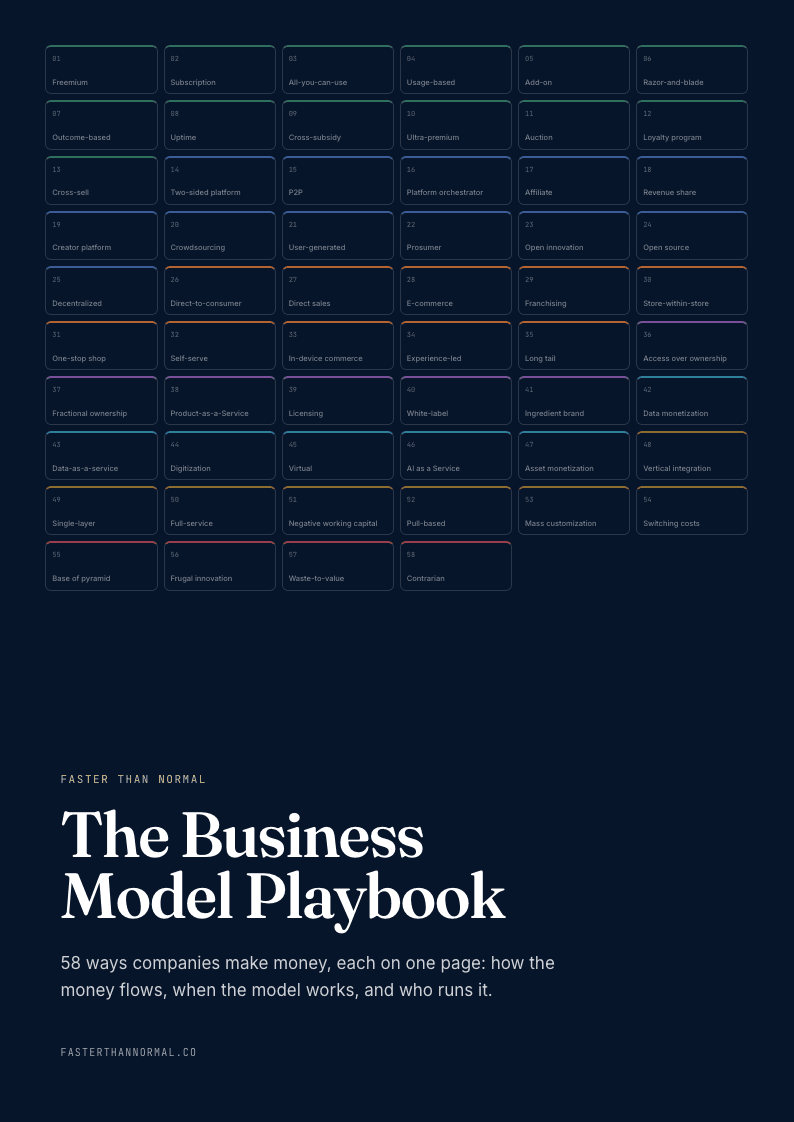
58 business models, one visual page each: how the money flows, the metrics that matter, and who runs it. Free when you join the Faster Than Normal email.
Free. No spam. Unsubscribe anytime.