In 1990, C.K. Prahalad and Gary Hamel published "The Core Competence of the Corporation" in Harvard Business Review and permanently changed how strategists think about competitive advantage. Their argument was simple and devastating: the most successful companies don't compete on products. They compete on the underlying capabilities that produce those products. The distinction sounds academic until you trace the consequences. Companies that define themselves by products get disrupted when the product category shifts. Companies that define themselves by competencies survive — and often dominate — because the capability transfers across product categories, market cycles, and technological disruptions that kill product-defined competitors.
Honda was their clearest example. In 1990, Honda made cars, motorcycles, lawn mowers, generators, marine engines, and snow blowers. A product-level analyst would see a conglomerate with no focus. Prahalad and Hamel saw something different: Honda's core competency was the design and manufacture of engines and powertrains. Every product in the portfolio was an application of that single capability. Honda didn't diversify randomly. It leveraged one deep competency across every market where small, efficient, reliable engines created customer value. The lawn mower division wasn't a distraction from the car division. Both were expressions of the same underlying advantage — and the R&D investment in engine technology for one product line improved every other product line simultaneously.
Canon demonstrated the same logic in a different domain. Canon made cameras, printers, copiers, and semiconductor lithography equipment. The products looked unrelated. The core competencies — precision optics, imaging technology, and microprocessor controls — connected them all. Canon's investment in optical engineering for cameras produced breakthroughs that improved printer resolution. Advances in microprocessor controls for copiers enhanced the precision of lithography equipment. Each product division was drawing from the same well of capability, and each R&D dollar generated returns across the entire portfolio.
Prahalad and Hamel specified three tests that a capability must pass to qualify as a core competency. First, it must provide access to a wide variety of markets — a competency locked into a single product category is a skill, not a core competency. Honda's engine expertise opens doors to automotive, marine, power equipment, and aviation markets. Second, it must make a significant contribution to perceived customer benefits — the competency must be something customers actually value, not an internal efficiency that matters only to the operations team. Canon's imaging technology directly determines the quality of every product the customer touches. Third, it must be difficult for competitors to imitate — a competency that can be replicated in twelve months is a temporary advantage, not a structural one. Honda spent decades building its engine design capability through thousands of incremental innovations, proprietary manufacturing processes, and accumulated engineering knowledge that no competitor could shortcut.
The framework exposed a strategic failure pattern that was epidemic in the 1980s and remains common today: companies that outsource or underinvest in their core competencies because the short-term economics look attractive. GE in the 1980s was Prahalad and Hamel's cautionary example. GE outsourced manufacturing of key components to Japanese suppliers because the purchased components were cheaper. The short-term margin improvement was real. The long-term consequence was that the suppliers accumulated the manufacturing competency that GE was shedding — and eventually used that competency to compete directly against GE in the finished product market. The company had traded a core competency for a quarterly earnings beat.
The inverse was NEC. In the 1980s, NEC identified the convergence of computing and communications as the defining market opportunity of the coming decades. It then identified the core competencies required to compete at that intersection — semiconductor design, telecommunications systems, and integrated computing architectures — and invested systematically in building those capabilities over a ten-year horizon. Product-level decisions were subordinated to competency-building decisions. NEC entered markets that appeared unrelated on a product map but were deeply connected on a competency map. By 1990, NEC held leadership positions in semiconductors, telecommunications equipment, and mainframe computers — three product categories that shared the same underlying capability base.
Free playbook
Get The Business Model Playbook
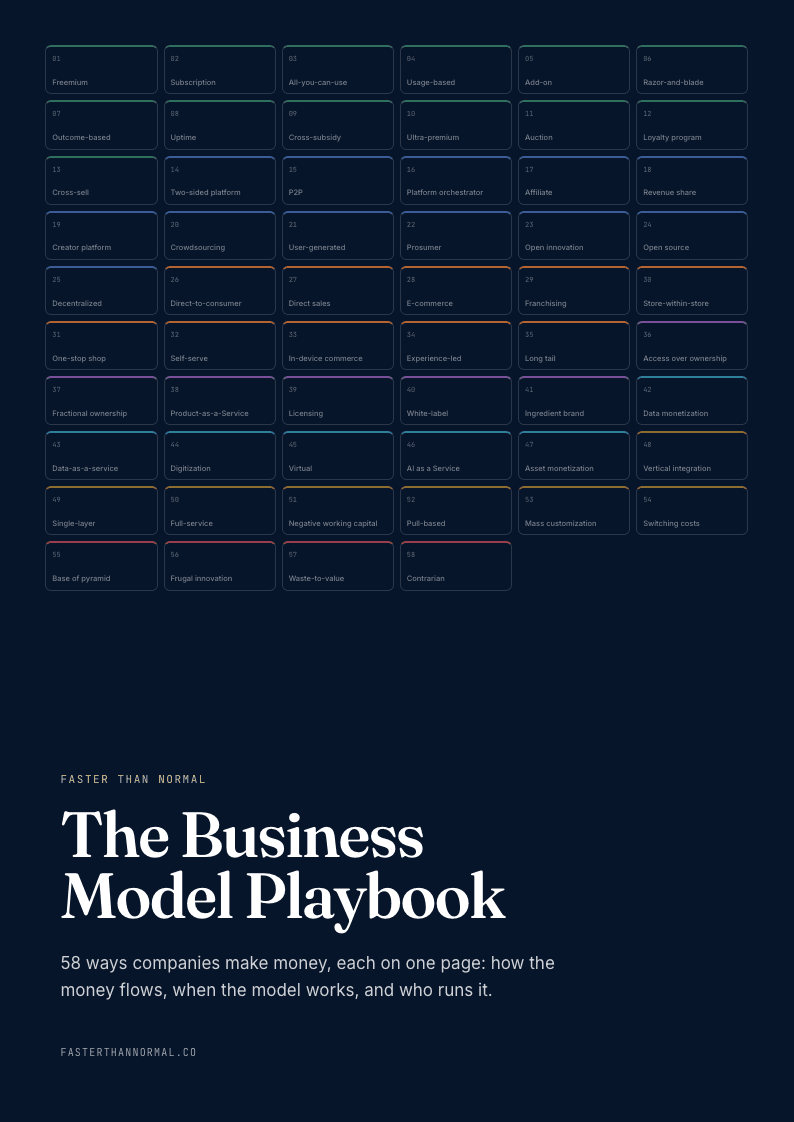
58 business models, one visual page each: how the money flows, the metrics that matter, and who runs it. Free when you join the Faster Than Normal email.
Free. No spam. Unsubscribe anytime.
Section 2
How to See It
Core competency reveals itself through a specific diagnostic: can the company's capability produce value in markets beyond its current product portfolio? If the answer is yes, you're looking at a core competency. If the answer is no — if the capability is useful only for the existing product — you're looking at a product-specific skill that doesn't meet Prahalad and Hamel's criteria.
The second signal is what happens when the company enters a new market. A company leveraging a genuine core competency enters adjacent markets with a structural advantage from day one, because the underlying capability transfers. A company without a core competency enters new markets as a de facto startup — no accumulated advantage, no transferable expertise, competing on capital and ambition alone.
Technology
You're seeing Core Competency when Apple enters the watch market in 2015 and captures over 50% market share within two years, displacing Swiss watchmakers who had dominated the category for centuries. Apple's core competency — the integration of custom silicon, proprietary software, and industrial design into seamless consumer experiences — transferred directly from iPhone to Watch. The hardware-software integration capability that made the iPhone dominant gave Apple a structural advantage in a market it had never competed in. Traditional watchmakers had no equivalent competency to draw on.
Cloud & Infrastructure
You're seeing Core Competency when Amazon leverages the infrastructure it built for its e-commerce operations to launch AWS. Amazon's core competency in distributed systems, data centre operations, and scalable infrastructure was developed to solve its own problems — handling peak traffic during Prime Day, managing inventory across millions of SKUs, running recommendation engines at global scale. The realisation that this capability was itself a product — sellable to every other company facing similar infrastructure challenges — turned an internal cost centre into a $90B revenue business.
Semiconductors
You're seeing Core Competency when NVIDIA pivots from gaming graphics cards to AI training hardware without a fundamental technology redesign. Jensen Huang identified in the early 2010s that NVIDIA's core competency — massively parallel processing architectures — was exactly what deep learning required. The GPU architecture designed for rendering pixels in video games was structurally identical to the architecture needed for matrix multiplication in neural networks. NVIDIA didn't build a new competency for AI. It discovered that its existing competency had a $1 trillion market it hadn't imagined.
Investing
You're seeing Core Competency when an investor evaluates a company's expansion into adjacent markets and asks: "Is this diversification, or is this competency leverage?" Honda entering the marine engine market is competency leverage — the engine design capability transfers directly. A software company acquiring a restaurant chain is diversification — no underlying competency connects the two businesses. The distinction determines whether the expansion creates value (competency leverage) or destroys it (conglomerate discount from unfocused diversification).
Section 3
How to Use It
Decision filter
"Before investing in any new product, market, or business line, ask: does this draw on a core competency we already possess — or does it require building one from scratch? If the former, you have a structural advantage. If the latter, you're a startup with a corporate cost structure."
The operational application starts with an honest audit. Most companies cannot name their core competencies — they confuse product-market positions with underlying capabilities. A company that says "our core competency is CRM software" is describing a product, not a capability. The core competency might be "building intuitive enterprise interfaces that reduce training time" or "managing large-scale relational data with sub-second query performance." The distinction matters because the product definition limits you to one market, while the competency definition opens adjacent markets that the product-level framing would never reveal.
As a founder
Identify your core competency within the first two years of the company's life — and protect it with your hiring, investment, and outsourcing decisions. The most dangerous thing a startup can do is outsource the capability that will eventually define its competitive advantage. If your core competency is algorithm design, don't outsource your ML pipeline to a vendor. If it's hardware integration, don't farm out your PCB design. Every outsourced competency is a capability that someone else is accumulating at your expense.
The second application: use core competency as a product roadmap filter. When evaluating new product ideas, rank them by how much they leverage your existing competency. A product that draws 80% of its value from a capability you've already built is structurally cheaper and faster to deliver than one that requires building a new capability from zero. Stripe's expansion from payments to billing to treasury to identity isn't random diversification. Every product leverages Stripe's core competency in financial infrastructure APIs. Each new product is cheaper to build than the last because the underlying capability compounds.
As an investor
Core competency analysis is the sharpest tool for evaluating whether a company's expansion plans will create value or destroy it. When a company announces entry into a new market, map the required capabilities against the company's existing competency base. If the overlap is 70%+, the expansion leverages existing advantages and the probability of success is structurally higher. If the overlap is below 30%, the company is entering as a well-funded startup — and should be valued accordingly, not at a premium to existing earnings.
Buffett's Circle of Competence is the investment-side equivalent: he invests only in businesses he understands, which functionally means businesses whose core competencies he can evaluate. The overlap between Prahalad's corporate strategy framework and Buffett's investment framework is not accidental — both are asking the same question from different vantage points: does this entity possess a capability that is valuable, transferable, and difficult to replicate?
As a decision-maker
Run the outsourcing decision through the core competency filter before the cost filter. The accountant will always find a vendor who can perform a function cheaper than your internal team. The strategist asks whether the function being outsourced is a core competency. If it is, the short-term savings come at the price of long-term competitive erosion. Boeing's outsourcing of 787 Dreamliner component manufacturing to global suppliers was justified on cost grounds. The result was years of delays, quality problems, and a $32B programme cost overrun — because Boeing had outsourced assembly competencies that it had spent decades building and could not easily reconstruct when the suppliers failed to deliver.
Common misapplication: Labelling everything the company does well as a "core competency." If your list has twelve items, you don't have twelve core competencies — you have zero clarity about which capabilities actually drive competitive advantage. Prahalad and Hamel were explicit: most corporations have five to six core competencies at most. The discipline is in selection, not enumeration.
Second misapplication: Treating core competency as static. Competencies atrophy without investment. Kodak's core competency in chemical film processing was world-class in 1990 and worthless by 2010. The competency didn't disappear — the market need it served was replaced by digital imaging, a competency Kodak had developed internally but failed to invest in at the expense of its legacy cash cow.
Section 4
The Mechanism
Section 5
Founders & Leaders in Action
The leaders below didn't just identify their companies' core competencies — they restructured the entire organisation around building and leveraging those competencies across every market they entered. Both understood that products are temporary but capabilities compound.
Jobs returned to Apple in 1997 and immediately identified the company's core competency: the integration of hardware, software, and industrial design into products that felt inevitable. Apple in 1997 had 15 product lines. Jobs cut it to four — a 2×2 matrix of consumer/professional and desktop/portable. The cuts weren't about focus for focus's sake. They were about concentrating every engineering dollar on the underlying competency rather than dissipating it across products that didn't leverage the integration advantage. The competency then transferred to every new market Apple entered: iPod (2001), iPhone (2007), iPad (2010), Apple Watch (2015), AirPods (2016). Each was a new product category. Each drew 80%+ of its competitive advantage from the same core competency. By 2023, Apple had built the highest market capitalisation in corporate history — not by competing in one market but by applying one competency across six markets, each of which it came to dominate.
Huang identified NVIDIA's core competency — programmable parallel processing architectures — and spent two decades expanding the markets it could serve. NVIDIA started in gaming GPUs. When Huang recognised in 2006 that the same architecture could accelerate scientific computing, he launched CUDA, a programming platform that made GPUs accessible to researchers outside gaming. CUDA didn't generate meaningful revenue for years. It built a competency ecosystem: researchers learned to write code for NVIDIA's architecture, creating switching costs and a developer community that made NVIDIA the default platform for any parallel computing workload. When deep learning exploded after 2012, NVIDIA's core competency — the same parallel processing architecture it had refined for gaming since 1999 — was exactly what the AI industry needed. Revenue grew from $5B in 2016 to $60B in 2024. Huang didn't pivot to AI. He discovered that a competency he had been building for twenty years had a market he hadn't anticipated.
Section 6
Visual Explanation
Core Competency — The distinction between competing on products (fragmented, siloed) and competing on competencies (integrated, transferable). A core competency must pass three tests to qualify.
The left side of the diagram shows the product-level view — four disconnected business units with no shared leverage. The right side shows the competency-level view — one deep capability producing four product lines that reinforce each other through shared R&D, shared manufacturing knowledge, and shared engineering talent. The three tests at the bottom serve as the qualification filter: if a capability passes all three, it's a core competency worth building the organisation around. If it fails any one of them — if it only serves one market, if customers don't value it, or if competitors can replicate it quickly — it's a useful skill but not a strategic asset.
Section 7
Connected Models
Core Competency sits at the centre of competitive strategy, connecting the internal capabilities of the firm to the external market positions those capabilities create. The models below explain how core competencies produce moats, how they relate to the investor's concept of knowing your strengths, and where the framework generates productive tension with models that emphasise market positioning over internal capability.
Reinforces
Circle of Competence
Buffett and Munger's Circle of Competence operates at the individual and investment level: invest only in what you understand deeply. Prahalad and Hamel's Core Competency operates at the corporate level: compete only where your capabilities create structural advantage. The reinforcement is direct — a company that defines its core competencies clearly has also defined its circle of competence, and one that strays outside its competency base is making the same error as an investor who buys into an industry they don't understand. The investor's question ("Do I understand this business?") and the strategist's question ("Does this leverage our competency?") converge on the same insight: self-knowledge is the foundation of sustainable advantage.
Reinforces
[Moats](/mental-models/moats)
Core competencies are the mechanism through which enduring moats are built. A moat describes the outcome — competitors cannot easily enter or replicate the business's position. A core competency describes the cause — the deep, accumulated capability that produces the moat. Honda's engine design competency is the cause; the competitive distance between Honda's reliability and competitors' reliability is the moat. Understanding core competencies gives you the ability to evaluate whether a moat is structural (built on a genuine competency) or cosmetic (built on temporary advantages like first-mover timing or capital subsidy that competitors can match).
Reinforces
7 Powers (Hamilton Helmer)
Helmer's seven strategic powers — scale economies, network effects, switching costs, branding, cornered resource, counter-positioning, and process power — describe the sources of durable competitive advantage. Several of these powers are direct outputs of core competencies. Process power (Toyota's production system, TSMC's fabrication processes) is a core competency so deeply embedded in the organisation that competitors cannot replicate it through hiring or investment. Cornered resource (a uniquely talented team or proprietary technology) is a competency that has become exclusive. The 7 Powers framework identifies what makes an advantage durable; core competency identifies where the advantage originates.
Tension
[Barriers to Entry](/mental-models/barriers-to-entry)
Barriers to Entry analysis focuses on the external factors that prevent competitors from entering a market — regulation, capital requirements, distribution access, patents. Core Competency focuses on the internal capabilities that make a firm competitive once it is in the market. The tension emerges when barriers fall: a company protected by regulatory barriers that has not built core competencies discovers it has no competitive advantage once the regulation changes. The pharmaceutical industry illustrates this — patent protection (a barrier) sustains pricing power for 20 years, but when the patent expires, only companies with manufacturing competency in generics or R&D competency in novel molecules retain competitive advantage.
Leads-to
Sustainable Competitive Advantage
Core competency is the primary path to sustainable competitive advantage — the condition where a company's position resists erosion over time. Advantages built on core competencies are sustainable because the competency compounds: each year of investment deepens the capability, widens the gap with competitors, and opens new markets for leverage. Advantages built on external factors (market timing, capital access, regulatory protection) are less sustainable because they can be matched. The progression from identifying a core competency to building sustainable competitive advantage is the central arc of corporate strategy as Prahalad and Hamel defined it.
Tension
[Specialization](/mental-models/specialization)
Specialization argues for depth in a narrow domain — do one thing and do it better than anyone. Core Competency argues for breadth of application — build one deep capability and apply it across many markets. The tension is real: a company that spreads its competency across too many markets may underinvest in any single one, losing to specialists who concentrate all resources on that market. Honda's engine competency works across automobiles, motorcycles, and power equipment. But Honda never became the best car company (Toyota) or the best motorcycle company (in certain segments, Ducati or BMW). The resolution is that core competency and specialization operate at different levels — you specialise in the competency itself while diversifying the markets you apply it to.
Section 8
One Key Quote
"In the long run, competitiveness derives from an ability to build, at lower cost and more speedily than competitors, the core competencies that spawn unanticipated products."
— C.K. Prahalad and Gary Hamel, 'The Core Competence of the Corporation,' HBR (1990)
The quote's precision lies in three words: "spawn unanticipated products." Not planned products. Not products on the current roadmap. Unanticipated products — products that don't yet exist in anyone's strategic plan but that become possible because the underlying competency has been developed to the point where new applications emerge naturally. Honda didn't plan to build marine engines when it invested in powertrain R&D in the 1960s. NVIDIA didn't plan to power AI training when it invested in parallel processing architectures in the 1990s. Apple didn't plan to dominate the smartwatch market when it invested in custom silicon in 2010. In each case, the competency preceded the product by years or decades — and the product opportunity was literally unanticipated until the competency made it obvious.
The implication for strategy is profound: the best product roadmap is a competency investment plan. Companies that plan products three years out are playing checkers. Companies that invest in competencies that will spawn unanticipated products ten years out are playing chess. The first group reacts to markets. The second group creates them.
Section 9
Analyst's Take
Faster Than Normal — Editorial View
Core Competency is the strategy framework I use most often to evaluate whether a company's expansion plans are brilliant or delusional. The test is simple: does the new market draw on a capability the company has spent years building, or does it require building a new capability from scratch? If it's the former, the expansion has a structural tailwind. If it's the latter, the company is spending corporate dollars on a startup-stage bet — and the corporate cost structure almost guarantees the bet will be more expensive and slower than a pure-play startup making the same move.
The pattern that separates great companies from good ones: compounding competencies. Apple's custom silicon programme, which began with the A4 chip in 2010, is the clearest modern example. Each generation of Apple silicon improved performance by 20-40% over the prior generation while reducing power consumption. By 2020, the M1 chip was so superior to Intel's offerings that Apple could exit the x86 architecture entirely. The competency compounded — each year's investment built on the prior year's, and the gap with competitors widened rather than narrowed. The M1 wasn't a single breakthrough. It was the fourteenth iteration of a competency that Apple had been building for a decade.
The most common strategic error I track: competency outsourcing disguised as efficiency. When a company outsources a function to save money, the relevant question is whether that function is a core competency. If it's payroll processing, outsource happily. If it's the capability that differentiates your product from competitors, you've just paid someone else to accumulate your competitive advantage. Boeing's 787 programme is the cautionary tale: outsourcing component manufacturing to global suppliers saved costs on paper and destroyed billions in value in practice, because the manufacturing coordination competency Boeing surrendered was the very capability that made it Boeing.
The AI-era application is critical. Every company is asking: should we build AI capabilities in-house or use API providers? The core competency framework gives the answer: if AI is going to be a core competency of your business — if it's the capability that drives customer value, opens new markets, and is difficult to imitate — you must build it internally. If AI is a supporting function (like accounting software or email), use the API. The companies that get this wrong in 2025 will discover in 2030 that they outsourced the capability that their competitors built — and the gap will be structural, not catchable with a cheque.
The framework's limitation is temporal. Core competencies are not permanent. They erode without investment, they become obsolete when technology paradigms shift, and they can be leapfrogged by competitors who build a superior version of the same capability. Kodak's chemical film competency, Nokia's hardware engineering, Blackberry's secure mobile architecture — all were genuine core competencies that market shifts rendered worthless. The discipline is not just to identify and invest in your core competencies but to monitor whether the market still values them. A competency that no one needs is not a strategic asset. It's a museum exhibit.
My operational rule for evaluating any company's strategic move: follow the competency. If the move leverages an existing deep capability into a new market, it will probably work. If the move requires building a new capability while competing against companies that already have it, it will probably fail — unless the company is willing to invest at a level and timeline that most boards and investors will not tolerate. The companies that build generational advantages are those that choose their competencies early, invest in them relentlessly, and refuse to outsource them regardless of the quarterly earnings pressure.
Section 10
Test Yourself
The scenarios below test whether you can distinguish genuine core competencies from product-level skills, and whether you can apply the three-test filter to evaluate expansion decisions. The key analytical challenge is separating what a company does (its products) from what it knows (its competencies) — and recognising that the competency, not the product, is the durable strategic asset.
Is this mental model at work here?
Scenario 1
Amazon announces it will begin offering healthcare services — starting with Amazon Pharmacy (online prescriptions), Amazon Clinic (virtual primary care), and the acquisition of One Medical (177 primary care clinics). Analysts debate whether a retailer can succeed in healthcare.
Scenario 2
A social media company with 500M monthly active users and core expertise in recommendation algorithms and content distribution acquires a hardware startup to build a branded smartphone. The phone will feature deep integration with the social platform. Three years and $4B later, the phone has sold fewer than 100,000 units.
Scenario 3
TSMC — a contract chip manufacturer with no consumer products — becomes the most strategically important company in the semiconductor industry. It manufactures chips for Apple, NVIDIA, AMD, and Qualcomm. Its advanced manufacturing nodes (3nm, 2nm) are 2–3 years ahead of any competitor. Intel, with $50B+ in annual revenue, announces plans to replicate TSMC's manufacturing capability.
Section 11
Top Resources
The core competency literature spans strategic management, organisational theory, and competitive analysis. Start with the original HBR article for the framework's purest statement, then expand into the resource-based view of the firm that provides its theoretical foundation, and finish with the modern applications that show how the concept operates in technology-driven markets.
The foundational text. Prahalad and Hamel lay out the three-test framework, the Honda and Canon case studies, and the argument that corporations should be managed as portfolios of competencies rather than portfolios of products. Read this first — it's eighteen pages that permanently changed corporate strategy, and the examples remain vivid three decades later. The article's distinction between the "competency-based" and "SBU-based" (strategic business unit) approaches to corporate management is the framework's most actionable contribution.
The book-length expansion of the HBR article. Prahalad and Hamel develop the concept of "strategic intent" — the long-term competency-building vision that should drive corporate investment — and provide detailed case studies of companies that won by building competencies their competitors didn't recognise as valuable until it was too late. The treatment of NEC's "C&C" (computers and communications) strategy is the most detailed example of competency-based strategic planning in the literature.
The intellectual foundation beneath core competency theory. Penrose argued that firms grow by deploying excess resources and capabilities into new markets — the same logic Prahalad and Hamel formalised three decades later. Penrose's resource-based view treats the firm as a bundle of productive resources rather than a collection of products, establishing the theoretical framework that makes core competency analysis possible. Academic but essential for understanding why the framework works at a deeper level than the HBR article addresses.
Helmer's framework identifies process power — "the systematic process that enables a lower cost or superior product" — as one of seven durable sources of competitive advantage. Process power is the modern label for what Prahalad and Hamel called core competency applied to operational execution. Toyota's production system and TSMC's fabrication processes are examples where the core competency is so deeply embedded in organisational routines that it constitutes a structural power. Helmer's taxonomy maps cleanly onto Prahalad and Hamel's three tests and provides additional analytical precision for evaluating whether a competency constitutes a durable competitive advantage.
Christensen documents the boundary condition of core competency theory: the moment when a competency becomes a liability. Companies with deep competencies in sustaining technologies are disrupted by entrants with competencies in disruptive technologies — not because the incumbents are incompetent but because their core competency is optimised for the wrong trajectory. Kodak's film competency, Digital Equipment's minicomputer competency, and Blockbuster's retail distribution competency all illustrate how the same framework that builds competitive advantage can create strategic blindness when the market shifts beneath the competency.
Core Competency is a mental model used for better thinking and decision-making.
How do you apply Core Competency?+
To apply Core Competency, identify situations where this framework is relevant, then use it as a lens to evaluate your options and decisions. The model is most useful when combined with other complementary mental models.
What category does Core Competency fall under?+
Core Competency falls under the Business & Strategy category of mental models. Other models in this category can be found on the Business & Strategy hub page.
Why is Core Competency important?+
Core Competency is important because it provides a structured way to think about problems that would otherwise be approached with intuition alone. Understanding this model helps you avoid common reasoning errors and make better decisions.
Where does Core Competency come from?+
Core Competency is discussed in the tradition of C.K. Prahalad / Gary Hamel.
58 business models, one visual page each: how the money flows, the metrics that matter, and who runs it. Free when you join the Faster Than Normal email.
We use cookies to run the site, remember your preferences, and for analytics and visitor identification. Where the law requires it, these only run with your consent; everywhere else you can opt out here. See our Cookie Policy.