
What is Leverage?
Force multipliers that allow disproportionate output from a given input — labor, capital, and code/media as the three forms of leverage.
Free playbook
Get The Business Model Playbook
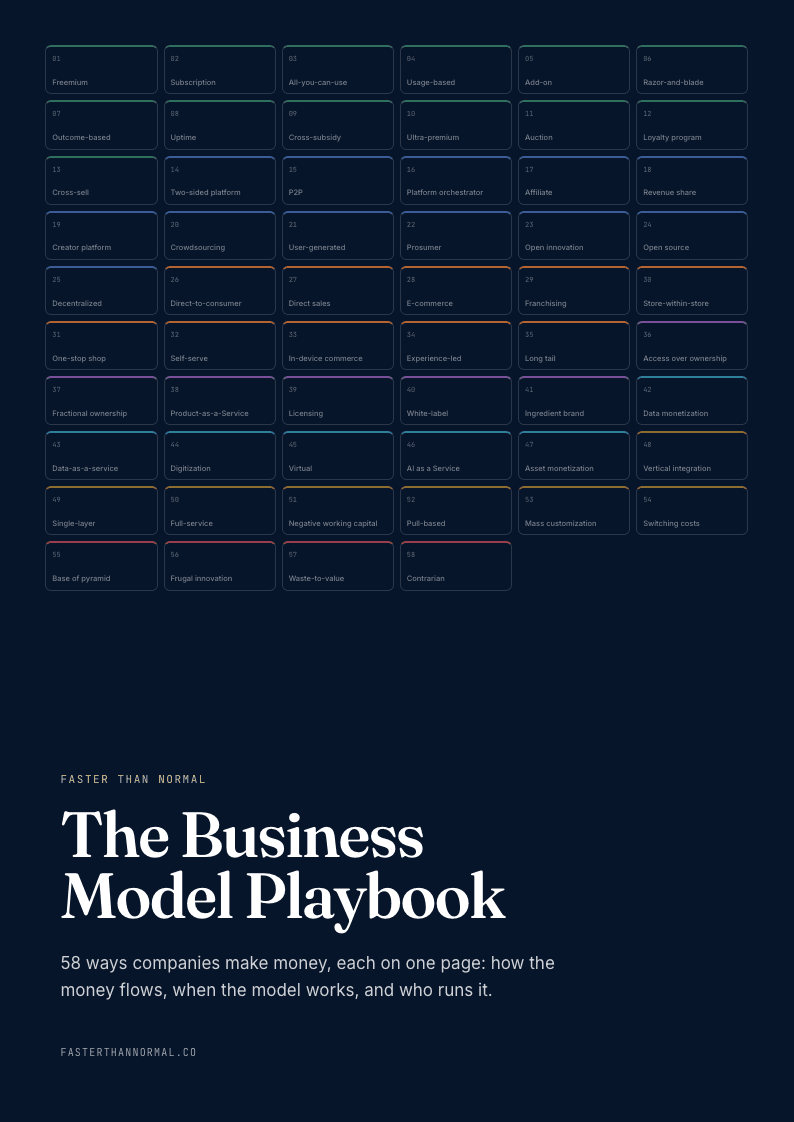
58 business models, one visual page each: how the money flows, the metrics that matter, and who runs it. Free when you join the Faster Than Normal email.
Free. No spam. Unsubscribe anytime.
Frequently asked questions
What is Leverage?
Force multipliers that allow disproportionate output from a given input — labor, capital, and code/media as the three forms of leverage.
How do you apply Leverage?
To apply Leverage, identify situations where this framework is relevant, then use it as a lens to evaluate your options and decisions. The model is most useful when combined with other complementary mental models.
What category does Leverage fall under?
Leverage falls under the Systems & Complexity category of mental models. Other models in this category can be found on the Systems & Complexity hub page.
Why is Leverage important?
Leverage is important because it provides a structured way to think about problems that would otherwise be approached with intuition alone. Understanding this model helps you avoid common reasoning errors and make better decisions.
Continue exploring
Mental model
Lollapalooza Effects
When multiple cognitive biases or forces act in the same direction simultaneousl
Mental model
Antifragility
Beyond resilience — some systems actually gain from disorder, volatility, and st
Mental model
Emergence
Complex system-level properties that arise from simple interactions between indi
Mental model
Feedback Loops
Circular causal chains where the output of a system feeds back as input — either
Mental model
Gall's Law
A complex system that works is invariably found to have evolved from a simple sy
Mental model
Leverage (Systems)
Places within a complex system where a small shift produces large changes — Mead
Free playbook
Get The Business Model Playbook
58 business models, one visual page each: how the money flows, the metrics that matter, and who runs it. Free when you join the Faster Than Normal email.
Free. No spam. Unsubscribe anytime.