
Contents
The Core Idea
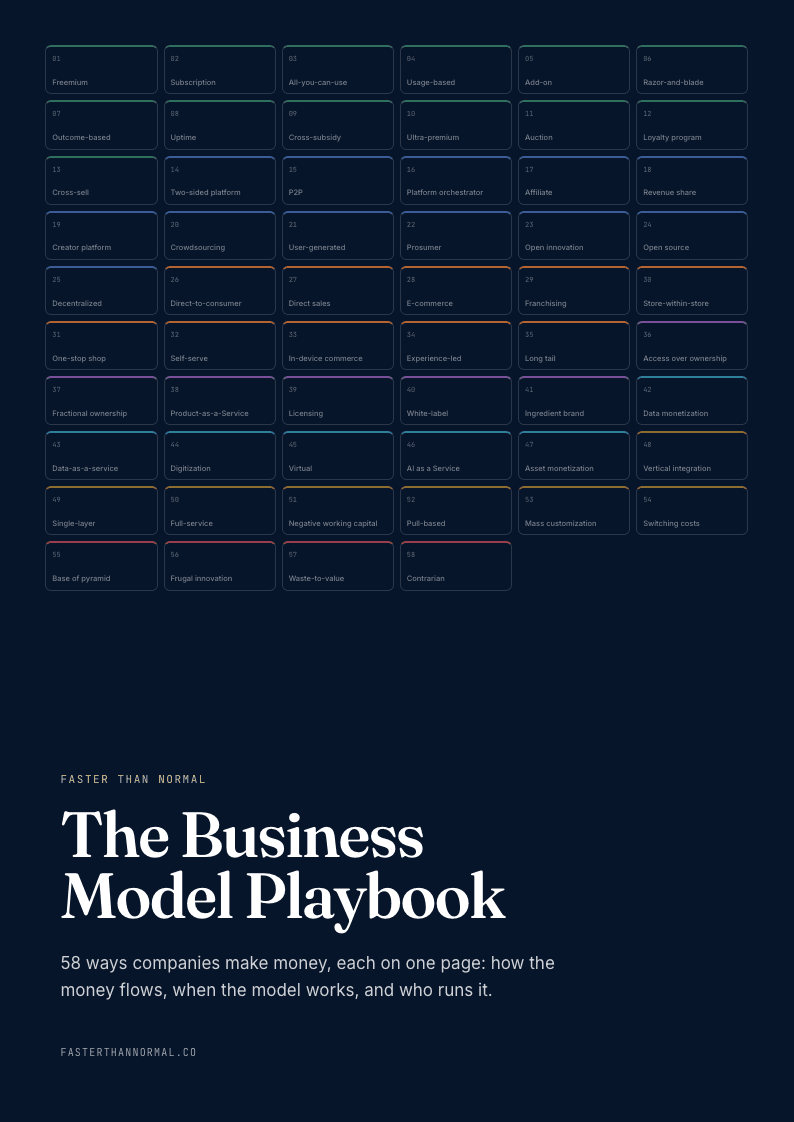
Free playbook
Get The Business Model Playbook
58 business models, one visual page each: how the money flows, the metrics that matter, and who runs it. Free when you join the Faster Than Normal email.
Free. No spam. Unsubscribe anytime.
How to See It
How to Use It
The Mechanism
Founders & Leaders in Action
Visual Explanation
Connected Models
One Key Quote
— Hamilton Helmer, 7 Powers: The Foundations of Business Strategy"Power is the set of conditions creating the potential for persistent differential returns. Strategy is a route to continuing Power in significant markets."
Analyst's Take
Test Yourself
Which power is at work?
A social media platform reaches 500 million users. Each new user makes the platform more valuable for existing users because they can connect with more friends and see more content. A well-funded competitor launches with better features and design but struggles to gain traction because users won't leave their existing network.
A cloud computing company invests $40 billion in data centres over five years. This massive infrastructure allows it to offer computing resources at per-unit costs 30% below smaller competitors. The lower costs attract more customers, which generates more revenue to invest in infrastructure, widening the gap further.
A startup offers free software that replaces expensive enterprise licenses. The incumbent has $8 billion in annual license revenue. The incumbent's board considers matching the free model but estimates it would destroy 60% of current revenue within three years. They decide to defend the existing business instead.
A fast-growing SaaS company has strong revenue growth, excellent customer reviews, and a talented team. When asked about competitive advantage, the CEO says: 'We just execute better than everyone else.' The company has no patents, no exclusive data, no network effects, and customers can switch to competitors in under a week.
Top Resources
Related guides
Why this matters next
7 Powers (Hamilton Helmer) applied the Network Effects mental model
7 Powers (Hamilton Helmer) applied the First Principles Thinking mental model
7 Powers (Hamilton Helmer) applied the Compounding mental model
7 Powers (Hamilton Helmer) applied the First-Mover mental model
7 Powers (Hamilton Helmer) applied the Trade-offs mental model
7 Powers (Hamilton Helmer) applied the Utility mental model
Frequently asked questions
What is 7 Powers (Hamilton Helmer)?
The seven — and only seven — sources of durable competitive advantage: Scale Economies, Network Economies, Counter-Positioning, Switching Costs, Branding, Cornered Resource, and Process Power.
How do you apply 7 Powers (Hamilton Helmer)?
To apply 7 Powers (Hamilton Helmer), identify situations where this framework is relevant, then use it as a lens to evaluate your options and decisions. The model is most useful when combined with other complementary mental models.
What category does 7 Powers (Hamilton Helmer) fall under?
7 Powers (Hamilton Helmer) falls under the Business & Strategy category of mental models. Other models in this category can be found on the Business & Strategy hub page.
Why is 7 Powers (Hamilton Helmer) important?
7 Powers (Hamilton Helmer) is important because it provides a structured way to think about problems that would otherwise be approached with intuition alone. Understanding this model helps you avoid common reasoning errors and make better decisions.
Where does 7 Powers (Hamilton Helmer) come from?
7 Powers (Hamilton Helmer) is discussed in the tradition of Hamilton Helmer.
Continue exploring
Mental model
100 People Love
Build something 100 people love rather than something 1 million people kind of l
Mental model
BATNA
Best Alternative to a Negotiated Agreement — your power in any negotiation comes
Mental model
Competition is for Losers
Peter Thiel's thesis: every moment spent competing is a moment not spent buildin
Mental model
Disagree and Commit
Once a decision is made after genuine debate, everyone — including dissenters —
Mental model
Disruptive Innovation
Inferior products that start in niche markets and improve until they overtake in
Mental model
Distribution
The channels and systems through which products reach customers — often more imp
Free playbook
Get The Business Model Playbook
58 business models, one visual page each: how the money flows, the metrics that matter, and who runs it. Free when you join the Faster Than Normal email.
Free. No spam. Unsubscribe anytime.