

Contents
Book summary
Zero to One
by Peter Thiel
The Core Premise
Most business books preach competition as the path to success, but Peter Thiel demolishes this myth with a counterintuitive truth: monopolies, not competitive markets, drive all meaningful progress. The PayPal co-founder and venture capitalist argues that creating something entirely new—going from "zero to one"—matters more than copying what already exists, because monopolistic businesses capture lasting value while competitive ones fight over scraps.
Thiel's central framework divides business progress into two categories: horizontal progress (going from "1 to n" by copying existing solutions) and vertical progress (going from "0 to 1" by creating breakthrough innovations). Google exemplified zero-to-one thinking by building the first scalable search engine, not by improving existing directories like Yahoo. The company achieved monopoly profits precisely because it solved search so much better than alternatives that users had no real substitutes. Thiel contends that such monopolies benefit society by pushing technology forward, while perfect competition leads to stagnation and zero profits.
The book introduces Thiel's "Power Law" principle, which governs both startup success and venture capital returns. A tiny number of companies generate the vast majority of returns in any portfolio—Thiel's investment in Facebook returned more than all other Founders Fund investments combined. This mathematical reality shapes how entrepreneurs should think about market size and growth potential. Rather than targeting huge existing markets with incremental improvements, founders should create new markets where they can achieve monopoly status, even if those markets initially appear small.
Thiel's "Last Mover Advantage" framework flips conventional first-mover thinking on its head. The goal isn't to be first to market but to be the last significant innovation in a space, capturing enduring value through network effects, economies of scale, proprietary technology, or brand strength. Amazon started by selling books online—hardly a revolutionary concept—but built logistics and technology capabilities that eventually created an unassailable competitive moat across multiple industries.
For executives and founders, Thiel's insights reshape fundamental strategic questions. Instead of asking "How do we compete?" leaders should ask "How do we avoid competition entirely?" This requires honest assessment of whether your company offers 10x improvement over alternatives—anything less leaves you vulnerable to competitive pressure. Thiel proved that the most valuable companies solve problems so effectively that they transcend traditional market categories, creating new realities rather than fighting over existing ones.
Zero to One by Peter Thiel belongs on the short shelf of books that change how you notice decisions in the wild. Whether you agree with every claim or not, the frame it offers is portable: you can apply it in meetings, investing, hiring, and personal trade-offs without carrying the whole volume.
Many readers return to this book because it names patterns that felt familiar but unnamed. Naming is leverage: once you can point to a mechanism, you can design around it. One through-line is “Zero to One vs. One to N: Vertical progress means creating breakthrough innovations that didn't exist before (0→1), while horizontal progress copies and scales existing solutions globally (1→n). PayPa” and its implications for judgment under uncertainty.
If you are reading for execution, translate each chapter into a testable habit: one prompt before a big decision, one review question after a project, one constraint you will respect next quarter. Theory becomes useful when it shows up in calendars, not only in margins.
Finally, pair this book with opposing voices. The strongest readers stress-test the thesis against cases where the advice fails, note the boundary conditions, and keep a short list of when not to use this lens. That discipline is how summaries become judgment.
Long-form books reward spaced attention: read a chapter, sleep, then write a half-page memo titled “What would I do differently on Monday?” If you cannot answer with specifics, the idea has not yet landed.
Use Zero to One as a conversation starter with peers who have different incentives. The disagreements often reveal which parts of the book are robust and which are fragile when power, risk, and time horizons change.
Key Ideas and Arguments
Zero to One vs. One to N: Vertical progress means creating breakthrough innovations that didn't exist before (0→1), while horizontal progress copies and scales existing solutions globally (1→n). PayPal created entirely new digital payment infrastructure rather than just improving existing banking.. This idea shows up repeatedly in Zero to One: separate the definition from the examples, then ask where the author's evidence is strongest and where anecdotes do most of the work. Consider writing a counterexample: a situation where applying the idea literally would misfire, and what guardrail you would add.
Monopoly vs. Competition: Monopolistic businesses capture lasting value and profits while driving innovation, whereas perfect competition eliminates profits and stagnates progress. Google's search monopoly generated massive returns that funded ambitious projects like self-driving cars.. This idea shows up repeatedly in Zero to One: separate the definition from the examples, then ask where the author's evidence is strongest and where anecdotes do most of the work. Consider writing a counterexample: a situation where applying the idea literally would misfire, and what guardrail you would add.
Power Law Distribution: In venture capital and startup ecosystems, a tiny percentage of investments generate the vast majority of returns, following mathematical power law curves. Thiel's Facebook investment returned more than all other Founders Fund investments combined.. This idea shows up repeatedly in Zero to One: separate the definition from the examples, then ask where the author's evidence is strongest and where anecdotes do most of the work. Consider writing a counterexample: a situation where applying the idea literally would misfire, and what guardrail you would add.
Last Mover Advantage: Success comes from being the final significant innovation in a space rather than the first mover, capturing enduring value through sustainable competitive advantages. Amazon wasn't first to sell online but built unassailable logistics and technology moats.. This idea shows up repeatedly in Zero to One: separate the definition from the examples, then ask where the author's evidence is strongest and where anecdotes do most of the work. Consider writing a counterexample: a situation where applying the idea literally would misfire, and what guardrail you would add.
10x Improvement Rule: Successful monopolies offer solutions at least 10 times better than existing alternatives, making competition irrelevant rather than marginally better. Anything less leaves companies vulnerable to competitive pressure and commoditization.. This idea shows up repeatedly in Zero to One: separate the definition from the examples, then ask where the author's evidence is strongest and where anecdotes do most of the work. Consider writing a counterexample: a situation where applying the idea literally would misfire, and what guardrail you would add.
Definite vs. Indefinite Optimism: Definite optimists believe the future will be better and have specific plans to make it happen, while indefinite optimists expect improvement but lack concrete visions. Silicon Valley's greatest successes came from definite optimists with clear technological visions.. This idea shows up repeatedly in Zero to One: separate the definition from the examples, then ask where the author's evidence is strongest and where anecdotes do most of the work. Consider writing a counterexample: a situation where applying the idea literally would misfire, and what guardrail you would add.
Secrets Framework: Valuable companies are built on secrets—important truths that few people know or believe. Successful entrepreneurs identify what valuable company isn't being built, rather than competing in obvious markets everyone already understands.. This idea shows up repeatedly in Zero to One: separate the definition from the examples, then ask where the author's evidence is strongest and where anecdotes do most of the work. Consider writing a counterexample: a situation where applying the idea literally would misfire, and what guardrail you would add.
Deeper Themes and Context
Zero to One is not only a catalogue of claims; it is a stance on how to interpret success, failure, and ambiguity. Readers who engage charitably still ask: which recommendations are universal, which are culturally situated, and which require institutional support you do not have?
Comparing the book's prescriptions to your own context is part of the work. A strategy that assumes abundant capital, patient stakeholders, or long feedback loops will read differently if you are resource-constrained, early in a career, or operating under regulatory pressure. Translation beats transcription.
The book also invites you to notice what it does not say. Silences can be instructive: topics the author avoids, counterexamples that never appear, or metrics that are praised without definition. A serious reader keeps a missing-evidence note alongside a to-try note.
Historically, the most influential business and biography titles survive because they double as vocabulary. Teams that share a phrase from Zero to One move faster only when they also share a definition and a worked example, otherwise they talk past each other with the same words.
How to Apply the Lessons
Connected Mental Models
Who Should Read This
Start here if you want a serious, book-length argument rather than a thread of bullet points. Zero to One rewards readers who will sketch their own examples, argue back in the margins, and connect chapters to decisions they are facing this quarter.
It is also useful as a shared vocabulary for teams: a common chapter reference can shorten debate if everyone agrees what the term means in practice. If your team only shares the title, not the definition, expect confusion.
Skip or skim if you need a narrow tactical recipe with no theory; this summary preserves the ideas, but the book's value is often in the extended case material and the author's sequencing.
Analyst's Take
Test Yourself
Check your grasp of the book’s moves
A colleague quotes Zero to One to justify a risky decision. What should you verify first?
You finished Zero to One and want behaviour change this week.
Further Reading
Featured in
Why this matters next
Continue exploring


Free playbook
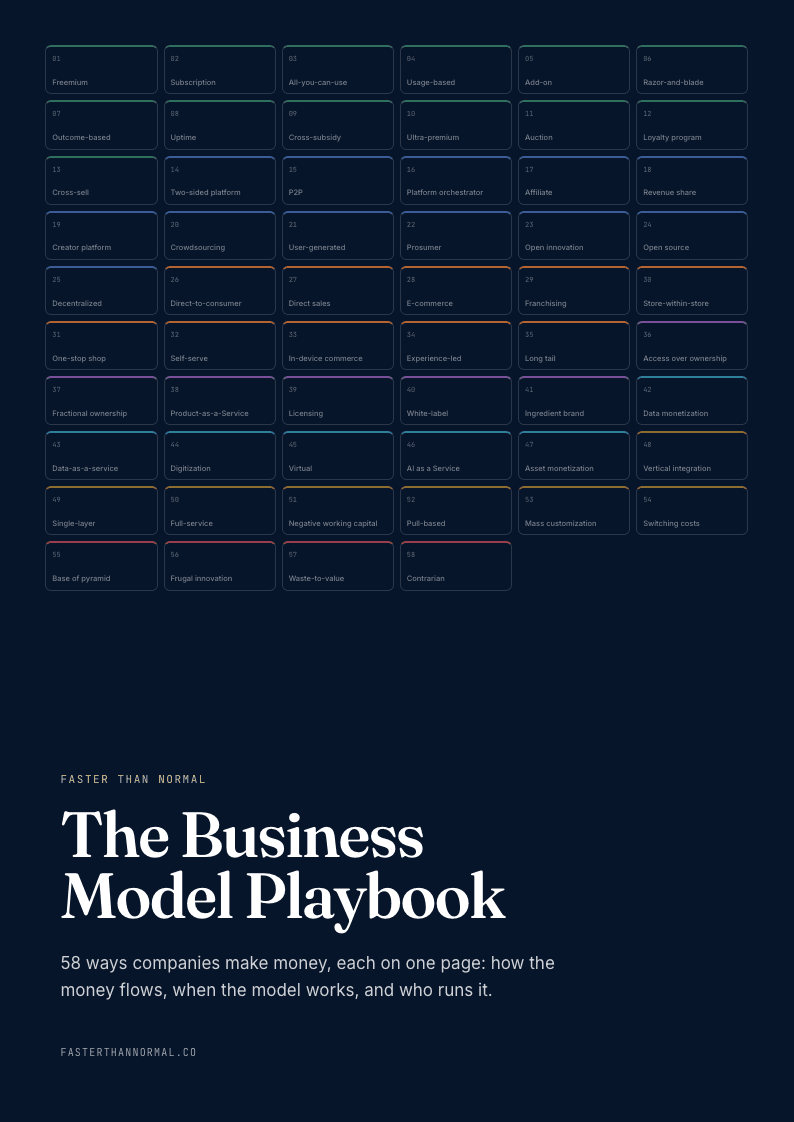
Get The Business Model Playbook
58 business models, one visual page each: how the money flows, the metrics that matter, and who runs it. Free when you join the Faster Than Normal email.
Free. No spam. Unsubscribe anytime.