

Contents
Book summary
Who Is Bill Gates?
by Patricia Brennan Demuth
The Core Premise
Patricia Brennan Demuth's biographical account traces Bill Gates's evolution from a privileged Seattle teenager obsessed with computers to the world's most influential philanthropist. The narrative demonstrates how Gates's early exposure to computing at Lakeside School, combined with his competitive drive and strategic thinking, created the foundation for Microsoft's dominance in personal computing. Demuth illustrates Gates's ability to recognize inflection points—like the shift from mainframes to personal computers—and position Microsoft accordingly through aggressive licensing strategies rather than hardware manufacturing. The book's most compelling insight lies in documenting Gates's systematic approach to problem-solving, whether debugging code, structuring business deals, or later tackling global health challenges through the Gates Foundation. His transition from ruthless businessman to thoughtful philanthropist exemplifies how cognitive frameworks developed in one domain can transfer to entirely different challenges. The author effectively shows how Gates's obsession with measurement and data-driven decision making remained constant whether he was optimizing software performance or reducing child mortality rates in developing countries.
This thread continues the same argument: Patricia Brennan Demuth's biographical account traces Bill Gates's evolution from a privileged Seattle teenager obsessed with computers to the world's most influential philanthropist. The narrative de…
This thread continues the same argument: Patricia Brennan Demuth's biographical account traces Bill Gates's evolution from a privileged Seattle teenager obsessed with computers to the world's most influential philanthropist. The narrative de…
This thread continues the same argument: Patricia Brennan Demuth's biographical account traces Bill Gates's evolution from a privileged Seattle teenager obsessed with computers to the world's most influential philanthropist. The narrative de…
Gates, born in Seattle, Washington, in 1955, is an American business magnate, investor, philanthropist, and author. In this biography, children will learn of Gates' childhood passion for computer technology, which led him to revolutionize personal co
Who Is Bill Gates? by Patricia Brennan Demuth belongs on the short shelf of books that change how you notice decisions in the wild. Whether you agree with every claim or not, the frame it offers is portable: you can apply it in meetings, investing, hiring, and personal trade-offs without carrying the whole volume.
Many readers return to this book because it names patterns that felt familiar but unnamed. Naming is leverage: once you can point to a mechanism, you can design around it. One through-line is “Recognizing technological inflection points allows early movers to capture disproportionate market share, as Gates did by betting on personal computers when others focused on mainframes.” and its implications for judgment under uncertainty.
If you are reading for execution, translate each chapter into a testable habit: one prompt before a big decision, one review question after a project, one constraint you will respect next quarter. Theory becomes useful when it shows up in calendars, not only in margins.
Finally, pair this book with opposing voices. The strongest readers stress-test the thesis against cases where the advice fails, note the boundary conditions, and keep a short list of when not to use this lens. That discipline is how summaries become judgment.
Long-form books reward spaced attention: read a chapter, sleep, then write a half-page memo titled “What would I do differently on Monday?” If you cannot answer with specifics, the idea has not yet landed.
Use Who Is Bill Gates? as a conversation starter with peers who have different incentives. The disagreements often reveal which parts of the book are robust and which are fragile when power, risk, and time horizons change.
Key Ideas and Arguments
Recognizing technological inflection points allows early movers to capture disproportionate market share, as Gates did by betting on personal computers when others focused on mainframes.. This idea shows up repeatedly in Who Is Bill Gates?: separate the definition from the examples, then ask where the author's evidence is strongest and where anecdotes do most of the work. Consider writing a counterexample: a situation where applying the idea literally would misfire, and what guardrail you would add.
Platform strategy involves creating ecosystems where others build complementary products, generating network effects and sustainable competitive advantages.. This idea shows up repeatedly in Who Is Bill Gates?: separate the definition from the examples, then ask where the author's evidence is strongest and where anecdotes do most of the work. Consider writing a counterexample: a situation where applying the idea literally would misfire, and what guardrail you would add.
Systematic philanthropy applies business principles like measurement, accountability, and scalable solutions to address global problems more effectively than traditional charity.. This idea shows up repeatedly in Who Is Bill Gates?: separate the definition from the examples, then ask where the author's evidence is strongest and where anecdotes do most of the work. Consider writing a counterexample: a situation where applying the idea literally would misfire, and what guardrail you would add.
Intellectual curiosity combined with competitive drive can fuel decades of sustained achievement across multiple domains.. This idea shows up repeatedly in Who Is Bill Gates?: separate the definition from the examples, then ask where the author's evidence is strongest and where anecdotes do most of the work. Consider writing a counterexample: a situation where applying the idea literally would misfire, and what guardrail you would add.
Strategic partnerships and licensing models can be more profitable than manufacturing, allowing companies to scale without heavy capital requirements.. This idea shows up repeatedly in Who Is Bill Gates?: separate the definition from the examples, then ask where the author's evidence is strongest and where anecdotes do most of the work. Consider writing a counterexample: a situation where applying the idea literally would misfire, and what guardrail you would add.
Data-driven decision making requires establishing clear metrics and feedback loops to optimize performance continuously.. This idea shows up repeatedly in Who Is Bill Gates?: separate the definition from the examples, then ask where the author's evidence is strongest and where anecdotes do most of the work. Consider writing a counterexample: a situation where applying the idea literally would misfire, and what guardrail you would add.
Deeper Themes and Context
Who Is Bill Gates? is not only a catalogue of claims; it is a stance on how to interpret success, failure, and ambiguity. Readers who engage charitably still ask: which recommendations are universal, which are culturally situated, and which require institutional support you do not have?
Comparing the book's prescriptions to your own context is part of the work. A strategy that assumes abundant capital, patient stakeholders, or long feedback loops will read differently if you are resource-constrained, early in a career, or operating under regulatory pressure. Translation beats transcription.
The book also invites you to notice what it does not say. Silences can be instructive: topics the author avoids, counterexamples that never appear, or metrics that are praised without definition. A serious reader keeps a missing-evidence note alongside a to-try note.
Historically, the most influential business and biography titles survive because they double as vocabulary. Teams that share a phrase from Who Is Bill Gates? move faster only when they also share a definition and a worked example, otherwise they talk past each other with the same words.
How to Apply the Lessons
Connected Mental Models
Who Should Read This
Start here if you want a serious, book-length argument rather than a thread of bullet points. Who Is Bill Gates? rewards readers who will sketch their own examples, argue back in the margins, and connect chapters to decisions they are facing this quarter.
It is also useful as a shared vocabulary for teams: a common chapter reference can shorten debate if everyone agrees what the term means in practice. If your team only shares the title, not the definition, expect confusion.
Skip or skim if you need a narrow tactical recipe with no theory; this summary preserves the ideas, but the book's value is often in the extended case material and the author's sequencing.
Analyst's Take
Test Yourself
Check your grasp of the book’s moves
A colleague quotes Who Is Bill Gates? to justify a risky decision. What should you verify first?
You finished Who Is Bill Gates? and want behaviour change this week.
Further Reading
Continue exploring


Free playbook
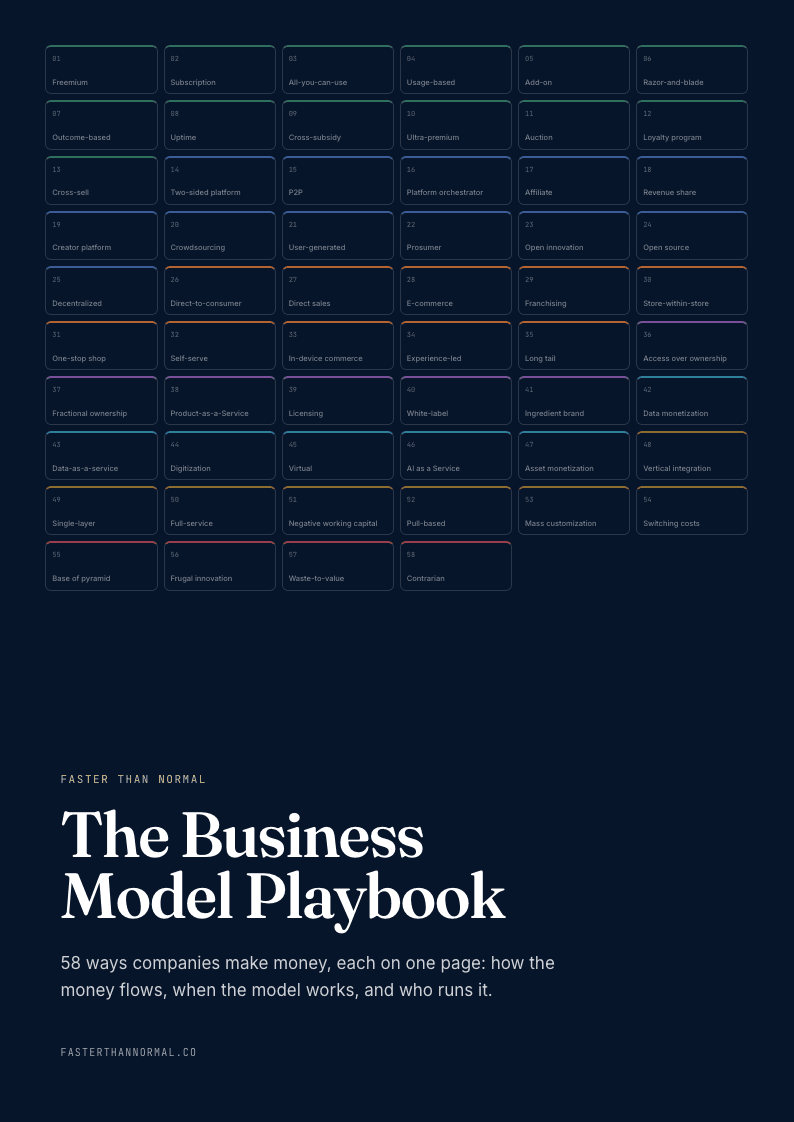
Get The Business Model Playbook
58 business models, one visual page each: how the money flows, the metrics that matter, and who runs it. Free when you join the Faster Than Normal email.
Free. No spam. Unsubscribe anytime.