

Contents
Book summary
Turn the Ship Around!
by L. David Marquet
The Core Premise
The Santa Fe's transformation from the Navy's worst-performing submarine to its most celebrated proves that the most counterintuitive leadership principle works: giving up control creates more control. When Captain L. David Marquet took command of this nuclear submarine, he faced a crew so demoralized that they had the worst retention rate in the fleet and a culture where sailors mindlessly followed orders without thinking. His accidental discovery—giving an impossible order that his crew tried to execute anyway—forced him to abandon traditional "leader-follower" hierarchies and build what he calls the "leader-leader" model.
Marquet's approach centers on two fundamental mechanisms: Control (moving decision-making authority to where the information lives) and Competence (ensuring people have both the technical knowledge and organizational clarity to make good decisions). Rather than the traditional submarine command structure where the captain makes every decision, Marquet began asking "What do you think we should do?" instead of issuing orders. When his sonar supervisor requested permission to submerge the ship, Marquet replied "What's your intention?" This simple linguistic shift transferred ownership of the decision back to the person with the most relevant information. The results were immediate: crew members began thinking critically about their actions rather than simply executing commands. The Santa Fe's performance metrics skyrocketed—from worst to first in operational effectiveness and retention.
The "Intent-Based Leadership" framework operates through three core practices that systematically transfer authority downward. First, "I intend to..." statements replace permission-seeking requests, forcing subordinates to state their plan and demonstrate competence before acting. Second, leaders resist the urge to provide solutions and instead ask "What do you see?" to develop their team's analytical capabilities. Third, the "thinking out loud" protocol requires team members to verbalize their reasoning, creating transparency and learning opportunities. Marquet discovered that when his crew had to articulate their intentions, they caught their own errors and developed stronger decision-making muscles.
The practical architecture for implementing leader-leader requires dismantling what Marquet calls "disempowerment" mechanisms embedded in most organizations. He identifies specific organizational antibodies that kill distributed leadership: approval processes that train people not to think, briefing practices that reward regurgitation over analysis, and measurement systems that punish initiative. The Santa Fe eliminated these barriers systematically. They stopped requiring permission for routine decisions, changed meeting formats from status updates to problem-solving sessions, and created "awards for bold action" rather than just perfect execution. Most significantly, they instituted "certification" processes where team members had to demonstrate mastery before gaining decision rights in specific domains.
For executives and founders, Marquet's model offers a scalable alternative to the bottleneck of centralized decision-making that kills growth in expanding organizations. The key insight: competence must precede control. You cannot simply delegate authority without ensuring people have the technical skills and organizational context to exercise it effectively. This means investing heavily in training systems, creating clear decision criteria, and building feedback loops that help people learn from their choices. The Santa Fe's success wasn't just about empowerment—it was about creating the infrastructure for empowerment to work safely and effectively in high-stakes environments.
“One of the 12 best business books of all time…. Timeless principles of empowering leadership.” – USA Today "The best how-to manual anywhere for managers on delegating, training, and driving flawless execution.” —FORTUNE Since Turn the Ship Around! was published in 2013, hundreds of thousands of readers have been inspired by former Navy captain David Marquet’s true story. Many have applied his insights to their own organizations, creating workplaces where everyone takes responsibility for his or her actions, where followers grow to become leaders, and where happier teams drive dramatically better results. Marquet was a Naval Academy graduate and an experienced officer when selected for submarine command. Trained to give orders in the traditional model of “know all–tell all” leadership, he faced a new wrinkle when he was shifted to the Santa Fe, a nuclear-powered submarine. Facing the high-stress environment of a sub where there’s little margin for error, he was determined to reverse the trends he found on the Santa Fe: poor morale, poor performance, and the worst retention rate in the fleet. Almost immediately, Marquet ran into trouble when he unknowingly gave an impossible order, …
Turn the Ship Around! by L. David Marquet belongs on the short shelf of books that change how you notice decisions in the wild. Whether you agree with every claim or not, the frame it offers is portable: you can apply it in meetings, investing, hiring, and personal trade-offs without carrying the whole volume.
Many readers return to this book because it names patterns that felt familiar but unnamed. Naming is leverage: once you can point to a mechanism, you can design around it. One through-line is “Leader-Leader Model: A hierarchy where people at every level are empowered to make decisions and take action within their domain of competence, replacing the traditional leader-follower dynamic. Unlik” and its implications for judgment under uncertainty.
If you are reading for execution, translate each chapter into a testable habit: one prompt before a big decision, one review question after a project, one constraint you will respect next quarter. Theory becomes useful when it shows up in calendars, not only in margins.
Finally, pair this book with opposing voices. The strongest readers stress-test the thesis against cases where the advice fails, note the boundary conditions, and keep a short list of when not to use this lens. That discipline is how summaries become judgment.
Long-form books reward spaced attention: read a chapter, sleep, then write a half-page memo titled “What would I do differently on Monday?” If you cannot answer with specifics, the idea has not yet landed.
Use Turn the Ship Around! as a conversation starter with peers who have different incentives. The disagreements often reveal which parts of the book are robust and which are fragile when power, risk, and time horizons change.
Key Ideas and Arguments
Leader-Leader Model: A hierarchy where people at every level are empowered to make decisions and take action within their domain of competence, replacing the traditional leader-follower dynamic. Unlike delegation, this transfers actual ownership of problems and solutions to those closest to the work.. This idea shows up repeatedly in Turn the Ship Around!: separate the definition from the examples, then ask where the author's evidence is strongest and where anecdotes do most of the work. Consider writing a counterexample: a situation where applying the idea literally would misfire, and what guardrail you would add.
Intent-Based Leadership: Decision-making framework where subordinates state 'I intend to...' followed by their proposed action, demonstrating both competence and ownership. This replaces permission-seeking with declaration of intent, forcing people to think through consequences before acting.. This idea shows up repeatedly in Turn the Ship Around!: separate the definition from the examples, then ask where the author's evidence is strongest and where anecdotes do most of the work. Consider writing a counterexample: a situation where applying the idea literally would misfire, and what guardrail you would add.
Control and Competence Mechanisms: The two pillars of empowerment where Control refers to moving decision-making authority to information sources, while Competence ensures people have technical knowledge and organizational clarity to decide well. Both must exist for empowerment to work safely.. This idea shows up repeatedly in Turn the Ship Around!: separate the definition from the examples, then ask where the author's evidence is strongest and where anecdotes do most of the work. Consider writing a counterexample: a situation where applying the idea literally would misfire, and what guardrail you would add.
Thinking Out Loud: Communication protocol requiring team members to verbalize their reasoning and observations rather than just conclusions. When the sonar operator said 'I think we should surface' instead of just 'surface now,' it created learning opportunities and error-catching mechanisms.. This idea shows up repeatedly in Turn the Ship Around!: separate the definition from the examples, then ask where the author's evidence is strongest and where anecdotes do most of the work. Consider writing a counterexample: a situation where applying the idea literally would misfire, and what guardrail you would add.
Certification vs. Training: Moving beyond teaching people what to do toward validating they can make good decisions independently. The Santa Fe required crew members to demonstrate mastery and judgment in specific domains before gaining decision rights in those areas.. This idea shows up repeatedly in Turn the Ship Around!: separate the definition from the examples, then ask where the author's evidence is strongest and where anecdotes do most of the work. Consider writing a counterexample: a situation where applying the idea literally would misfire, and what guardrail you would add.
Don't Brief, Certify: Replacing status-update meetings with competence validation sessions where people prove they understand problems deeply enough to solve them. This shifts focus from information transfer to capability building.. This idea shows up repeatedly in Turn the Ship Around!: separate the definition from the examples, then ask where the author's evidence is strongest and where anecdotes do most of the work. Consider writing a counterexample: a situation where applying the idea literally would misfire, and what guardrail you would add.
Organizational Antibodies: Structural elements that kill empowerment including approval processes that train helplessness, briefing formats that reward regurgitation, and measurement systems that punish initiative. These must be systematically identified and eliminated.. This idea shows up repeatedly in Turn the Ship Around!: separate the definition from the examples, then ask where the author's evidence is strongest and where anecdotes do most of the work. Consider writing a counterexample: a situation where applying the idea literally would misfire, and what guardrail you would add.
Deeper Themes and Context
Turn the Ship Around! is not only a catalogue of claims; it is a stance on how to interpret success, failure, and ambiguity. Readers who engage charitably still ask: which recommendations are universal, which are culturally situated, and which require institutional support you do not have?
Comparing the book's prescriptions to your own context is part of the work. A strategy that assumes abundant capital, patient stakeholders, or long feedback loops will read differently if you are resource-constrained, early in a career, or operating under regulatory pressure. Translation beats transcription.
The book also invites you to notice what it does not say. Silences can be instructive: topics the author avoids, counterexamples that never appear, or metrics that are praised without definition. A serious reader keeps a missing-evidence note alongside a to-try note.
Historically, the most influential business and biography titles survive because they double as vocabulary. Teams that share a phrase from Turn the Ship Around! move faster only when they also share a definition and a worked example, otherwise they talk past each other with the same words.
How to Apply the Lessons
Connected Mental Models
Who Should Read This
Start here if you want a serious, book-length argument rather than a thread of bullet points. Turn the Ship Around! rewards readers who will sketch their own examples, argue back in the margins, and connect chapters to decisions they are facing this quarter.
It is also useful as a shared vocabulary for teams: a common chapter reference can shorten debate if everyone agrees what the term means in practice. If your team only shares the title, not the definition, expect confusion.
Skip or skim if you need a narrow tactical recipe with no theory; this summary preserves the ideas, but the book's value is often in the extended case material and the author's sequencing.
Analyst's Take
Test Yourself
Check your grasp of the book’s moves
A colleague quotes Turn the Ship Around! to justify a risky decision. What should you verify first?
You finished Turn the Ship Around! and want behaviour change this week.
Further Reading
Featured in
Continue exploring


Free playbook
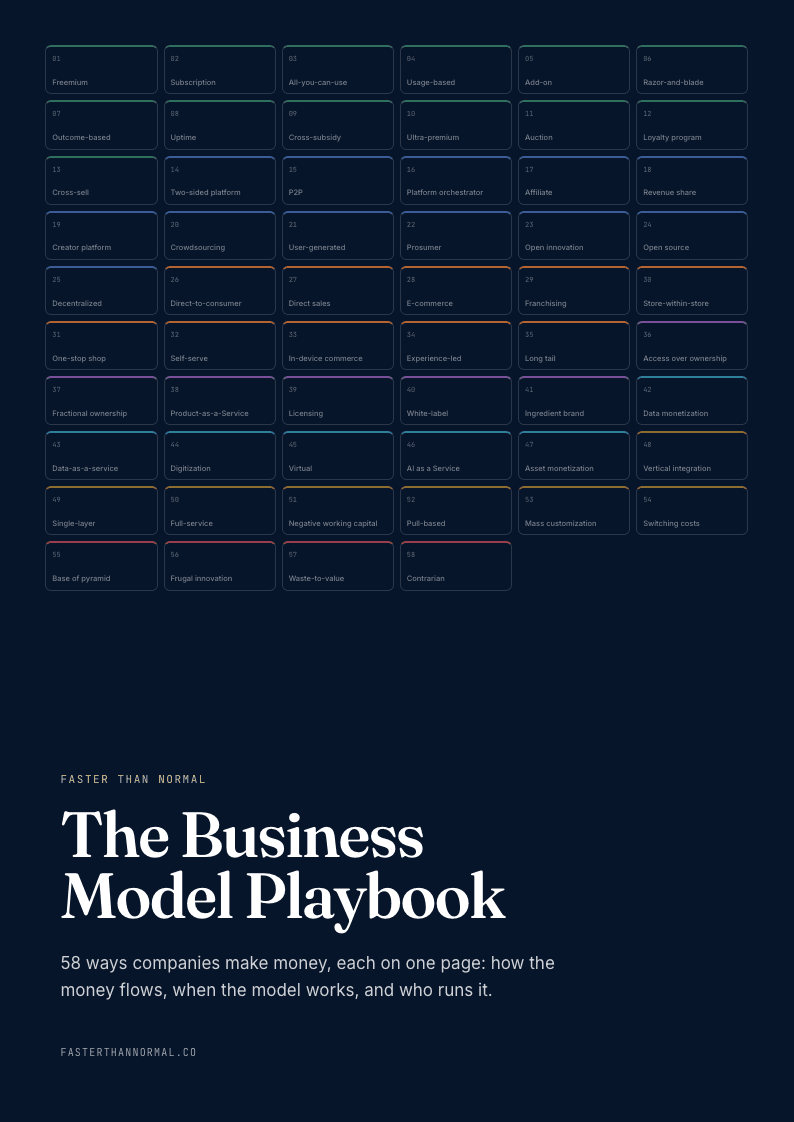
Get The Business Model Playbook
58 business models, one visual page each: how the money flows, the metrics that matter, and who runs it. Free when you join the Faster Than Normal email.
Free. No spam. Unsubscribe anytime.