

Contents
Book summary
Tools and Weapons
by Brad Smith
The Core Premise
Microsoft President Brad Smith argues that technology has reached an inflection point where its dual nature as both tool and weapon demands urgent governance frameworks. Drawing from Microsoft's frontline experiences with cyberattacks, government surveillance requests, and AI development, Smith demonstrates how tech companies have inadvertently become geopolitical actors wielding unprecedented power over privacy, democracy, and national security. His central thesis revolves around the 'responsibility gap' — the space between what technology can do and what it should do, which current institutions fail to address. Smith introduces the concept of 'digital diplomacy' as essential infrastructure for the 21st century, arguing that tech companies must embrace public-private partnerships rather than resist regulation. The book's distinctive value lies in Smith's insider access to pivotal moments like the 2016 election interference, the Snowden revelations, and Microsoft's legal battles with the DOJ. He proposes specific governance models, including his 'Digital Geneva Convention' for cyberspace and algorithmic accountability frameworks. Unlike typical tech criticism, Smith writes from within the industry while advocating for external oversight. His 'principled approach' framework suggests that technology companies should proactively establish ethical guidelines rather than wait for reactive regulation. The book illuminates how decisions made in Silicon Valley boardrooms now carry consequences typically reserved for nation-states, making corporate responsibility not just a nice-to-have but a democratic imperative.
This thread continues the same argument: Microsoft President Brad Smith argues that technology has reached an inflection point where its dual nature as both tool and weapon demands urgent governance frameworks. Drawing from Microsoft's front…
This thread continues the same argument: Microsoft President Brad Smith argues that technology has reached an inflection point where its dual nature as both tool and weapon demands urgent governance frameworks. Drawing from Microsoft's front…
This thread continues the same argument: Microsoft President Brad Smith argues that technology has reached an inflection point where its dual nature as both tool and weapon demands urgent governance frameworks. Drawing from Microsoft's front…
"In Tools and Weapons, Brad Smith and Carol Ann Browne take us into the cockpit of one of the world's largest and most powerful tech companies as it finds itself in the middle of some of the thorniest emerging issues of our time. These are challenges that come with no preexisting playbook, including privacy, cybercrime and cyberwar, social media, the moral conundrums of artificial intelligence, big tech's relationship to inequality, and the challenges for democracy, far and near. While in no way a self-glorifying "Microsoft memoir," the book pulls back the curtain remarkably wide onto some of the company's most crucial recent decision points, as it strives to protect the hopes technology offers against the very real threats it also presents. There are huge ramifications for communities and countries, and Brad Smith provides a thoughtful and urgent contribution to that effort." -- Descripción del editor.
Tools and Weapons by Brad Smith belongs on the short shelf of books that change how you notice decisions in the wild. Whether you agree with every claim or not, the frame it offers is portable: you can apply it in meetings, investing, hiring, and personal trade-offs without carrying the whole volume.
Many readers return to this book because it names patterns that felt familiar but unnamed. Naming is leverage: once you can point to a mechanism, you can design around it. One through-line is “Responsibility Gap: The growing chasm between technological capabilities and the institutional frameworks needed to govern them ethically and effectively.” and its implications for judgment under uncertainty.
If you are reading for execution, translate each chapter into a testable habit: one prompt before a big decision, one review question after a project, one constraint you will respect next quarter. Theory becomes useful when it shows up in calendars, not only in margins.
Finally, pair this book with opposing voices. The strongest readers stress-test the thesis against cases where the advice fails, note the boundary conditions, and keep a short list of when not to use this lens. That discipline is how summaries become judgment.
Long-form books reward spaced attention: read a chapter, sleep, then write a half-page memo titled “What would I do differently on Monday?” If you cannot answer with specifics, the idea has not yet landed.
Use Tools and Weapons as a conversation starter with peers who have different incentives. The disagreements often reveal which parts of the book are robust and which are fragile when power, risk, and time horizons change.
Key Ideas and Arguments
Responsibility Gap: The growing chasm between technological capabilities and the institutional frameworks needed to govern them ethically and effectively.. This idea shows up repeatedly in Tools and Weapons: separate the definition from the examples, then ask where the author's evidence is strongest and where anecdotes do most of the work. Consider writing a counterexample: a situation where applying the idea literally would misfire, and what guardrail you would add.
Digital Geneva Convention: Smith's proposed international framework to protect civilians from nation-state cyberattacks, modeled after humanitarian law.. This idea shows up repeatedly in Tools and Weapons: separate the definition from the examples, then ask where the author's evidence is strongest and where anecdotes do most of the work. Consider writing a counterexample: a situation where applying the idea literally would misfire, and what guardrail you would add.
Corporate Digital Responsibility: The obligation of technology companies to consider broader societal impacts beyond shareholder returns and user engagement metrics.. This idea shows up repeatedly in Tools and Weapons: separate the definition from the examples, then ask where the author's evidence is strongest and where anecdotes do most of the work. Consider writing a counterexample: a situation where applying the idea literally would misfire, and what guardrail you would add.
Public-Private Partnership Model: Collaborative governance approach where tech companies work with governments rather than operating in isolation or opposition.. This idea shows up repeatedly in Tools and Weapons: separate the definition from the examples, then ask where the author's evidence is strongest and where anecdotes do most of the work. Consider writing a counterexample: a situation where applying the idea literally would misfire, and what guardrail you would add.
Algorithmic Accountability: The principle that AI systems should be transparent, explainable, and subject to human oversight, especially in high-stakes decisions.. This idea shows up repeatedly in Tools and Weapons: separate the definition from the examples, then ask where the author's evidence is strongest and where anecdotes do most of the work. Consider writing a counterexample: a situation where applying the idea literally would misfire, and what guardrail you would add.
Digital Diplomacy: The practice of technology companies engaging in quasi-governmental negotiations and relationship-building across international boundaries.. This idea shows up repeatedly in Tools and Weapons: separate the definition from the examples, then ask where the author's evidence is strongest and where anecdotes do most of the work. Consider writing a counterexample: a situation where applying the idea literally would misfire, and what guardrail you would add.
Principled Approach Framework: Proactive establishment of ethical guidelines and self-regulation by companies before external regulation forces compliance.. This idea shows up repeatedly in Tools and Weapons: separate the definition from the examples, then ask where the author's evidence is strongest and where anecdotes do most of the work. Consider writing a counterexample: a situation where applying the idea literally would misfire, and what guardrail you would add.
Deeper Themes and Context
Tools and Weapons is not only a catalogue of claims; it is a stance on how to interpret success, failure, and ambiguity. Readers who engage charitably still ask: which recommendations are universal, which are culturally situated, and which require institutional support you do not have?
Comparing the book's prescriptions to your own context is part of the work. A strategy that assumes abundant capital, patient stakeholders, or long feedback loops will read differently if you are resource-constrained, early in a career, or operating under regulatory pressure. Translation beats transcription.
The book also invites you to notice what it does not say. Silences can be instructive: topics the author avoids, counterexamples that never appear, or metrics that are praised without definition. A serious reader keeps a missing-evidence note alongside a to-try note.
Historically, the most influential business and biography titles survive because they double as vocabulary. Teams that share a phrase from Tools and Weapons move faster only when they also share a definition and a worked example, otherwise they talk past each other with the same words.
How to Apply the Lessons
Connected Mental Models
Who Should Read This
Start here if you want a serious, book-length argument rather than a thread of bullet points. Tools and Weapons rewards readers who will sketch their own examples, argue back in the margins, and connect chapters to decisions they are facing this quarter.
It is also useful as a shared vocabulary for teams: a common chapter reference can shorten debate if everyone agrees what the term means in practice. If your team only shares the title, not the definition, expect confusion.
Skip or skim if you need a narrow tactical recipe with no theory; this summary preserves the ideas, but the book's value is often in the extended case material and the author's sequencing.
Analyst's Take
Test Yourself
Check your grasp of the book’s moves
A colleague quotes Tools and Weapons to justify a risky decision. What should you verify first?
You finished Tools and Weapons and want behaviour change this week.
Further Reading
Continue exploring


Free playbook
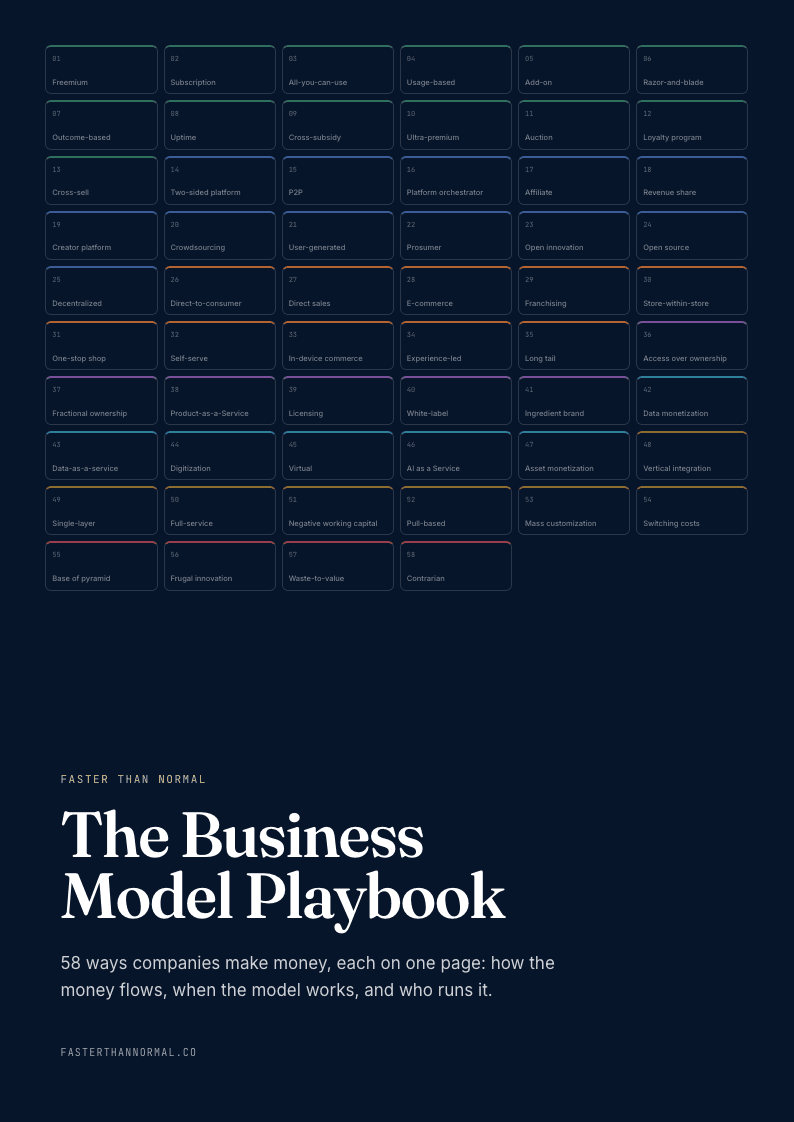
Get The Business Model Playbook
58 business models, one visual page each: how the money flows, the metrics that matter, and who runs it. Free when you join the Faster Than Normal email.
Free. No spam. Unsubscribe anytime.