

Contents
Book summary
The Vagabonds
by Jeff Guinn
The Core Premise
Four of America's most powerful industrialists—Henry Ford, Thomas Edison, Harvey Firestone, and John Burroughs—escaped their empires each summer for camping trips that redefined how titans think about innovation, friendship, and legacy. Between 1914 and 1925, these men who collectively shaped modern America abandoned their boardrooms for weeks-long adventures they called "vagabonding," creating an unlikely laboratory for cross-pollination of ideas that would influence everything from the Model T's mass production to Edison's later inventions.
Guinn reveals how the Vagabonds' camping philosophy became a deliberate strategy for breakthrough thinking. Ford insisted on roughing it authentically, while Edison brought along a portable laboratory. Firestone networked relentlessly even around campfires, and naturalist Burroughs provided the group's intellectual anchor. Their 1918 trip through West Virginia's mountains produced Ford's insight about vertical integration—watching Firestone struggle with tire supply shortages in remote areas convinced Ford that controlling every component of production wasn't paranoia, it was necessity. The conversations that emerged from shared hardship and removed context generated solutions that none of them reached in their corporate environments.
The Vagabonds understood that proximity breeds innovation, but only when combined with cognitive diversity and environmental disruption. Edison's deafness meant he absorbed different information during group discussions, often catching nuances others missed. Ford's mechanical obsessions complemented Firestone's commercial instincts and Burroughs' systems thinking. When Warren G. Harding and other politicians started joining their trips, the dynamic shifted from creative exploration to performative networking, ultimately killing the magic that made their early expeditions so productive.
Modern executives can extract the Vagabonds' core methodology: deliberate removal from operational environments, extended unstructured time with intellectual peers, and the discipline to keep these sessions small and purpose-driven. The camping was never about camping—it was about creating conditions where established mental frameworks break down and new connections emerge. Ford credited these trips with solving his biggest strategic challenges, while Edison used them to test ideas outside his laboratory's constraints. The key was combining physical adventure with intellectual adventure, forcing their minds to operate in unfamiliar modes while maintaining deep trust and candid communication.
"In 1914 Henry Ford and naturalist John Burroughs visited Thomas Edison in Florida and toured the Everglades. The following year Ford, Edison, and tire maker Harvey Firestone joined together on a summer camping trip and decided to call themselves the Vagabonds. They would continue their summer road trips until 1925, when they announced that their fame made it too difficult for them to carry on. Although the Vagabonds traveled with an entourage of chefs, butlers, and others, this elite fraternity also had a serious purpose: to examine the conditions of America's roadways and improve the practicality of automobile travel. Cars were unreliable and the roads were even worse. But newspaper coverage of these trips was extensive, and as cars and roads improved, the summer trip by automobile soon became a desired element of American life. In The Vagabonds Jeff Guinn shares the story of this pivotal moment in American history. But he also examines the important relationship between the older Edison and the younger Ford, who once worked for the famous inventor. The road trips made the automobile ubiquitous and magnified Ford's reputation, even as Edison's diminished. The automobile had come …
The Vagabonds by Jeff Guinn belongs on the short shelf of books that change how you notice decisions in the wild. Whether you agree with every claim or not, the frame it offers is portable: you can apply it in meetings, investing, hiring, and personal trade-offs without carrying the whole volume.
Many readers return to this book because it names patterns that felt familiar but unnamed. Naming is leverage: once you can point to a mechanism, you can design around it. One through-line is “Vagabonding Philosophy: Extended removal from business environments to enable breakthrough thinking through shared hardship and unstructured time. Ford, Edison, and their companions discovered that ca” and its implications for judgment under uncertainty.
If you are reading for execution, translate each chapter into a testable habit: one prompt before a big decision, one review question after a project, one constraint you will respect next quarter. Theory becomes useful when it shows up in calendars, not only in margins.
Finally, pair this book with opposing voices. The strongest readers stress-test the thesis against cases where the advice fails, note the boundary conditions, and keep a short list of when not to use this lens. That discipline is how summaries become judgment.
Long-form books reward spaced attention: read a chapter, sleep, then write a half-page memo titled “What would I do differently on Monday?” If you cannot answer with specifics, the idea has not yet landed.
Use The Vagabonds as a conversation starter with peers who have different incentives. The disagreements often reveal which parts of the book are robust and which are fragile when power, risk, and time horizons change.
Key Ideas and Arguments
Vagabonding Philosophy: Extended removal from business environments to enable breakthrough thinking through shared hardship and unstructured time. Ford, Edison, and their companions discovered that camping together for weeks created cognitive conditions impossible to replicate in boardrooms or laboratories.. This idea shows up repeatedly in The Vagabonds: separate the definition from the examples, then ask where the author's evidence is strongest and where anecdotes do most of the work. Consider writing a counterexample: a situation where applying the idea literally would misfire, and what guardrail you would add.
Cross-Pollination Innovation: Ideas emerge when diverse expertise combines in neutral environments. Edison's electrical thinking influenced Ford's assembly line innovations, while Firestone's distribution challenges shaped both men's understanding of market dynamics.. This idea shows up repeatedly in The Vagabonds: separate the definition from the examples, then ask where the author's evidence is strongest and where anecdotes do most of the work. Consider writing a counterexample: a situation where applying the idea literally would misfire, and what guardrail you would add.
Environmental Disruption Strategy: Physical discomfort and unfamiliar surroundings break down established thinking patterns. The Vagabonds deliberately chose challenging camping conditions because struggle forced them to approach problems from entirely new angles.. This idea shows up repeatedly in The Vagabonds: separate the definition from the examples, then ask where the author's evidence is strongest and where anecdotes do most of the work. Consider writing a counterexample: a situation where applying the idea literally would misfire, and what guardrail you would add.
Proximity-Based Problem Solving: Extended face-to-face time with trusted peers generates solutions that correspondence and meetings cannot. Ford's biggest strategic insights came from week-long conversations around campfires, not from formal business discussions.. This idea shows up repeatedly in The Vagabonds: separate the definition from the examples, then ask where the author's evidence is strongest and where anecdotes do most of the work. Consider writing a counterexample: a situation where applying the idea literally would misfire, and what guardrail you would add.
Scale Contamination Effect: When the Vagabonds' trips grew larger and attracted politicians, they lost their creative power and became networking events. Group dynamics that enable breakthrough thinking require careful curation and size limits.. This idea shows up repeatedly in The Vagabonds: separate the definition from the examples, then ask where the author's evidence is strongest and where anecdotes do most of the work. Consider writing a counterexample: a situation where applying the idea literally would misfire, and what guardrail you would add.
Complementary Cognitive Styles: Edison's deafness, Ford's mechanical obsession, Firestone's commercial instincts, and Burroughs' naturalist perspective created a cognitive ecosystem where each member's limitations became the group's strengths.. This idea shows up repeatedly in The Vagabonds: separate the definition from the examples, then ask where the author's evidence is strongest and where anecdotes do most of the work. Consider writing a counterexample: a situation where applying the idea literally would misfire, and what guardrail you would add.
Deeper Themes and Context
The Vagabonds is not only a catalogue of claims; it is a stance on how to interpret success, failure, and ambiguity. Readers who engage charitably still ask: which recommendations are universal, which are culturally situated, and which require institutional support you do not have?
Comparing the book's prescriptions to your own context is part of the work. A strategy that assumes abundant capital, patient stakeholders, or long feedback loops will read differently if you are resource-constrained, early in a career, or operating under regulatory pressure. Translation beats transcription.
The book also invites you to notice what it does not say. Silences can be instructive: topics the author avoids, counterexamples that never appear, or metrics that are praised without definition. A serious reader keeps a missing-evidence note alongside a to-try note.
Historically, the most influential business and biography titles survive because they double as vocabulary. Teams that share a phrase from The Vagabonds move faster only when they also share a definition and a worked example, otherwise they talk past each other with the same words.
How to Apply the Lessons
Connected Mental Models
Who Should Read This
Start here if you want a serious, book-length argument rather than a thread of bullet points. The Vagabonds rewards readers who will sketch their own examples, argue back in the margins, and connect chapters to decisions they are facing this quarter.
It is also useful as a shared vocabulary for teams: a common chapter reference can shorten debate if everyone agrees what the term means in practice. If your team only shares the title, not the definition, expect confusion.
Skip or skim if you need a narrow tactical recipe with no theory; this summary preserves the ideas, but the book's value is often in the extended case material and the author's sequencing.
Analyst's Take
Test Yourself
Check your grasp of the book’s moves
A colleague quotes The Vagabonds to justify a risky decision. What should you verify first?
You finished The Vagabonds and want behaviour change this week.
Further Reading
Continue exploring


Free playbook
Get The Business Model Playbook
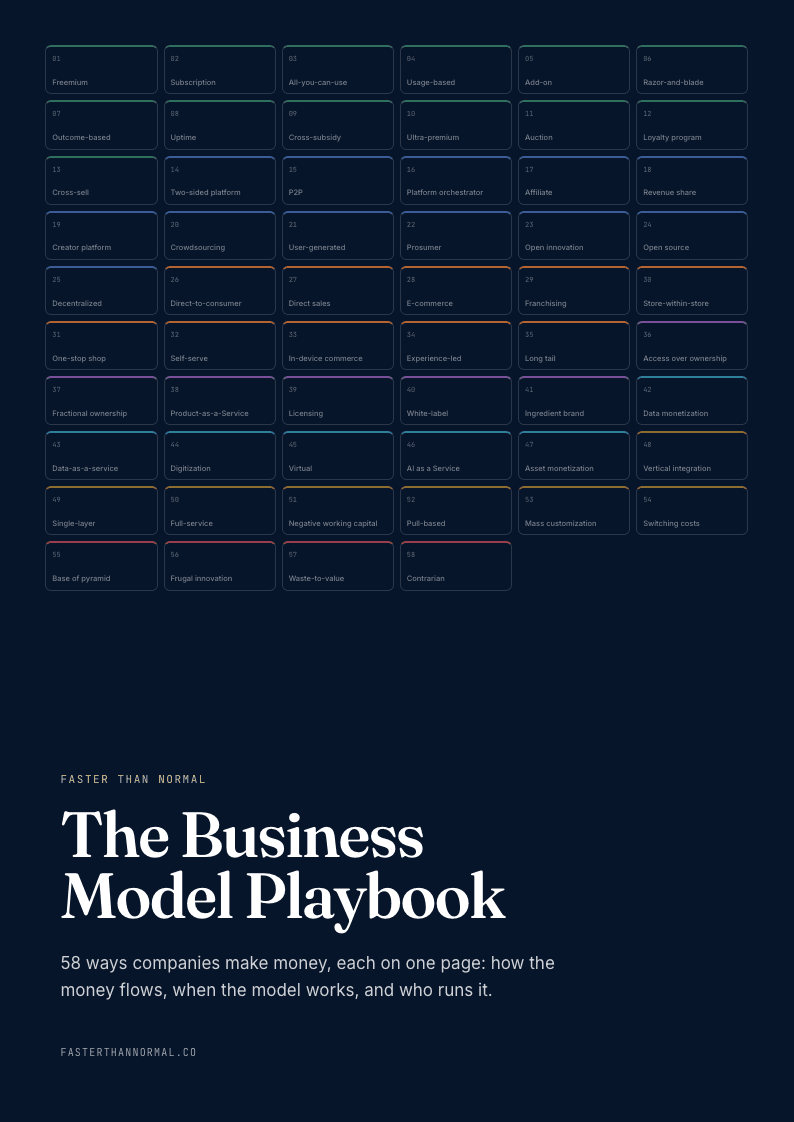
58 business models, one visual page each: how the money flows, the metrics that matter, and who runs it. Free when you join the Faster Than Normal email.
Free. No spam. Unsubscribe anytime.