

Contents
Book summary
The Taste of Luxury
by Nadege Forestier and Nazanine Ravai
The Core Premise
Forestier and Ravai deconstruct luxury consumption through what they term the 'Luxury Code' — a framework revealing how authentic luxury brands create emotional resonance beyond material value. Drawing from their extensive research in luxury markets, the authors argue that true luxury operates on three interconnected dimensions: craftsmanship excellence, cultural storytelling, and experiential exclusivity. Their 'Heritage-Innovation Matrix' demonstrates how brands like Hermès and Louis Vuitton balance tradition with contemporary relevance, while their concept of 'Luxury Democratization' explains why mass accessibility paradoxically destroys luxury value. The book introduces the 'Emotional Premium Theory,' showing how luxury purchases function as identity investments rather than mere transactions. Through case studies spanning from Swiss watchmaking to Japanese hospitality, they reveal how luxury brands manufacture desire through scarcity psychology and cultural mythology. Their 'Authenticity Paradox' framework explains why consumers simultaneously crave both heritage and novelty, forcing luxury brands to innovate while preserving core identity elements. The authors' 'Luxury Lifecycle Model' maps how brands evolve from artisanal origins to global icons, identifying critical transition points where brands either transcend commodity status or lose their luxury positioning. This analysis proves particularly valuable for understanding why certain luxury sectors resist digital transformation while others embrace it, and how cultural context shapes luxury perception across different markets.
This thread continues the same argument: Forestier and Ravai deconstruct luxury consumption through what they term the 'Luxury Code' — a framework revealing how authentic luxury brands create emotional resonance beyond material value. Drawin…
This thread continues the same argument: Forestier and Ravai deconstruct luxury consumption through what they term the 'Luxury Code' — a framework revealing how authentic luxury brands create emotional resonance beyond material value. Drawin…
This thread continues the same argument: Forestier and Ravai deconstruct luxury consumption through what they term the 'Luxury Code' — a framework revealing how authentic luxury brands create emotional resonance beyond material value. Drawin…
A biography of Bernard Arnault, from his obscure beginnings to head of Louis Vuitton Moet Hennessy, France's leading luxury empire, with a stable of champagne, brandy and haute couture.
The Taste of Luxury by Nadege Forestier and Nazanine Ravai belongs on the short shelf of books that change how you notice decisions in the wild. Whether you agree with every claim or not, the frame it offers is portable: you can apply it in meetings, investing, hiring, and personal trade-offs without carrying the whole volume.
Many readers return to this book because it names patterns that felt familiar but unnamed. Naming is leverage: once you can point to a mechanism, you can design around it. One through-line is “The Luxury Code: A three-dimensional framework encompassing craftsmanship excellence, cultural storytelling, and experiential exclusivity that defines authentic luxury positioning.” and its implications for judgment under uncertainty.
If you are reading for execution, translate each chapter into a testable habit: one prompt before a big decision, one review question after a project, one constraint you will respect next quarter. Theory becomes useful when it shows up in calendars, not only in margins.
Finally, pair this book with opposing voices. The strongest readers stress-test the thesis against cases where the advice fails, note the boundary conditions, and keep a short list of when not to use this lens. That discipline is how summaries become judgment.
Long-form books reward spaced attention: read a chapter, sleep, then write a half-page memo titled “What would I do differently on Monday?” If you cannot answer with specifics, the idea has not yet landed.
Use The Taste of Luxury as a conversation starter with peers who have different incentives. The disagreements often reveal which parts of the book are robust and which are fragile when power, risk, and time horizons change.
Key Ideas and Arguments
The Luxury Code: A three-dimensional framework encompassing craftsmanship excellence, cultural storytelling, and experiential exclusivity that defines authentic luxury positioning.. This idea shows up repeatedly in The Taste of Luxury: separate the definition from the examples, then ask where the author's evidence is strongest and where anecdotes do most of the work. Consider writing a counterexample: a situation where applying the idea literally would misfire, and what guardrail you would add.
Heritage-Innovation Matrix: The strategic balance luxury brands must maintain between preserving traditional identity and adapting to contemporary market demands.. This idea shows up repeatedly in The Taste of Luxury: separate the definition from the examples, then ask where the author's evidence is strongest and where anecdotes do most of the work. Consider writing a counterexample: a situation where applying the idea literally would misfire, and what guardrail you would add.
Emotional Premium Theory: The concept that luxury purchases function as identity investments, with consumers paying for psychological and social benefits rather than functional utility.. This idea shows up repeatedly in The Taste of Luxury: separate the definition from the examples, then ask where the author's evidence is strongest and where anecdotes do most of the work. Consider writing a counterexample: a situation where applying the idea literally would misfire, and what guardrail you would add.
Authenticity Paradox: The simultaneous consumer demand for both heritage authenticity and innovative novelty that creates tension in luxury brand strategy.. This idea shows up repeatedly in The Taste of Luxury: separate the definition from the examples, then ask where the author's evidence is strongest and where anecdotes do most of the work. Consider writing a counterexample: a situation where applying the idea literally would misfire, and what guardrail you would add.
Luxury Democratization: The process by which mass accessibility destroys luxury value, explaining why scarcity and exclusivity are fundamental to luxury positioning.. This idea shows up repeatedly in The Taste of Luxury: separate the definition from the examples, then ask where the author's evidence is strongest and where anecdotes do most of the work. Consider writing a counterexample: a situation where applying the idea literally would misfire, and what guardrail you would add.
Luxury Lifecycle Model: A framework mapping how brands evolve from artisanal origins to global luxury status, identifying critical transition points and potential failure modes.. This idea shows up repeatedly in The Taste of Luxury: separate the definition from the examples, then ask where the author's evidence is strongest and where anecdotes do most of the work. Consider writing a counterexample: a situation where applying the idea literally would misfire, and what guardrail you would add.
Scarcity Psychology: The mental mechanisms by which limited availability creates heightened desire and perceived value in luxury consumption.. This idea shows up repeatedly in The Taste of Luxury: separate the definition from the examples, then ask where the author's evidence is strongest and where anecdotes do most of the work. Consider writing a counterexample: a situation where applying the idea literally would misfire, and what guardrail you would add.
Deeper Themes and Context
The Taste of Luxury is not only a catalogue of claims; it is a stance on how to interpret success, failure, and ambiguity. Readers who engage charitably still ask: which recommendations are universal, which are culturally situated, and which require institutional support you do not have?
Comparing the book's prescriptions to your own context is part of the work. A strategy that assumes abundant capital, patient stakeholders, or long feedback loops will read differently if you are resource-constrained, early in a career, or operating under regulatory pressure. Translation beats transcription.
The book also invites you to notice what it does not say. Silences can be instructive: topics the author avoids, counterexamples that never appear, or metrics that are praised without definition. A serious reader keeps a missing-evidence note alongside a to-try note.
Historically, the most influential business and biography titles survive because they double as vocabulary. Teams that share a phrase from The Taste of Luxury move faster only when they also share a definition and a worked example, otherwise they talk past each other with the same words.
How to Apply the Lessons
Connected Mental Models
Who Should Read This
Start here if you want a serious, book-length argument rather than a thread of bullet points. The Taste of Luxury rewards readers who will sketch their own examples, argue back in the margins, and connect chapters to decisions they are facing this quarter.
It is also useful as a shared vocabulary for teams: a common chapter reference can shorten debate if everyone agrees what the term means in practice. If your team only shares the title, not the definition, expect confusion.
Skip or skim if you need a narrow tactical recipe with no theory; this summary preserves the ideas, but the book's value is often in the extended case material and the author's sequencing.
Analyst's Take
Test Yourself
Check your grasp of the book’s moves
A colleague quotes The Taste of Luxury to justify a risky decision. What should you verify first?
You finished The Taste of Luxury and want behaviour change this week.
Further Reading
Featured in
Continue exploring


Free playbook
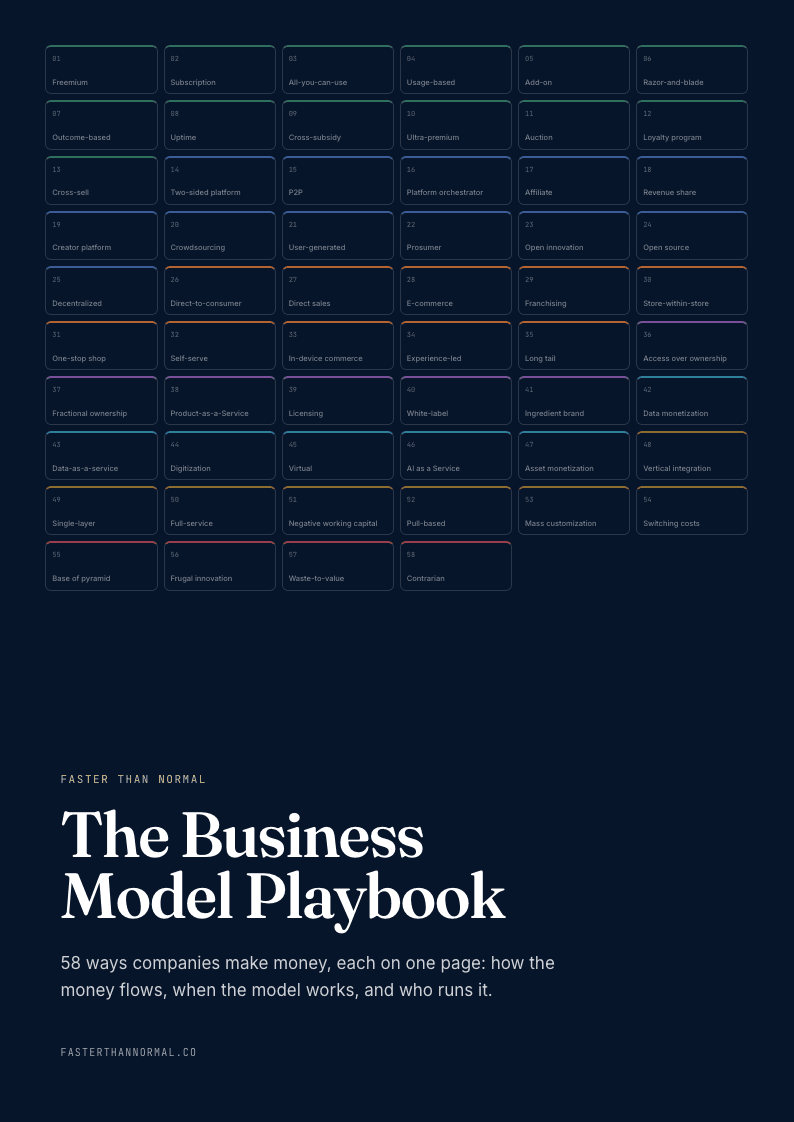
Get The Business Model Playbook
58 business models, one visual page each: how the money flows, the metrics that matter, and who runs it. Free when you join the Faster Than Normal email.
Free. No spam. Unsubscribe anytime.