

Contents
Book summary
The Price of Panic
by Jay W. Richards
The Core Premise
The economic devastation from COVID-19 lockdowns exceeded the virus's direct health impact by orders of magnitude, creating what Richards calls the "cure worse than the disease" paradox. Through meticulous analysis of mortality data, economic indicators, and policy outcomes, Richards demonstrates that fear-driven decision-making led to catastrophic policy errors that destroyed more lives than they saved. The book exposes how panic hijacked rational risk assessment, turning public health into a zero-sum game where any COVID death justified unlimited economic and social destruction.
Richards introduces the "Panic Cycle" — a four-stage process where initial fear triggers media amplification, political grandstanding, and institutional capture that makes rational course correction nearly impossible. He documents how Sweden's lighter-touch approach achieved similar health outcomes without the economic carnage, while places like Michigan and California created policy disasters through theatrical lockdowns that ignored basic cost-benefit analysis. The lockdown states didn't just fail to save significantly more lives; they created secondary health crises through delayed medical care, mental health deterioration, and educational collapse that will compound for decades.
The book's most damning insight centers on what Richards terms "Statistical Life Distortion" — the systematic overvaluing of prevented COVID deaths while ignoring deaths caused by lockdown policies. When economic disruption destroys livelihoods, it literally kills people through increased suicide, delayed cancer screenings, and reduced access to healthcare. Richards calculates that lockdowns likely caused more years of life lost than COVID itself when accounting for the age distribution of victims and the long-term consequences of economic devastation. A 30-year-old losing their business faces decades of reduced life expectancy, while the median COVID victim was already past average life expectancy.
Richards builds a framework called "Proportional Response Theory" that demands policy interventions match the actual risk profile rather than worst-case scenarios. He shows how targeted protection of vulnerable populations — nursing homes, immunocompromised individuals — could have achieved 80% of lockdowns' benefits at 10% of the cost. The book provides a devastating case study of nursing home policies in New York, where Governor Cuomo's mandates seeded infections into the most vulnerable populations while simultaneously destroying the broader economy. This wasn't just poor policy; it was precisely backwards.
The implications extend far beyond pandemic response into organizational crisis management and risk assessment. Richards demonstrates that leaders who succumb to panic invariably make suboptimal decisions because they optimize for the wrong variables — avoiding blame rather than maximizing outcomes. The book provides a framework for maintaining analytical clarity under pressure, emphasizing that the appearance of action often substitutes for effective action. For executives facing their own crisis moments, Richards offers tools for resisting panic-driven groupthink and maintaining focus on measurable outcomes rather than political theater.
WHAT JUST HAPPENED? The human cost of the emergency response to COVID-19 has far outweighed the benefits. That’s the sobering verdict of a trio of scholars—a biologist, a statistician, and a philosopher— in this comprehensive assessment of the worst panic-induced disaster in history. As the media fanned the flames of panic, government officials and a new elite of scientific experts ignored the established protocols for mitigating a dangerous disease. Instead, they shut down the world economy, closed every school, confined citizens to their homes, and threatened to enforce a regime of extreme social distancing indefinitely. And the American public—amazingly enough—complied without protest. Modestly but relentlessly focused on what we know and don’t know about the coronavirus, Douglas Axe, William M. Briggs, and Jay W. Richards demonstrate in this eye-opening study what real experts can contribute when a pandemic strikes. In the early spring of 2020, the panic of government officials, the hysteria of the media, and the hubris of suddenly powerful scientists produced a worldwide calamity. The Price of Panic is the essential book for understanding what happened and how to avoid repeati…
The Price of Panic by Jay W. Richards belongs on the short shelf of books that change how you notice decisions in the wild. Whether you agree with every claim or not, the frame it offers is portable: you can apply it in meetings, investing, hiring, and personal trade-offs without carrying the whole volume.
Many readers return to this book because it names patterns that felt familiar but unnamed. Naming is leverage: once you can point to a mechanism, you can design around it. One through-line is “The Panic Cycle: Richards identifies a four-stage process where initial fear creates media amplification, political grandstanding, and institutional capture that makes rational course correction nearl” and its implications for judgment under uncertainty.
If you are reading for execution, translate each chapter into a testable habit: one prompt before a big decision, one review question after a project, one constraint you will respect next quarter. Theory becomes useful when it shows up in calendars, not only in margins.
Finally, pair this book with opposing voices. The strongest readers stress-test the thesis against cases where the advice fails, note the boundary conditions, and keep a short list of when not to use this lens. That discipline is how summaries become judgment.
Long-form books reward spaced attention: read a chapter, sleep, then write a half-page memo titled “What would I do differently on Monday?” If you cannot answer with specifics, the idea has not yet landed.
Use The Price of Panic as a conversation starter with peers who have different incentives. The disagreements often reveal which parts of the book are robust and which are fragile when power, risk, and time horizons change.
Key Ideas and Arguments
The Panic Cycle: Richards identifies a four-stage process where initial fear creates media amplification, political grandstanding, and institutional capture that makes rational course correction nearly impossible. Once panic takes hold, admitting error becomes politically toxic, locking in destructive policies.. This idea shows up repeatedly in The Price of Panic: separate the definition from the examples, then ask where the author's evidence is strongest and where anecdotes do most of the work. Consider writing a counterexample: a situation where applying the idea literally would misfire, and what guardrail you would add.
Statistical Life Distortion: The systematic overvaluing of prevented deaths from the primary threat while ignoring deaths caused by the response itself. Lockdown policies prevented some COVID deaths while causing deaths through delayed medical care, increased suicide, and long-term economic devastation.. This idea shows up repeatedly in The Price of Panic: separate the definition from the examples, then ask where the author's evidence is strongest and where anecdotes do most of the work. Consider writing a counterexample: a situation where applying the idea literally would misfire, and what guardrail you would add.
Proportional Response Theory: Policy interventions should match the actual risk profile rather than worst-case scenarios. Targeted protection of truly vulnerable populations achieves most benefits at a fraction of the economic and social cost of broad lockdowns.. This idea shows up repeatedly in The Price of Panic: separate the definition from the examples, then ask where the author's evidence is strongest and where anecdotes do most of the work. Consider writing a counterexample: a situation where applying the idea literally would misfire, and what guardrail you would add.
Secondary Health Crisis: The cascade of health problems created by lockdown policies, including delayed cancer screenings, avoided emergency care, mental health deterioration, and educational disruption that compounds over decades.. This idea shows up repeatedly in The Price of Panic: separate the definition from the examples, then ask where the author's evidence is strongest and where anecdotes do most of the work. Consider writing a counterexample: a situation where applying the idea literally would misfire, and what guardrail you would add.
Age-Stratified Risk Assessment: COVID mortality was heavily concentrated among elderly populations with comorbidities, but lockdown policies treated all demographics as equally vulnerable, destroying young people's futures to marginally extend elderly lives.. This idea shows up repeatedly in The Price of Panic: separate the definition from the examples, then ask where the author's evidence is strongest and where anecdotes do most of the work. Consider writing a counterexample: a situation where applying the idea literally would misfire, and what guardrail you would add.
Economic Mortality Linkage: The documented relationship between economic disruption and mortality through mechanisms like reduced healthcare access, increased stress-related illness, and delayed medical interventions that kill people over longer time horizons.. This idea shows up repeatedly in The Price of Panic: separate the definition from the examples, then ask where the author's evidence is strongest and where anecdotes do most of the work. Consider writing a counterexample: a situation where applying the idea literally would misfire, and what guardrail you would add.
Policy Theater vs. Effective Action: The tendency for crisis responses to optimize for visible action rather than measurable outcomes, leading to destructive policies that feel decisive but accomplish little beyond political positioning.. This idea shows up repeatedly in The Price of Panic: separate the definition from the examples, then ask where the author's evidence is strongest and where anecdotes do most of the work. Consider writing a counterexample: a situation where applying the idea literally would misfire, and what guardrail you would add.
Deeper Themes and Context
The Price of Panic is not only a catalogue of claims; it is a stance on how to interpret success, failure, and ambiguity. Readers who engage charitably still ask: which recommendations are universal, which are culturally situated, and which require institutional support you do not have?
Comparing the book's prescriptions to your own context is part of the work. A strategy that assumes abundant capital, patient stakeholders, or long feedback loops will read differently if you are resource-constrained, early in a career, or operating under regulatory pressure. Translation beats transcription.
The book also invites you to notice what it does not say. Silences can be instructive: topics the author avoids, counterexamples that never appear, or metrics that are praised without definition. A serious reader keeps a missing-evidence note alongside a to-try note.
Historically, the most influential business and biography titles survive because they double as vocabulary. Teams that share a phrase from The Price of Panic move faster only when they also share a definition and a worked example, otherwise they talk past each other with the same words.
How to Apply the Lessons
Connected Mental Models
Who Should Read This
Start here if you want a serious, book-length argument rather than a thread of bullet points. The Price of Panic rewards readers who will sketch their own examples, argue back in the margins, and connect chapters to decisions they are facing this quarter.
It is also useful as a shared vocabulary for teams: a common chapter reference can shorten debate if everyone agrees what the term means in practice. If your team only shares the title, not the definition, expect confusion.
Skip or skim if you need a narrow tactical recipe with no theory; this summary preserves the ideas, but the book's value is often in the extended case material and the author's sequencing.
Analyst's Take
Test Yourself
Check your grasp of the book’s moves
A colleague quotes The Price of Panic to justify a risky decision. What should you verify first?
You finished The Price of Panic and want behaviour change this week.
Further Reading
Continue exploring


Free playbook
Get The Business Model Playbook
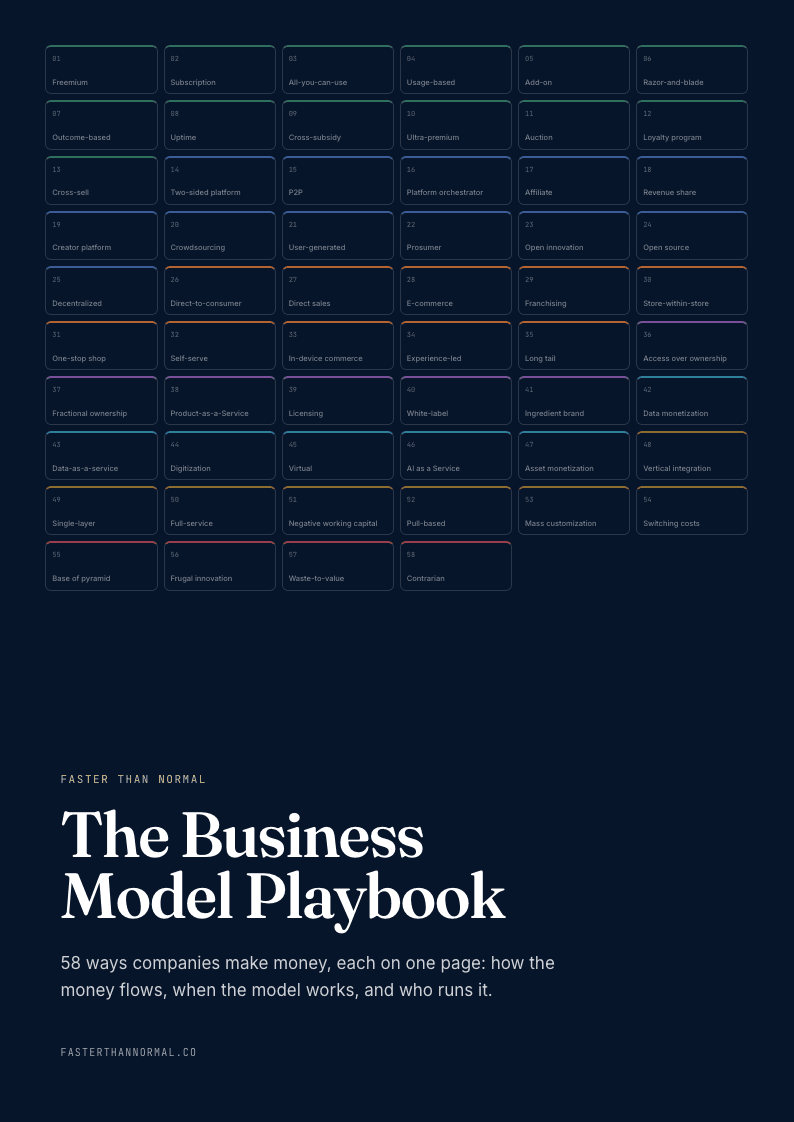
58 business models, one visual page each: how the money flows, the metrics that matter, and who runs it. Free when you join the Faster Than Normal email.
Free. No spam. Unsubscribe anytime.