
Contents
Book summary
The Nvidia Way: Jensen Huang and the Making of a Tech Giant
by Tae Kim
The Core Premise
Jensen Huang transformed a graphics card company into the world's most valuable semiconductor firm by betting everything on parallel computing when the rest of Silicon Valley dismissed it as a gaming curiosity. While competitors like Intel remained wedded to sequential processing power, Huang recognized that artificial intelligence would demand fundamentally different architecture—thousands of simple cores working simultaneously rather than a few complex ones working in sequence. This architectural insight, crystallized in Nvidia's CUDA platform, created a moat so deep that today's AI revolution runs almost exclusively on Nvidia silicon.
Huang's leadership philosophy centers on what Kim calls "productive paranoia"—the discipline of preparing for existential threats while the company appears to be thriving. When Nvidia faced near-bankruptcy in 2008, Huang didn't just cut costs; he doubled down on research and development, pouring resources into Tesla, the company's first general-purpose GPU architecture. This decision proved prescient when the deep learning boom arrived in 2012, triggered by Alex Krizhevsky's ImageNet breakthrough using Nvidia GPUs. While AMD and Intel scrambled to catch up, Nvidia already possessed the hardware and software ecosystem that machine learning researchers desperately needed.
The book reveals how Huang built what Kim terms the "CUDA moat"—a software platform so deeply integrated with AI research that switching costs became prohibitive. Unlike traditional semiconductor companies that simply manufactured chips, Nvidia created an entire programming environment that made their hardware indispensable. When Google's researchers achieved breakthrough results with convolutional neural networks, they did so using CUDA-enabled GPUs, not because Nvidia paid them, but because the software stack made parallel computation accessible to computer scientists rather than hardware engineers.
Kim demonstrates how Huang's "amplified leadership" model—his term for combining technical vision with operational discipline—enabled Nvidia to navigate multiple near-death experiences. The company survived the crypto crash of 2018 not through financial engineering but by maintaining focus on long-term architectural advantages. When cryptocurrency miners stopped buying GPUs overnight, Nvidia's data center business, built on the same parallel computing foundation, provided the revenue bridge to the AI explosion. This resilience stemmed from Huang's insistence on building platforms rather than products, creating multiple applications for the same core technology. The lesson for executives is clear: sustainable competitive advantage comes from architectural insights that compound over time, not incremental improvements to existing approaches.
"[L]oaded with fascinating details about Huang’s unusual leadership style and maniacal work habits." —Ben Cohen, Wall Street Journal "The definitive look at the most remarkable business story of this era." —Morgan Housel, New York Times best-selling author of The Psychology of Money and Same As Ever A deeply reported business history of the chip-designer Nvidia—from its founding in 1993 to its recent emergence as one of the most valuable corporations in the world—explaining how the company’s culture, overseen by cofounder and CEO Jensen Huang, has powered its incredible success. Nvidia is the darling of the age of artificial intelligence: its chips are powering the generative-AI revolution, and demand is insatiable. For all the current interest and attention, however, Nvidia is not of our time. Founded more than three decades ago in a Denny’s in East San Jose, for years it was known primarily in the then-niche world of computer gaming. In fact, the company’s leather-jacketed leader, Jensen Huang, is the longest-serving CEO in an industry marked by near constant turmoil and failure. In The Nvidia Way, acclaimed tech writer Tae Kim draws on more than one hundred interviews—including …
The Nvidia Way: Jensen Huang and the Making of a Tech Giant by Tae Kim belongs on the short shelf of books that change how you notice decisions in the wild. Whether you agree with every claim or not, the frame it offers is portable: you can apply it in meetings, investing, hiring, and personal trade-offs without carrying the whole volume.
Many readers return to this book because it names patterns that felt familiar but unnamed. Naming is leverage: once you can point to a mechanism, you can design around it. One through-line is “Productive Paranoia: Huang's practice of preparing for existential threats during periods of apparent success. This meant investing heavily in R&D during the 2008 financial crisis and diversifying bey” and its implications for judgment under uncertainty.
If you are reading for execution, translate each chapter into a testable habit: one prompt before a big decision, one review question after a project, one constraint you will respect next quarter. Theory becomes useful when it shows up in calendars, not only in margins.
Finally, pair this book with opposing voices. The strongest readers stress-test the thesis against cases where the advice fails, note the boundary conditions, and keep a short list of when not to use this lens. That discipline is how summaries become judgment.
Long-form books reward spaced attention: read a chapter, sleep, then write a half-page memo titled “What would I do differently on Monday?” If you cannot answer with specifics, the idea has not yet landed.
Use The Nvidia Way: Jensen Huang and the Making of a Tech Giant as a conversation starter with peers who have different incentives. The disagreements often reveal which parts of the book are robust and which are fragile when power, risk, and time horizons change.
Key Ideas and Arguments
Productive Paranoia: Huang's practice of preparing for existential threats during periods of apparent success. This meant investing heavily in R&D during the 2008 financial crisis and diversifying beyond gaming when crypto revenues collapsed, ensuring Nvidia survived multiple industry downturns.. This idea shows up repeatedly in The Nvidia Way: Jensen Huang and the Making of a Tech Giant: separate the definition from the examples, then ask where the author's evidence is strongest and where anecdotes do most of the work. Consider writing a counterexample: a situation where applying the idea literally would misfire, and what guardrail you would add.
CUDA Moat: The software platform that made Nvidia's parallel computing architecture accessible to researchers and developers. By creating programming tools rather than just hardware, Nvidia established switching costs that competitors couldn't easily overcome, even with superior chips.. This idea shows up repeatedly in The Nvidia Way: Jensen Huang and the Making of a Tech Giant: separate the definition from the examples, then ask where the author's evidence is strongest and where anecdotes do most of the work. Consider writing a counterexample: a situation where applying the idea literally would misfire, and what guardrail you would add.
Amplified Leadership: Kim's framework describing how Huang combines deep technical understanding with operational discipline. Unlike pure visionaries or pure operators, amplified leaders can both identify architectural shifts and execute the organizational changes necessary to capitalize on them.. This idea shows up repeatedly in The Nvidia Way: Jensen Huang and the Making of a Tech Giant: separate the definition from the examples, then ask where the author's evidence is strongest and where anecdotes do most of the work. Consider writing a counterexample: a situation where applying the idea literally would misfire, and what guardrail you would add.
Platform Thinking: Nvidia's strategy of building reusable computing foundations rather than single-purpose products. The same GPU architecture powers gaming, cryptocurrency mining, data centers, and autonomous vehicles, creating multiple revenue streams from shared R&D investments.. This idea shows up repeatedly in The Nvidia Way: Jensen Huang and the Making of a Tech Giant: separate the definition from the examples, then ask where the author's evidence is strongest and where anecdotes do most of the work. Consider writing a counterexample: a situation where applying the idea literally would misfire, and what guardrail you would add.
Architectural Insight: The recognition that AI would require fundamentally different computing approaches—parallel rather than sequential processing. This insight, developed years before the deep learning boom, positioned Nvidia as the essential infrastructure provider for the AI revolution.. This idea shows up repeatedly in The Nvidia Way: Jensen Huang and the Making of a Tech Giant: separate the definition from the examples, then ask where the author's evidence is strongest and where anecdotes do most of the work. Consider writing a counterexample: a situation where applying the idea literally would misfire, and what guardrail you would add.
Technical Debt Avoidance: Huang's insistence on rebuilding core architectures rather than incrementally improving existing designs. This approach, exemplified in the Tesla architecture overhaul, prevented the technical compromises that trapped competitors in outdated paradigms.. This idea shows up repeatedly in The Nvidia Way: Jensen Huang and the Making of a Tech Giant: separate the definition from the examples, then ask where the author's evidence is strongest and where anecdotes do most of the work. Consider writing a counterexample: a situation where applying the idea literally would misfire, and what guardrail you would add.
Deeper Themes and Context
The Nvidia Way: Jensen Huang and the Making of a Tech Giant is not only a catalogue of claims; it is a stance on how to interpret success, failure, and ambiguity. Readers who engage charitably still ask: which recommendations are universal, which are culturally situated, and which require institutional support you do not have?
Comparing the book's prescriptions to your own context is part of the work. A strategy that assumes abundant capital, patient stakeholders, or long feedback loops will read differently if you are resource-constrained, early in a career, or operating under regulatory pressure. Translation beats transcription.
The book also invites you to notice what it does not say. Silences can be instructive: topics the author avoids, counterexamples that never appear, or metrics that are praised without definition. A serious reader keeps a missing-evidence note alongside a to-try note.
Historically, the most influential business and biography titles survive because they double as vocabulary. Teams that share a phrase from The Nvidia Way: Jensen Huang and the Making of a Tech Giant move faster only when they also share a definition and a worked example, otherwise they talk past each other with the same words.
How to Apply the Lessons
Connected Mental Models
Who Should Read This
Start here if you want a serious, book-length argument rather than a thread of bullet points. The Nvidia Way: Jensen Huang and the Making of a Tech Giant rewards readers who will sketch their own examples, argue back in the margins, and connect chapters to decisions they are facing this quarter.
It is also useful as a shared vocabulary for teams: a common chapter reference can shorten debate if everyone agrees what the term means in practice. If your team only shares the title, not the definition, expect confusion.
Skip or skim if you need a narrow tactical recipe with no theory; this summary preserves the ideas, but the book's value is often in the extended case material and the author's sequencing.
Analyst's Take
Test Yourself
Check your grasp of the book’s moves
A colleague quotes The Nvidia Way: Jensen Huang and the Making of a Tech Giant to justify a risky decision. What should you verify first?
You finished The Nvidia Way: Jensen Huang and the Making of a Tech Giant and want behaviour change this week.
Further Reading
Featured in
Continue exploring


Free playbook
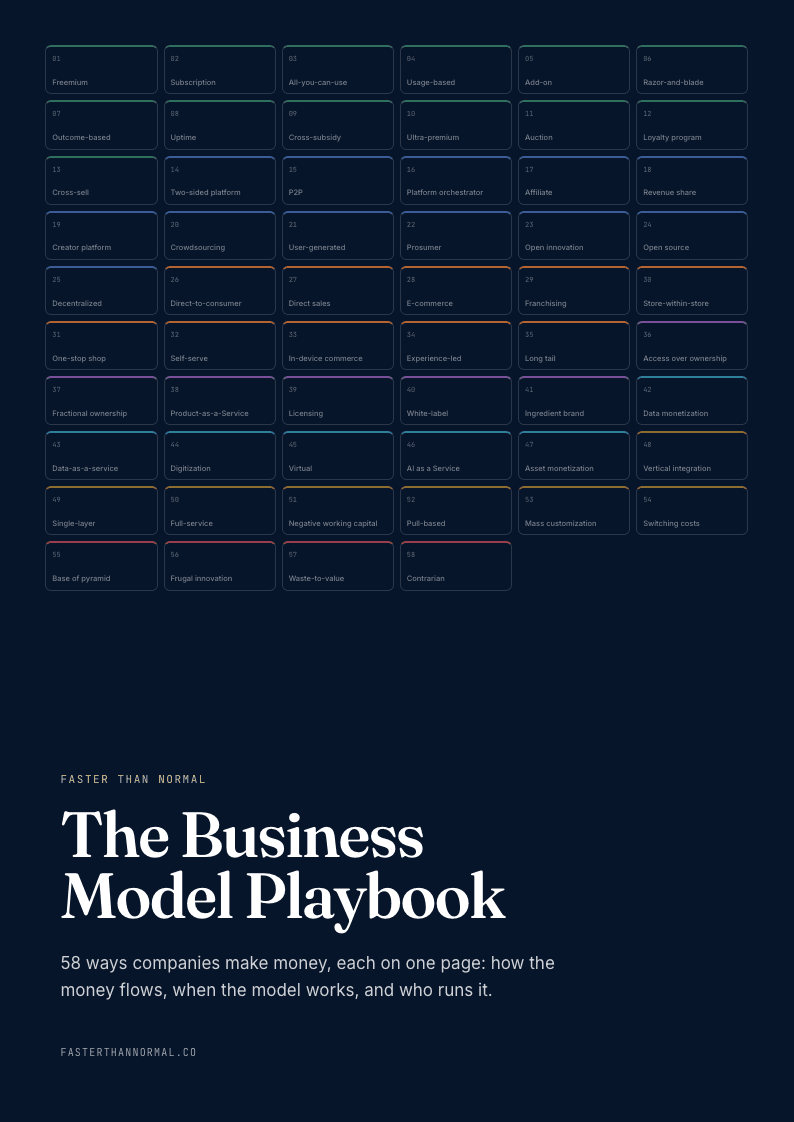
Get The Business Model Playbook
58 business models, one visual page each: how the money flows, the metrics that matter, and who runs it. Free when you join the Faster Than Normal email.
Free. No spam. Unsubscribe anytime.