

Contents
Book summary
The Fountainhead
by Ayn Rand
The Core Premise
Architecture becomes the battlefield for individualism versus conformity in Ayn Rand's philosophical manifesto disguised as a novel. Howard Roark, an uncompromising architect, refuses to design buildings that follow established conventions, choosing poverty and obscurity over compromise with collective mediocrity. His struggle against architectural committees, established firms, and public opinion reveals the fundamental tension between creating original value and satisfying market demand—a tension every founder faces when deciding whether to build what customers think they want or what they actually need.
Rand constructs her argument through four archetypal characters who represent different approaches to achievement and recognition. Roark embodies what she calls the "prime mover"—the creator who works from internal conviction rather than external validation. Peter Keating represents the "second-hander" who seeks success through social approval and imitation, climbing the career ladder at Francon & Heyer by designing derivative buildings that please committees but advance no new ideas. Ellsworth Toohey, the architecture critic, demonstrates how intellectuals can destroy innovation by promoting mediocrity as democratic virtue, systematically undermining exceptional work through appeals to equality and social responsibility. Gail Wynand, the newspaper publisher, shows how even powerful individuals can become slaves to public opinion when they prioritize influence over integrity.
The novel's central case study emerges through the Cortlandt Homes project, a public housing development that Roark agrees to design anonymously through Keating. When the project is built with modifications that destroy his architectural vision, Roark dynamites the building rather than allow his work to be corrupted. His subsequent trial becomes a platform for Rand's core thesis: that society progresses only through individuals who refuse to subordinate their judgment to collective opinion. Roark's defense speech articulates what Rand calls "rational selfishness"—the principle that creators serve humanity best by remaining true to their own vision rather than trying to please everyone.
The Fountainhead's relevance to business leadership lies not in its political philosophy but in its analysis of how original thinking gets diluted by committee decisions and market research. Roark's approach parallels that of breakthrough entrepreneurs who ignore focus groups and build products that customers don't know they want yet. Steve Jobs famously echoed Roark's philosophy when he said that customers don't know what they want until you show them. The novel demonstrates how the pressure to conform—whether to architectural traditions or market expectations—systematically eliminates the innovations that create new categories and define new standards. For executives, the book offers a framework for recognizing when consensus represents wisdom versus when it represents the lowest common denominator of ambition.
The story of a gifted architect, his struggle against conventional standards, and his violent love affair.
The Fountainhead by Ayn Rand belongs on the short shelf of books that change how you notice decisions in the wild. Whether you agree with every claim or not, the frame it offers is portable: you can apply it in meetings, investing, hiring, and personal trade-offs without carrying the whole volume.
Many readers return to this book because it names patterns that felt familiar but unnamed. Naming is leverage: once you can point to a mechanism, you can design around it. One through-line is “The Prime Mover: Rand's term for individuals who create original value through independent thinking rather than following established patterns. Prime movers like Howard Roark work from internal convic” and its implications for judgment under uncertainty.
If you are reading for execution, translate each chapter into a testable habit: one prompt before a big decision, one review question after a project, one constraint you will respect next quarter. Theory becomes useful when it shows up in calendars, not only in margins.
Finally, pair this book with opposing voices. The strongest readers stress-test the thesis against cases where the advice fails, note the boundary conditions, and keep a short list of when not to use this lens. That discipline is how summaries become judgment.
Long-form books reward spaced attention: read a chapter, sleep, then write a half-page memo titled “What would I do differently on Monday?” If you cannot answer with specifics, the idea has not yet landed.
Use The Fountainhead as a conversation starter with peers who have different incentives. The disagreements often reveal which parts of the book are robust and which are fragile when power, risk, and time horizons change.
Key Ideas and Arguments
The Prime Mover: Rand's term for individuals who create original value through independent thinking rather than following established patterns. Prime movers like Howard Roark work from internal conviction, generating innovations that initially appear unmarketable but eventually reshape entire industries.. This idea shows up repeatedly in The Fountainhead: separate the definition from the examples, then ask where the author's evidence is strongest and where anecdotes do most of the work. Consider writing a counterexample: a situation where applying the idea literally would misfire, and what guardrail you would add.
Second-Hander Mentality: The psychological pattern of deriving self-worth from others' approval rather than objective achievement. Peter Keating exemplifies this by choosing popular architectural styles over innovative design, ultimately achieving conventional success while producing nothing of lasting value.. This idea shows up repeatedly in The Fountainhead: separate the definition from the examples, then ask where the author's evidence is strongest and where anecdotes do most of the work. Consider writing a counterexample: a situation where applying the idea literally would misfire, and what guardrail you would add.
Rational Selfishness: Rand's philosophy that individuals serve society best by pursuing their own rational judgment rather than sacrificing their vision for collective approval. This doesn't mean ignoring others, but rather maintaining intellectual integrity when creating value.. This idea shows up repeatedly in The Fountainhead: separate the definition from the examples, then ask where the author's evidence is strongest and where anecdotes do most of the work. Consider writing a counterexample: a situation where applying the idea literally would misfire, and what guardrail you would add.
The Altruist-Collectivist Trap: Toohey's strategy of convincing talented individuals to subordinate their abilities to social causes, effectively neutralizing innovation by making creators feel guilty for excellence. Modern equivalent: talented founders diluting their vision to satisfy every stakeholder's input.. This idea shows up repeatedly in The Fountainhead: separate the definition from the examples, then ask where the author's evidence is strongest and where anecdotes do most of the work. Consider writing a counterexample: a situation where applying the idea literally would misfire, and what guardrail you would add.
Architectural Integrity as Business Principle: Roark's refusal to compromise his designs parallels the business decision to maintain product vision despite market pressure. His buildings succeed because they solve problems in new ways, not because they follow popular conventions.. This idea shows up repeatedly in The Fountainhead: separate the definition from the examples, then ask where the author's evidence is strongest and where anecdotes do most of the work. Consider writing a counterexample: a situation where applying the idea literally would misfire, and what guardrail you would add.
The Parasitic Elite: Rand's observation that some successful people achieve status by manipulating others' productivity rather than creating value themselves. Toohey gains influence by positioning himself as arbiter of architectural taste without ever designing buildings.. This idea shows up repeatedly in The Fountainhead: separate the definition from the examples, then ask where the author's evidence is strongest and where anecdotes do most of the work. Consider writing a counterexample: a situation where applying the idea literally would misfire, and what guardrail you would add.
Deeper Themes and Context
The Fountainhead is not only a catalogue of claims; it is a stance on how to interpret success, failure, and ambiguity. Readers who engage charitably still ask: which recommendations are universal, which are culturally situated, and which require institutional support you do not have?
Comparing the book's prescriptions to your own context is part of the work. A strategy that assumes abundant capital, patient stakeholders, or long feedback loops will read differently if you are resource-constrained, early in a career, or operating under regulatory pressure. Translation beats transcription.
The book also invites you to notice what it does not say. Silences can be instructive: topics the author avoids, counterexamples that never appear, or metrics that are praised without definition. A serious reader keeps a missing-evidence note alongside a to-try note.
Historically, the most influential business and biography titles survive because they double as vocabulary. Teams that share a phrase from The Fountainhead move faster only when they also share a definition and a worked example, otherwise they talk past each other with the same words.
How to Apply the Lessons
Connected Mental Models
Who Should Read This
Start here if you want a serious, book-length argument rather than a thread of bullet points. The Fountainhead rewards readers who will sketch their own examples, argue back in the margins, and connect chapters to decisions they are facing this quarter.
It is also useful as a shared vocabulary for teams: a common chapter reference can shorten debate if everyone agrees what the term means in practice. If your team only shares the title, not the definition, expect confusion.
Skip or skim if you need a narrow tactical recipe with no theory; this summary preserves the ideas, but the book's value is often in the extended case material and the author's sequencing.
Analyst's Take
Test Yourself
Check your grasp of the book’s moves
A colleague quotes The Fountainhead to justify a risky decision. What should you verify first?
You finished The Fountainhead and want behaviour change this week.
Further Reading
Continue exploring


Free playbook
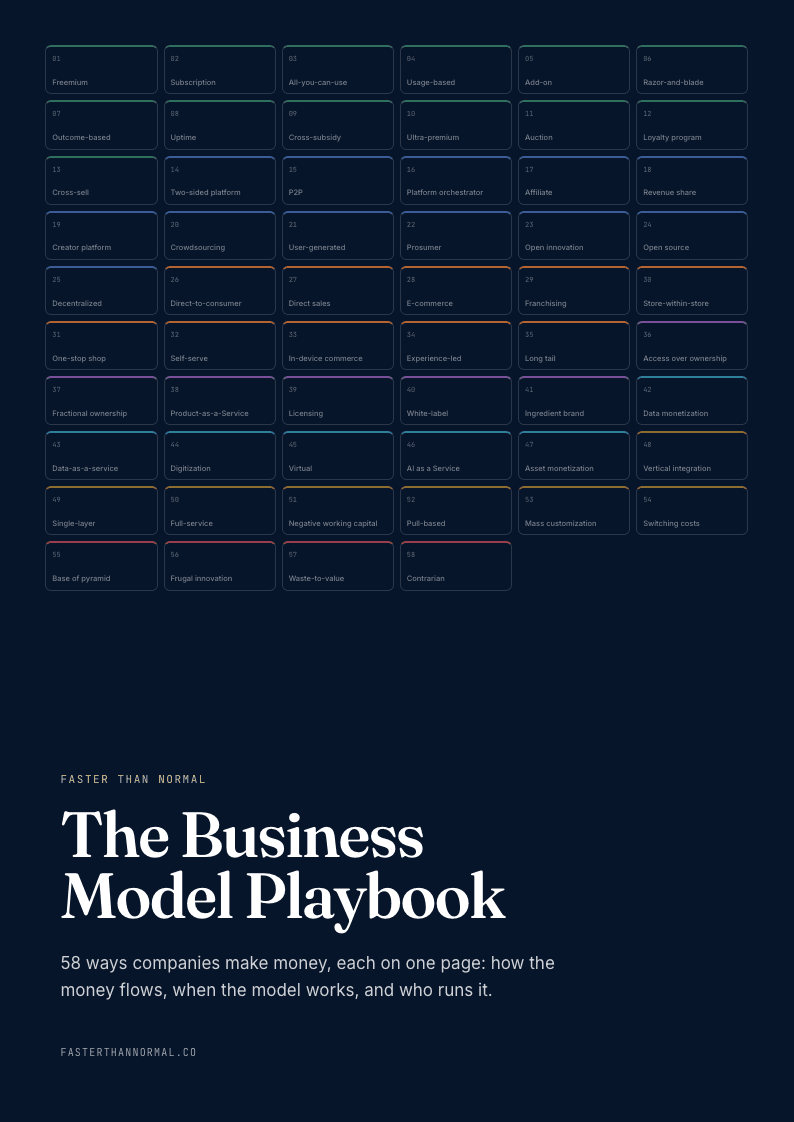
Get The Business Model Playbook
58 business models, one visual page each: how the money flows, the metrics that matter, and who runs it. Free when you join the Faster Than Normal email.
Free. No spam. Unsubscribe anytime.