

Contents
Book summary
The Fords: An American Epic
by Peter Collier
The Core Premise
Henry Ford's revolutionary assembly line didn't just transform manufacturing—it created the template for how American dynasties destroy themselves through successive generations of entitlement, paranoia, and the gradual erosion of founding genius. Peter Collier's masterwork reveals that the Ford family's century-long saga represents the quintessential American business tragedy: a company built by one man's obsessive vision, nearly destroyed by his pathological need for control, and then locked in endless cycles of revival and decay as heirs struggled with the impossible burden of inherited greatness.
The first Henry Ford embodied what Collier calls the "Founder's Paradox"—the same traits that build empires inevitably corrupt them. Ford's genius lay in his systematic approach to mass production and his intuitive understanding of market psychology, but his anti-Semitic crusades, union-busting violence, and megalomaniacal rejection of the Model A nearly bankrupted the company by 1945. His son Edsel, groomed for leadership but systematically undermined at every turn, died at 49 from what company insiders called "Henry Ford disease"—the slow psychological destruction that comes from being perpetually second-guessed by a tyrant. Ford's treatment of Edsel reveals Collier's central insight about family businesses: founders often unconsciously sabotage their successors because relinquishing control feels like admitting mortality.
Henry Ford II's takeover in 1945 demonstrates what Collier terms "Crisis Leadership"—the phenomenon where third-generation heirs often prove more capable than their parents because they inherit disasters rather than success. Henry II fired his grandfather's cronies, hired the "Whiz Kids" including Robert McNamara, and rebuilt Ford into a modern corporation. Yet even his successes carried the seeds of future dysfunction. His decision-making framework relied heavily on personal relationships and intuition rather than systematic processes, creating a culture where everything depended on the CEO's mood and attention. When Henry II recruited Lee Iacocca, their partnership initially flourished, but Henry II's paranoia about being overshadowed led him to fire Iacocca at his peak—a decision that handed Chrysler its greatest asset while revealing the deep insecurity that plagued even successful Ford leaders.
The book's most devastating insight concerns what Collier calls "Legacy Inversion"—the way family businesses gradually prioritize preserving the past over creating the future. By the 1970s, Ford's board meetings had become elaborate rituals where Henry II's whims trumped market data, and family members advanced based on bloodline rather than competence. The company's response to Japanese competition proved catastrophic precisely because it required the kind of systematic, ego-free analysis that family dynasties struggle to achieve. When Henry II finally stepped down, he left behind a company culturally incapable of the disciplined execution that had originally made Ford great. Collier's chronicle offers executives a brutal education in how founder-led advantages transform into structural weaknesses, and why the very qualities that build business empires—obsessive control, personal charisma, family loyalty—become organizational cancer when institutionalized across generations.
Reveals the story of three generations of Fords, from Henry I, the mechanical wizard of the automobile and son Henry II, who saved the company from financial ruin and from Lee Iacocca.
The Fords: An American Epic by Peter Collier belongs on the short shelf of books that change how you notice decisions in the wild. Whether you agree with every claim or not, the frame it offers is portable: you can apply it in meetings, investing, hiring, and personal trade-offs without carrying the whole volume.
Many readers return to this book because it names patterns that felt familiar but unnamed. Naming is leverage: once you can point to a mechanism, you can design around it. One through-line is “Founder's Paradox: The same psychological traits that enable entrepreneurs to build great companies—obsessive control, rejection of conventional wisdom, paranoid attention to threats—become destructiv” and its implications for judgment under uncertainty.
If you are reading for execution, translate each chapter into a testable habit: one prompt before a big decision, one review question after a project, one constraint you will respect next quarter. Theory becomes useful when it shows up in calendars, not only in margins.
Finally, pair this book with opposing voices. The strongest readers stress-test the thesis against cases where the advice fails, note the boundary conditions, and keep a short list of when not to use this lens. That discipline is how summaries become judgment.
Long-form books reward spaced attention: read a chapter, sleep, then write a half-page memo titled “What would I do differently on Monday?” If you cannot answer with specifics, the idea has not yet landed.
Use The Fords: An American Epic as a conversation starter with peers who have different incentives. The disagreements often reveal which parts of the book are robust and which are fragile when power, risk, and time horizons change.
Key Ideas and Arguments
Founder's Paradox: The same psychological traits that enable entrepreneurs to build great companies—obsessive control, rejection of conventional wisdom, paranoid attention to threats—become destructive when those founders refuse to evolve. Henry Ford's genius in revolutionizing manufacturing was inseparable from his inability to delegate or accept criticism, ultimately nearly destroying the company he created.. This idea shows up repeatedly in The Fords: An American Epic: separate the definition from the examples, then ask where the author's evidence is strongest and where anecdotes do most of the work. Consider writing a counterexample: a situation where applying the idea literally would misfire, and what guardrail you would add.
Henry Ford Disease: The psychological deterioration that occurs when capable heirs are systematically undermined by controlling founders. Edsel Ford's early death exemplified how being groomed for leadership while being denied real authority creates a toxic dynamic that destroys both individuals and institutional knowledge.. This idea shows up repeatedly in The Fords: An American Epic: separate the definition from the examples, then ask where the author's evidence is strongest and where anecdotes do most of the work. Consider writing a counterexample: a situation where applying the idea literally would misfire, and what guardrail you would add.
Crisis Leadership: Third-generation family business leaders often outperform their parents because they inherit disasters that require dramatic action rather than gradual improvement. Henry Ford II's success came from having the authority to completely restructure a failing company rather than manage an ongoing success.. This idea shows up repeatedly in The Fords: An American Epic: separate the definition from the examples, then ask where the author's evidence is strongest and where anecdotes do most of the work. Consider writing a counterexample: a situation where applying the idea literally would misfire, and what guardrail you would add.
Legacy Inversion: The gradual transformation of family businesses from growth-oriented enterprises into preservation societies focused on maintaining past glory rather than creating future value. Ford's cultural shift from innovation leader to follower occurred as family dynamics began trumping business logic.. This idea shows up repeatedly in The Fords: An American Epic: separate the definition from the examples, then ask where the author's evidence is strongest and where anecdotes do most of the work. Consider writing a counterexample: a situation where applying the idea literally would misfire, and what guardrail you would add.
Institutional Charisma Dependency: When companies become overly reliant on the personal magnetism and decision-making style of individual leaders rather than developing systematic processes. Ford's success under Henry II masked the reality that the company lacked the organizational capabilities to function effectively without his direct involvement.. This idea shows up repeatedly in The Fords: An American Epic: separate the definition from the examples, then ask where the author's evidence is strongest and where anecdotes do most of the work. Consider writing a counterexample: a situation where applying the idea literally would misfire, and what guardrail you would add.
Succession Sabotage: The unconscious ways that founders and family leaders undermine their chosen successors, often because transferring real power feels like acknowledging mortality. The pattern of building up heirs while simultaneously denying them the authority needed to succeed creates a cycle of disappointment and organizational dysfunction.. This idea shows up repeatedly in The Fords: An American Epic: separate the definition from the examples, then ask where the author's evidence is strongest and where anecdotes do most of the work. Consider writing a counterexample: a situation where applying the idea literally would misfire, and what guardrail you would add.
Deeper Themes and Context
The Fords: An American Epic is not only a catalogue of claims; it is a stance on how to interpret success, failure, and ambiguity. Readers who engage charitably still ask: which recommendations are universal, which are culturally situated, and which require institutional support you do not have?
Comparing the book's prescriptions to your own context is part of the work. A strategy that assumes abundant capital, patient stakeholders, or long feedback loops will read differently if you are resource-constrained, early in a career, or operating under regulatory pressure. Translation beats transcription.
The book also invites you to notice what it does not say. Silences can be instructive: topics the author avoids, counterexamples that never appear, or metrics that are praised without definition. A serious reader keeps a missing-evidence note alongside a to-try note.
Historically, the most influential business and biography titles survive because they double as vocabulary. Teams that share a phrase from The Fords: An American Epic move faster only when they also share a definition and a worked example, otherwise they talk past each other with the same words.
How to Apply the Lessons
Connected Mental Models
Who Should Read This
Start here if you want a serious, book-length argument rather than a thread of bullet points. The Fords: An American Epic rewards readers who will sketch their own examples, argue back in the margins, and connect chapters to decisions they are facing this quarter.
It is also useful as a shared vocabulary for teams: a common chapter reference can shorten debate if everyone agrees what the term means in practice. If your team only shares the title, not the definition, expect confusion.
Skip or skim if you need a narrow tactical recipe with no theory; this summary preserves the ideas, but the book's value is often in the extended case material and the author's sequencing.
Analyst's Take
Test Yourself
Check your grasp of the book’s moves
A colleague quotes The Fords: An American Epic to justify a risky decision. What should you verify first?
You finished The Fords: An American Epic and want behaviour change this week.
Further Reading
Continue exploring


Free playbook
Get The Business Model Playbook
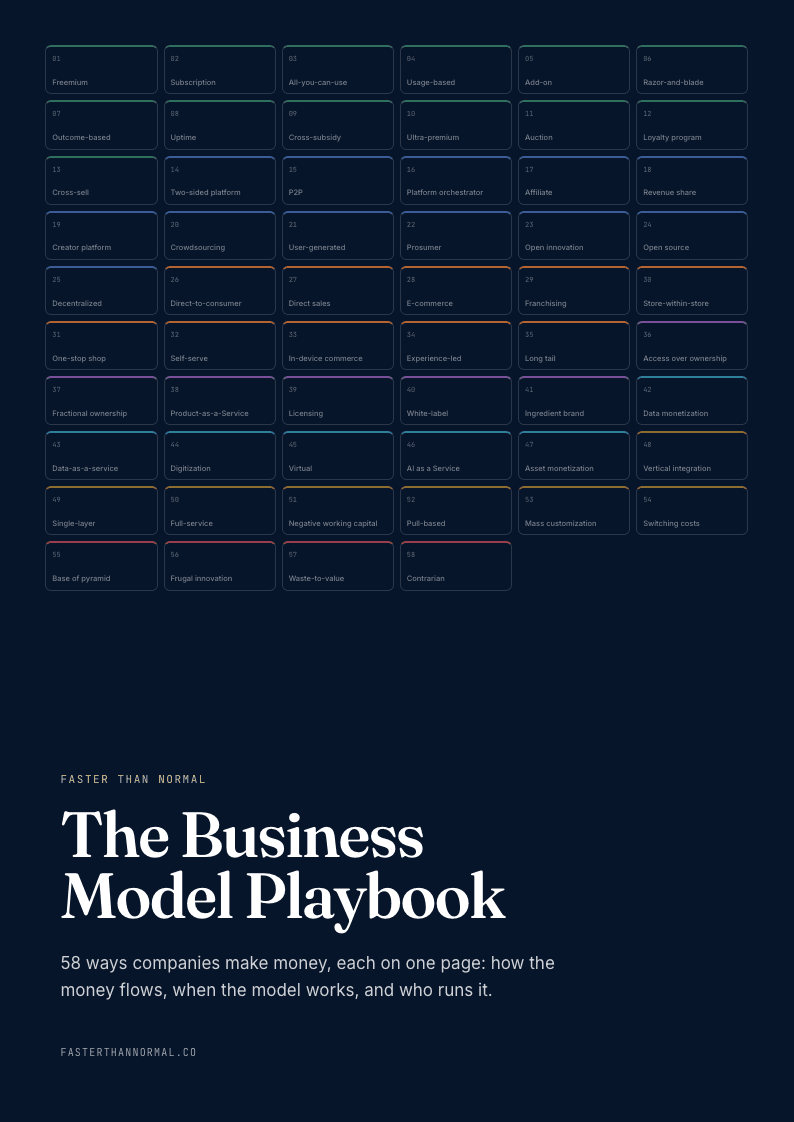
58 business models, one visual page each: how the money flows, the metrics that matter, and who runs it. Free when you join the Faster Than Normal email.
Free. No spam. Unsubscribe anytime.