

Contents
Book summary
The Billionaire and the Mechanic
by Julian Guthrie
The Core Premise
Larry Ellison, Oracle's billionaire founder, spent $13 million of his own money to fund America's Cup sailing not for glory, but to prove that relentless systematic improvement could defeat entrenched institutional advantages. Guthrie reveals how Ellison's partnership with a blue-collar boat mechanic named Norbert Bajurin created the most unlikely championship team in sailing history, demolishing the notion that elite competition requires elite pedigree.
The Oracle sailing team's victory demonstrates what Guthrie calls the "Outsider's Advantage" — the systematic methodology that transforms perceived disadvantages into competitive weapons. While the established sailing teams relied on tradition and incremental improvements, Ellison applied Silicon Valley's ruthless iteration cycles to boat design and team performance. He hired aerospace engineers instead of traditional boat builders, used computational fluid dynamics instead of intuition, and created a feedback loop system that compressed decades of sailing evolution into months of concentrated development. The team didn't just build faster boats; they built a faster learning system.
Bajurin's mechanical expertise proved equally crucial through what Guthrie identifies as "Ground Truth Thinking" — the practice of validating every assumption through direct, hands-on testing rather than theoretical models. When Oracle's high-tech catamaran kept breaking down during practice runs, Bajurin's old-school troubleshooting methodology saved the campaign. He insisted on stress-testing every component beyond its theoretical limits, discovering failure points that computer models had missed. This combination of Ellison's systematic resource deployment and Bajurin's empirical validation created an unstoppable competitive engine.
The book's central framework, the "Resource-Iteration Loop," shows how unlimited capital becomes worthless without disciplined learning cycles, while disciplined learning cycles become transformative when properly funded. Ellison didn't just outspend his competitors — he out-learned them by creating more feedback loops, faster iteration cycles, and better measurement systems. This principle extends far beyond sailing: founders who combine sufficient resources with systematic experimentation consistently defeat better-funded competitors who rely on conventional wisdom and incremental improvement.
Executives can apply Oracle's sailing methodology to any competitive landscape by implementing Guthrie's "Systematic Disruption Framework" — identify the industry's sacred assumptions, deploy resources to test alternatives rapidly, and scale only the approaches that survive empirical validation. The billionaire-mechanic partnership proves that elite performance emerges not from perfect planning but from superior adaptation speed.
Expanded to include the behind-the-scenes story of the 34th America’s Cup and Team USA’s incredible comeback Down eight-to-one in the 34th America’s Cup in September 2013, Oracle Team USA pulled off a comeback for the ages, with eight straight wins against Emirates Team New Zealand. Julian Guthrie’s The Billionaire and the Mechanic tells the incredible story of how a car mechanic and one of the world’s richest men teamed up to win the world’s greatest race. With a lengthy new section on the 34th America’s Cup, Guthrie also shows how they did it again. The America’s Cup, first awarded in 1851, is the oldest trophy in international sports. In 2000, Larry Ellison, co-founder and billionaire CEO of Oracle Corporation, decided to run for the prize and found an unlikely partner in Norbert Bajurin, a car mechanic and Commodore of the blue-collar Golden Gate Yacht Club. After unsuccessful runs for the Cup in 2003 and 2007, they won for the first time in 2010. With unparalleled access to Ellison and his team, Guthrie takes readers inside the building process of these astonishing boats and the lives of the athletes who race them and throws readers into exhilarating races from Australia to Va…
The Billionaire and the Mechanic by Julian Guthrie belongs on the short shelf of books that change how you notice decisions in the wild. Whether you agree with every claim or not, the frame it offers is portable: you can apply it in meetings, investing, hiring, and personal trade-offs without carrying the whole volume.
Many readers return to this book because it names patterns that felt familiar but unnamed. Naming is leverage: once you can point to a mechanism, you can design around it. One through-line is “Outsider's Advantage: The systematic methodology that transforms lack of industry experience into competitive advantage by questioning fundamental assumptions that insiders never challenge. Oracle's s” and its implications for judgment under uncertainty.
If you are reading for execution, translate each chapter into a testable habit: one prompt before a big decision, one review question after a project, one constraint you will respect next quarter. Theory becomes useful when it shows up in calendars, not only in margins.
Finally, pair this book with opposing voices. The strongest readers stress-test the thesis against cases where the advice fails, note the boundary conditions, and keep a short list of when not to use this lens. That discipline is how summaries become judgment.
Long-form books reward spaced attention: read a chapter, sleep, then write a half-page memo titled “What would I do differently on Monday?” If you cannot answer with specifics, the idea has not yet landed.
Use The Billionaire and the Mechanic as a conversation starter with peers who have different incentives. The disagreements often reveal which parts of the book are robust and which are fragile when power, risk, and time horizons change.
Key Ideas and Arguments
Outsider's Advantage: The systematic methodology that transforms lack of industry experience into competitive advantage by questioning fundamental assumptions that insiders never challenge. Oracle's sailing team hired aerospace engineers who redesigned boat hulls using computational fluid dynamics, achieving breakthroughs that traditional boat builders considered impossible.. This idea shows up repeatedly in The Billionaire and the Mechanic: separate the definition from the examples, then ask where the author's evidence is strongest and where anecdotes do most of the work. Consider writing a counterexample: a situation where applying the idea literally would misfire, and what guardrail you would add.
Ground Truth Thinking: The practice of validating every theoretical model through direct, hands-on testing under real-world conditions. Bajurin's insistence on stress-testing boat components beyond their computer-modeled limits revealed failure points that saved Oracle's campaign from catastrophic breakdowns during actual races.. This idea shows up repeatedly in The Billionaire and the Mechanic: separate the definition from the examples, then ask where the author's evidence is strongest and where anecdotes do most of the work. Consider writing a counterexample: a situation where applying the idea literally would misfire, and what guardrail you would add.
Resource-Iteration Loop: The framework combining unlimited resources with disciplined learning cycles to achieve systematic competitive advantage. Ellison funded hundreds of design iterations and practice runs, creating more learning opportunities than competitors who relied on traditional once-per-season boat modifications.. This idea shows up repeatedly in The Billionaire and the Mechanic: separate the definition from the examples, then ask where the author's evidence is strongest and where anecdotes do most of the work. Consider writing a counterexample: a situation where applying the idea literally would misfire, and what guardrail you would add.
Systematic Disruption Framework: The methodology for entering established industries by identifying sacred assumptions, rapidly testing alternatives, and scaling only empirically validated approaches. Oracle disrupted sailing by treating boat design as a software problem requiring continuous iteration rather than annual upgrades.. This idea shows up repeatedly in The Billionaire and the Mechanic: separate the definition from the examples, then ask where the author's evidence is strongest and where anecdotes do most of the work. Consider writing a counterexample: a situation where applying the idea literally would misfire, and what guardrail you would add.
Elite Performance Paradox: The counterintuitive principle that superior results emerge from adaptation speed rather than perfect initial planning. Oracle's team won by building better learning systems, not better initial boats, proving that systematic improvement beats static excellence.. This idea shows up repeatedly in The Billionaire and the Mechanic: separate the definition from the examples, then ask where the author's evidence is strongest and where anecdotes do most of the work. Consider writing a counterexample: a situation where applying the idea literally would misfire, and what guardrail you would add.
Deeper Themes and Context
The Billionaire and the Mechanic is not only a catalogue of claims; it is a stance on how to interpret success, failure, and ambiguity. Readers who engage charitably still ask: which recommendations are universal, which are culturally situated, and which require institutional support you do not have?
Comparing the book's prescriptions to your own context is part of the work. A strategy that assumes abundant capital, patient stakeholders, or long feedback loops will read differently if you are resource-constrained, early in a career, or operating under regulatory pressure. Translation beats transcription.
The book also invites you to notice what it does not say. Silences can be instructive: topics the author avoids, counterexamples that never appear, or metrics that are praised without definition. A serious reader keeps a missing-evidence note alongside a to-try note.
Historically, the most influential business and biography titles survive because they double as vocabulary. Teams that share a phrase from The Billionaire and the Mechanic move faster only when they also share a definition and a worked example, otherwise they talk past each other with the same words.
How to Apply the Lessons
Connected Mental Models
Who Should Read This
Start here if you want a serious, book-length argument rather than a thread of bullet points. The Billionaire and the Mechanic rewards readers who will sketch their own examples, argue back in the margins, and connect chapters to decisions they are facing this quarter.
It is also useful as a shared vocabulary for teams: a common chapter reference can shorten debate if everyone agrees what the term means in practice. If your team only shares the title, not the definition, expect confusion.
Skip or skim if you need a narrow tactical recipe with no theory; this summary preserves the ideas, but the book's value is often in the extended case material and the author's sequencing.
Analyst's Take
Test Yourself
Check your grasp of the book’s moves
A colleague quotes The Billionaire and the Mechanic to justify a risky decision. What should you verify first?
You finished The Billionaire and the Mechanic and want behaviour change this week.
Further Reading
Continue exploring


Free playbook
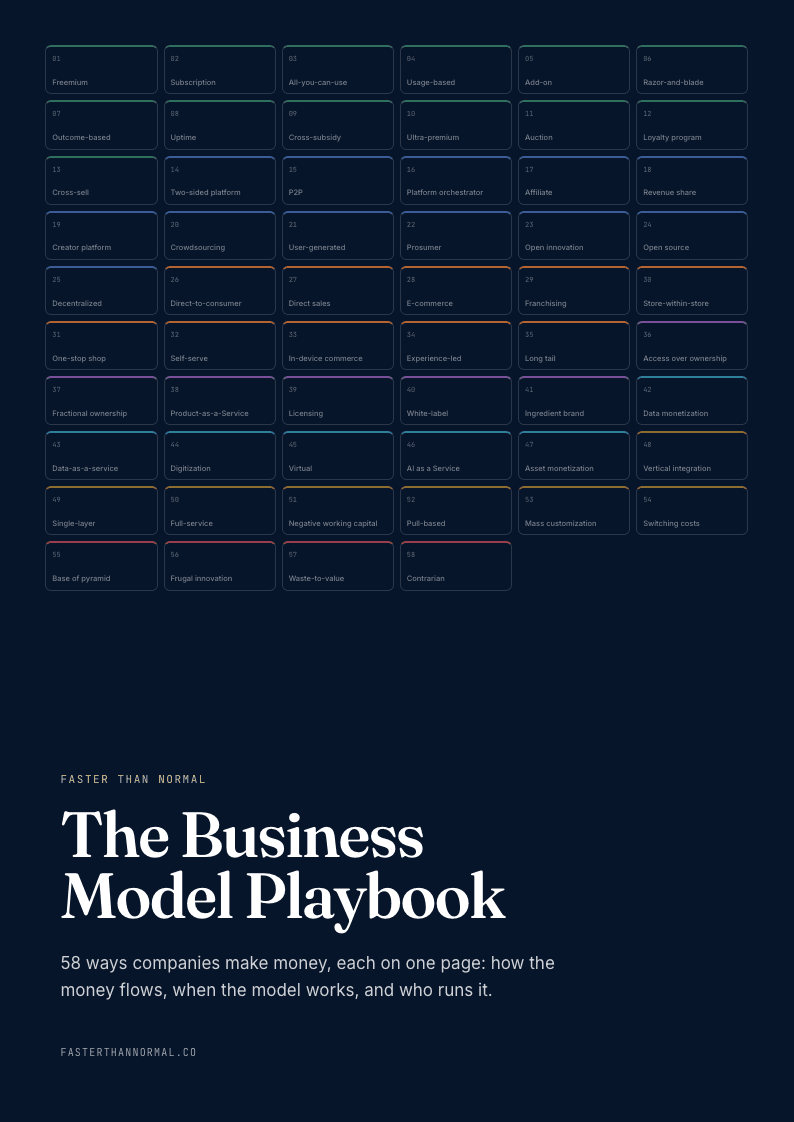
Get The Business Model Playbook
58 business models, one visual page each: how the money flows, the metrics that matter, and who runs it. Free when you join the Faster Than Normal email.
Free. No spam. Unsubscribe anytime.