
Contents
Book summary
The Art of War
by Sun Tzu
The Core Premise
Victory belongs to those who win without fighting. Sun Tzu's ancient Chinese military treatise reveals that the highest form of warfare is defeating enemies through superior positioning, intelligence, and psychological pressure rather than direct confrontation. This principle transforms how modern leaders approach competition, negotiation, and strategic decision-making across every domain from Silicon Valley boardrooms to geopolitical chess matches.
Sun Tzu built his strategic philosophy around five fundamental factors that determine victory: the Way (moral authority and unified purpose), Heaven (timing and external conditions), Earth (terrain and positioning), Command (leadership capabilities), and Method (organization and logistics). His doctrine of knowing yourself and knowing your enemy creates an information advantage that renders physical conflict unnecessary. When Mao Zedong applied Sun Tzu's principles during the Chinese Civil War, he avoided direct battles against the better-equipped Nationalist forces, instead using mobility, local support, and strategic retreats to gradually erode enemy strength until victory became inevitable. Similarly, Southwest Airlines defeated larger carriers not through price wars but by redefining the competitive terrain entirely—choosing secondary airports, standardizing aircraft, and creating operational advantages that competitors couldn't easily replicate.
The concept of "winning all under heaven without fighting" translates directly into business strategy through what Sun Tzu calls the supreme excellence of breaking the enemy's resistance without fighting. Netflix exemplified this approach when it shifted from DVD-by-mail to streaming, making Blockbuster's physical infrastructure a liability rather than an asset. Rather than compete on Blockbuster's terms, Netflix changed the rules of engagement entirely. Sun Tzu's emphasis on speed—"rapidity is the essence of war"—explains why first-mover advantages compound and why hesitation kills strategic opportunities.
Sun Tzu's intelligence-gathering principles create frameworks for modern competitive analysis and market research. His concept of using local guides and native sources parallels how successful companies embed themselves in customer communities and industry networks to gain informational advantages. The principle of "attacking plans" means disrupting competitors' strategies before they can execute, which explains why companies like Amazon announce initiatives early to shape market expectations and force competitors into reactive positions. His warning against prolonged campaigns—"no country has ever benefited from protracted warfare"—applies directly to startup burn rates and the danger of getting trapped in unsustainable competitive dynamics.
The Definitive Translation with Over Two Million Copies Sold From esteemed translator Thomas Cleary and including commentary from philosophers such as Cao Cao, Du Mu, and Du You, this timeless Chinese classic captures the essence of military strategy used in ancient East Asia, with lessons on how to handle conflict confidently, efficiently, and successfully. As Sun Tzu teaches, aggression and response in kind can lead only to destruction—we must learn to work with conflict in a more profound and effective way. Crucial to this strategic vision is knowledge—especially self-knowledge—and a view of the whole that seeks to bring the conflicting ideas around to a larger perspective. The techniques and instructions discussed in The Art of War apply to competition and conflict on every level, from the interpersonal to the international. A study of the anatomy of forces in conflict, it has been discovered by modern businesspeople who understand the principles it contains are as useful for understanding the interactions of modern corporations as they are for understanding the tactics of ancient Chinese armies. Its aim is invincibility, victory without battle, and unassailable strength throug…
The Art of War by Sun Tzu belongs on the short shelf of books that change how you notice decisions in the wild. Whether you agree with every claim or not, the frame it offers is portable: you can apply it in meetings, investing, hiring, and personal trade-offs without carrying the whole volume.
Many readers return to this book because it names patterns that felt familiar but unnamed. Naming is leverage: once you can point to a mechanism, you can design around it. One through-line is “The Five Factors: Sun Tzu identified five elements that determine strategic outcomes—the Way (moral authority), Heaven (timing), Earth (positioning), Command (leadership), and Method (organization). L” and its implications for judgment under uncertainty.
If you are reading for execution, translate each chapter into a testable habit: one prompt before a big decision, one review question after a project, one constraint you will respect next quarter. Theory becomes useful when it shows up in calendars, not only in margins.
Finally, pair this book with opposing voices. The strongest readers stress-test the thesis against cases where the advice fails, note the boundary conditions, and keep a short list of when not to use this lens. That discipline is how summaries become judgment.
Long-form books reward spaced attention: read a chapter, sleep, then write a half-page memo titled “What would I do differently on Monday?” If you cannot answer with specifics, the idea has not yet landed.
Use The Art of War as a conversation starter with peers who have different incentives. The disagreements often reveal which parts of the book are robust and which are fragile when power, risk, and time horizons change.
Key Ideas and Arguments
The Five Factors: Sun Tzu identified five elements that determine strategic outcomes—the Way (moral authority), Heaven (timing), Earth (positioning), Command (leadership), and Method (organization). Leaders must assess all five factors in themselves and their competitors to predict likely outcomes. Amazon's dominance stems from excelling across all five: clear mission (Way), perfect timing for internet adoption (Heaven), logistical positioning (Earth), strong leadership (Command), and operational excellence (Method).. This idea shows up repeatedly in The Art of War: separate the definition from the examples, then ask where the author's evidence is strongest and where anecdotes do most of the work. Consider writing a counterexample: a situation where applying the idea literally would misfire, and what guardrail you would add.
Know Yourself, Know Your Enemy: Complete information about both sides' capabilities, weaknesses, and intentions enables victory without conflict. This principle requires brutal honesty about your own limitations combined with deep intelligence about competitors' true strengths and vulnerabilities. Companies that honestly assess their capabilities while deeply understanding competitor weaknesses can avoid costly direct confrontations.. This idea shows up repeatedly in The Art of War: separate the definition from the examples, then ask where the author's evidence is strongest and where anecdotes do most of the work. Consider writing a counterexample: a situation where applying the idea literally would misfire, and what guardrail you would add.
All Warfare is Deception: Strategic success depends on making opponents misjudge your intentions, capabilities, and timing. This doesn't mean lying but rather controlling information flow and creating multiple plausible scenarios that force enemies to spread their defenses. Apple's legendary secrecy and misdirection around product launches exemplifies this principle in action.. This idea shows up repeatedly in The Art of War: separate the definition from the examples, then ask where the author's evidence is strongest and where anecdotes do most of the work. Consider writing a counterexample: a situation where applying the idea literally would misfire, and what guardrail you would add.
Supreme Excellence: The highest level of strategic skill is achieving objectives without direct confrontation through superior positioning and psychological pressure. This requires changing the terms of engagement rather than accepting existing competitive frameworks. Uber achieved this by positioning itself as a technology company rather than a taxi service, avoiding traditional transportation regulations.. This idea shows up repeatedly in The Art of War: separate the definition from the examples, then ask where the author's evidence is strongest and where anecdotes do most of the work. Consider writing a counterexample: a situation where applying the idea literally would misfire, and what guardrail you would add.
Speed and Timing: Rapid execution and perfect timing create opportunities that slow competitors cannot match or counter. Sun Tzu emphasized that prolonged campaigns drain resources and create vulnerabilities that enemies can exploit. Successful startups often win through speed of iteration and market response rather than superior initial resources.. This idea shows up repeatedly in The Art of War: separate the definition from the examples, then ask where the author's evidence is strongest and where anecdotes do most of the work. Consider writing a counterexample: a situation where applying the idea literally would misfire, and what guardrail you would add.
Concentration of Force: Applying maximum strength against enemy weaknesses at decisive points creates breakthrough opportunities. This principle explains why successful companies focus resources on key strategic initiatives rather than spreading efforts across multiple fronts. Google's early focus on search quality, despite pressure to diversify, exemplified this concentrated approach.. This idea shows up repeatedly in The Art of War: separate the definition from the examples, then ask where the author's evidence is strongest and where anecdotes do most of the work. Consider writing a counterexample: a situation where applying the idea literally would misfire, and what guardrail you would add.
Intelligence Networks: Superior information gathering through multiple sources and local knowledge creates decisive advantages in planning and execution. Modern applications include customer development, competitive analysis, and market research that provide early warning of threats and opportunities. Companies with better intelligence networks consistently outmaneuver competitors.. This idea shows up repeatedly in The Art of War: separate the definition from the examples, then ask where the author's evidence is strongest and where anecdotes do most of the work. Consider writing a counterexample: a situation where applying the idea literally would misfire, and what guardrail you would add.
Deeper Themes and Context
The Art of War is not only a catalogue of claims; it is a stance on how to interpret success, failure, and ambiguity. Readers who engage charitably still ask: which recommendations are universal, which are culturally situated, and which require institutional support you do not have?
Comparing the book's prescriptions to your own context is part of the work. A strategy that assumes abundant capital, patient stakeholders, or long feedback loops will read differently if you are resource-constrained, early in a career, or operating under regulatory pressure. Translation beats transcription.
The book also invites you to notice what it does not say. Silences can be instructive: topics the author avoids, counterexamples that never appear, or metrics that are praised without definition. A serious reader keeps a missing-evidence note alongside a to-try note.
Historically, the most influential business and biography titles survive because they double as vocabulary. Teams that share a phrase from The Art of War move faster only when they also share a definition and a worked example, otherwise they talk past each other with the same words.
How to Apply the Lessons
Connected Mental Models
Who Should Read This
Start here if you want a serious, book-length argument rather than a thread of bullet points. The Art of War rewards readers who will sketch their own examples, argue back in the margins, and connect chapters to decisions they are facing this quarter.
It is also useful as a shared vocabulary for teams: a common chapter reference can shorten debate if everyone agrees what the term means in practice. If your team only shares the title, not the definition, expect confusion.
Skip or skim if you need a narrow tactical recipe with no theory; this summary preserves the ideas, but the book's value is often in the extended case material and the author's sequencing.
Analyst's Take
Test Yourself
Check your grasp of the book’s moves
A colleague quotes The Art of War to justify a risky decision. What should you verify first?
You finished The Art of War and want behaviour change this week.
Further Reading
Featured in
Continue exploring


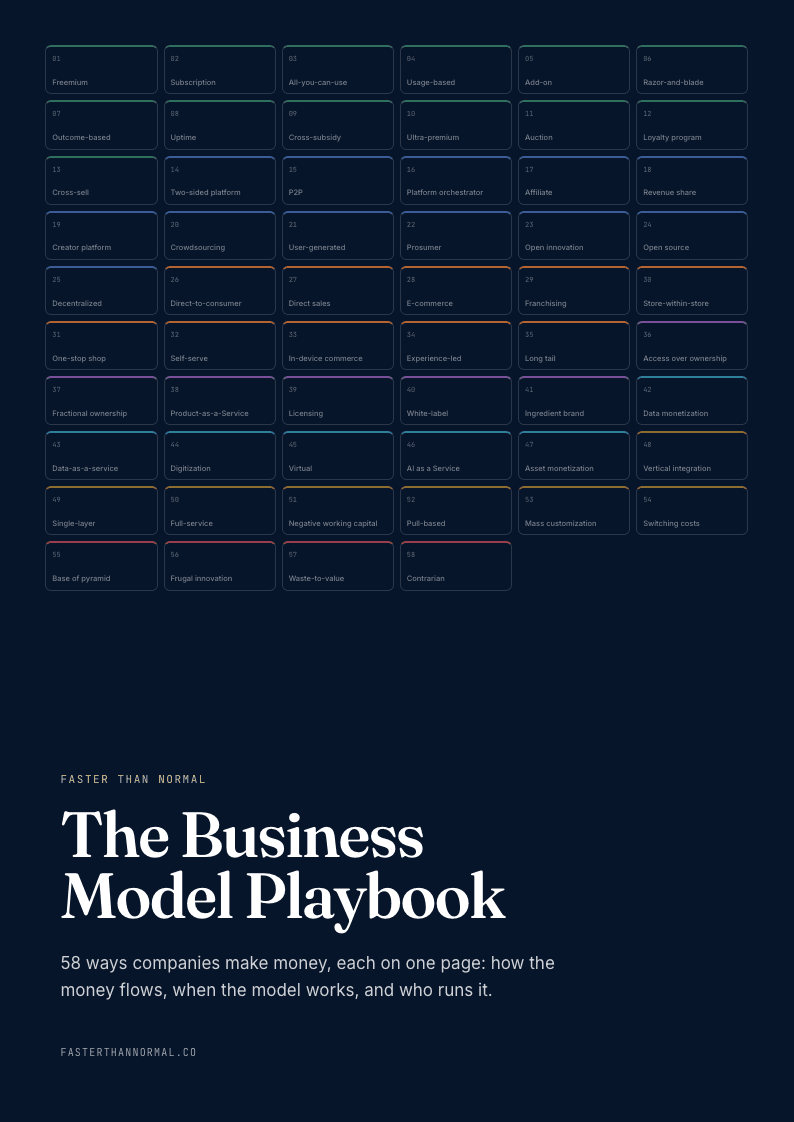
Free playbook
Get The Business Model Playbook
58 business models, one visual page each: how the money flows, the metrics that matter, and who runs it. Free when you join the Faster Than Normal email.
Free. No spam. Unsubscribe anytime.