

Contents
Book summary
Steve Jobs
by Walter Isaacson
The Core Premise
Steve Jobs transformed himself from an adopted college dropout into the most compelling CEO of his generation by mastering what Walter Isaacson reveals as the "reality distortion field" — a psychological weapon that bent people, timelines, and technical possibilities to his will. This wasn't mere charisma or vision, but a systematic approach to leadership that combined brutal perfectionism with an almost mystical belief that the impossible was simply another engineering problem. Isaacson spent over forty interviews with Jobs himself, plus hundreds more with colleagues, competitors, and family members, to decode how someone so famously difficult created products that redefined entire industries.
Jobs operated through what Isaacson identifies as "binary thinking" — products were either brilliant or shit, people were either A-players or bozos, with no middle ground tolerated. This wasn't personality quirk but strategic methodology. When Jonathan Ive presented the first iPhone prototype, Jobs immediately declared the plastic screen "shit" and demanded glass, despite every engineer insisting it was impossible. Jobs simply refused to accept technical limitations, creating what Isaacson calls "the intersection of technology and liberal arts." Within months, Corning had developed Gorilla Glass specifically for Apple. The reality distortion field worked because Jobs genuinely believed that passion and perfectionism could overcome physics.
The biography reveals Jobs' "control freak" approach as systematic vertical integration — owning every piece of the customer experience from hardware to software to retail. While competitors like Dell focused on efficient manufacturing and Microsoft on software ubiquity, Jobs insisted on what he called "end-to-end responsibility." When Apple opened its first retail stores, traditional wisdom said computer companies couldn't succeed in retail. Jobs studied luxury brands like Tiffany and Four Seasons, applying their principles to technology retail. He personally obsessed over details like the glass staircases and the "breathing" sleep light on MacBooks, understanding that emotional connection drove premium pricing power.
Isaacson demonstrates how Jobs weaponized what he calls "managed collaboration" — bringing together diverse teams under extreme pressure to achieve breakthrough innovation. The original Macintosh team worked in a separate building with a pirate flag, deliberately isolated from Apple's bureaucracy. Jobs would pit different teams against each other, sometimes having multiple groups work on competing approaches to the same problem. This created internal competition that accelerated development while giving Jobs multiple options. When the iPhone team struggled with battery life, Jobs simultaneously pushed hardware engineers to improve efficiency while software teams optimized iOS, creating redundant paths to the same goal.
For executives, Jobs' methodology translates into three core practices: ruthless prioritization, vertical integration of customer experience, and using constraints as creative catalysts. Jobs famously limited Apple to working on just a handful of products at any time, personally reviewing and killing projects that didn't meet his "insanely great" standard. He proved that saying no to good opportunities creates space for extraordinary ones. His approach to product launches — building narrative tension through secrecy, then revealing products as "magical" solutions to problems customers didn't know they had — became the template for modern product marketing. The lesson isn't to copy Jobs' abrasive personality, but to adopt his systematic approach to perfectionism and his refusal to accept conventional limitations as permanent constraints.
De siste månedene av sitt liv brukte Apple-gründer Steve Jobs på å gjennomføre en rekke intervjuer med forfatter Walter Isaacson. Denne biografien avslører nye og ukjente sider ved Jobs liv og virke, og den internasjonale lanseringen av boka regnes som en av de mest betydelige på lang tid. Ikke lenge etter dødsfallet uttalte president Barack Obama at Jobs forandret måten hver enkelt av oss ser på verden på. Walter Isaacson har blant annet utgitt biografien om Albert Einstein (2009).
Steve Jobs by Walter Isaacson belongs on the short shelf of books that change how you notice decisions in the wild. Whether you agree with every claim or not, the frame it offers is portable: you can apply it in meetings, investing, hiring, and personal trade-offs without carrying the whole volume.
Many readers return to this book because it names patterns that felt familiar but unnamed. Naming is leverage: once you can point to a mechanism, you can design around it. One through-line is “Reality Distortion Field: Jobs' ability to convince anyone of practically anything through a combination of charismatic rhetorical style, indomitable will, and eagerness to bend any fact to fit the pu” and its implications for judgment under uncertainty.
If you are reading for execution, translate each chapter into a testable habit: one prompt before a big decision, one review question after a project, one constraint you will respect next quarter. Theory becomes useful when it shows up in calendars, not only in margins.
Finally, pair this book with opposing voices. The strongest readers stress-test the thesis against cases where the advice fails, note the boundary conditions, and keep a short list of when not to use this lens. That discipline is how summaries become judgment.
Long-form books reward spaced attention: read a chapter, sleep, then write a half-page memo titled “What would I do differently on Monday?” If you cannot answer with specifics, the idea has not yet landed.
Use Steve Jobs as a conversation starter with peers who have different incentives. The disagreements often reveal which parts of the book are robust and which are fragile when power, risk, and time horizons change.
Key Ideas and Arguments
Reality Distortion Field: Jobs' ability to convince anyone of practically anything through a combination of charismatic rhetorical style, indomitable will, and eagerness to bend any fact to fit the purpose at hand. This wasn't manipulation but genuine belief that passionate conviction could overcome technical limitations, as demonstrated when he convinced engineers that impossible timelines were achievable.. This idea shows up repeatedly in Steve Jobs: separate the definition from the examples, then ask where the author's evidence is strongest and where anecdotes do most of the work. Consider writing a counterexample: a situation where applying the idea literally would misfire, and what guardrail you would add.
Binary Thinking: Jobs' worldview that divided everything into two categories - brilliant or shit, A-players or bozos, revolutionary or incremental. This mental model eliminated middle ground and forced clear decision-making, though it often brutalized people who fell into the 'shit' category.. This idea shows up repeatedly in Steve Jobs: separate the definition from the examples, then ask where the author's evidence is strongest and where anecdotes do most of the work. Consider writing a counterexample: a situation where applying the idea literally would misfire, and what guardrail you would add.
End-to-End Control: Jobs' insistence on owning every aspect of the customer experience rather than relying on partners or industry standards. Unlike Microsoft's platform approach, Jobs integrated hardware, software, services, and retail to create seamless user experiences that commanded premium pricing.. This idea shows up repeatedly in Steve Jobs: separate the definition from the examples, then ask where the author's evidence is strongest and where anecdotes do most of the work. Consider writing a counterexample: a situation where applying the idea literally would misfire, and what guardrail you would add.
The Intersection: Jobs' philosophy of combining technology with liberal arts, humanities, and design thinking. He believed breakthrough products emerged not from pure technical advancement but from understanding human needs and translating them through beautiful, intuitive technology.. This idea shows up repeatedly in Steve Jobs: separate the definition from the examples, then ask where the author's evidence is strongest and where anecdotes do most of the work. Consider writing a counterexample: a situation where applying the idea literally would misfire, and what guardrail you would add.
Managed Collaboration: Jobs' approach to team dynamics that combined small, elite teams with internal competition and extreme pressure. He would often have multiple teams work on competing solutions, then choose the best approach while maintaining secrecy and urgency.. This idea shows up repeatedly in Steve Jobs: separate the definition from the examples, then ask where the author's evidence is strongest and where anecdotes do most of the work. Consider writing a counterexample: a situation where applying the idea literally would misfire, and what guardrail you would add.
Perfectionist Simplicity: The design philosophy of removing everything unnecessary until only the essential remains, then perfecting those elements obsessively. Jobs would spend months debating the exact shade of white for a product casing or the precise curve of an icon.. This idea shows up repeatedly in Steve Jobs: separate the definition from the examples, then ask where the author's evidence is strongest and where anecdotes do most of the work. Consider writing a counterexample: a situation where applying the idea literally would misfire, and what guardrail you would add.
Narrative Control: Jobs' mastery of product storytelling, building anticipation through secrecy then revealing products as magical solutions to problems customers didn't know they had. He understood that great products needed great stories to reach their potential market impact.. This idea shows up repeatedly in Steve Jobs: separate the definition from the examples, then ask where the author's evidence is strongest and where anecdotes do most of the work. Consider writing a counterexample: a situation where applying the idea literally would misfire, and what guardrail you would add.
Deeper Themes and Context
Steve Jobs is not only a catalogue of claims; it is a stance on how to interpret success, failure, and ambiguity. Readers who engage charitably still ask: which recommendations are universal, which are culturally situated, and which require institutional support you do not have?
Comparing the book's prescriptions to your own context is part of the work. A strategy that assumes abundant capital, patient stakeholders, or long feedback loops will read differently if you are resource-constrained, early in a career, or operating under regulatory pressure. Translation beats transcription.
The book also invites you to notice what it does not say. Silences can be instructive: topics the author avoids, counterexamples that never appear, or metrics that are praised without definition. A serious reader keeps a missing-evidence note alongside a to-try note.
Historically, the most influential business and biography titles survive because they double as vocabulary. Teams that share a phrase from Steve Jobs move faster only when they also share a definition and a worked example, otherwise they talk past each other with the same words.
How to Apply the Lessons
Connected Mental Models
Who Should Read This
Start here if you want a serious, book-length argument rather than a thread of bullet points. Steve Jobs rewards readers who will sketch their own examples, argue back in the margins, and connect chapters to decisions they are facing this quarter.
It is also useful as a shared vocabulary for teams: a common chapter reference can shorten debate if everyone agrees what the term means in practice. If your team only shares the title, not the definition, expect confusion.
Skip or skim if you need a narrow tactical recipe with no theory; this summary preserves the ideas, but the book's value is often in the extended case material and the author's sequencing.
Analyst's Take
Test Yourself
Check your grasp of the book’s moves
A colleague quotes Steve Jobs to justify a risky decision. What should you verify first?
You finished Steve Jobs and want behaviour change this week.
Further Reading
Featured in
Continue exploring


Free playbook
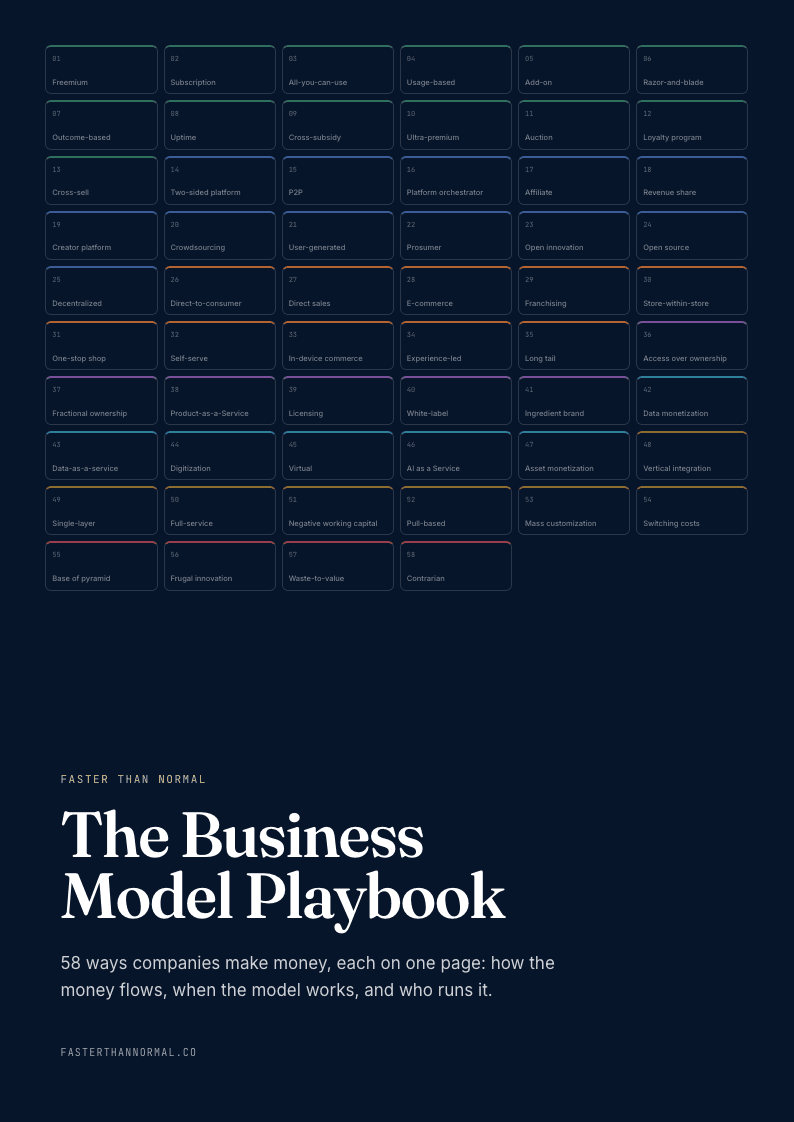
Get The Business Model Playbook
58 business models, one visual page each: how the money flows, the metrics that matter, and who runs it. Free when you join the Faster Than Normal email.
Free. No spam. Unsubscribe anytime.