

Contents
Book summary
Sol Price: Retail Revolutionary & Social Innovator
by Robert E. Price
The Core Premise
Sol Price didn't just invent the wholesale club — he shattered the fundamental assumptions about how retail works by proving that customers would pay for the privilege of buying from you. His Price Club model turned conventional wisdom on its head: charge membership fees upfront, operate in spartan warehouses, offer limited SKUs, and maintain razor-thin margins while still generating superior returns. This counterintuitive approach became the blueprint that Walmart's Sam Walton openly copied and Amazon's Jeff Bezos studied religiously.
Price's "Limited SKU Strategy" demonstrated that offering fewer choices actually increased customer satisfaction and operational efficiency. Where traditional retailers stocked 50,000+ items, Price Club carried just 3,500 carefully curated products, each selected for maximum turnover velocity. This radical simplification eliminated the paradox of choice while allowing Price to negotiate unprecedented volume discounts. When Procter & Gamble initially refused to sell directly to Price Club, Sol bypassed them entirely, purchasing P&G products from a Canadian distributor at better margins than traditional retailers received from the manufacturer. This move forced P&G to restructure their entire distribution strategy.
The membership model created what Price called the "Virtuous Circle of Value" — a self-reinforcing system where membership fees funded lower operating costs, enabling better prices, which attracted more members, generating more fee revenue. Price proved that customers weren't just willing to pay annual fees; they became more loyal and spent more per visit because of their financial commitment. This psychological principle of escalating commitment transformed retail from a transactional business into a relationship business. Members averaged 24 visits per year versus 4-6 for traditional discount store customers.
Price's innovation extended beyond retail mechanics to what he termed "Stakeholder Capitalism" decades before the concept gained mainstream acceptance. He instituted profit-sharing plans, provided comprehensive healthcare, and maintained a 6-to-1 CEO-to-median-worker pay ratio when most CEOs earned 40 times their average employee. Price understood that employee ownership mentality directly translated to customer service quality and operational efficiency. His stores consistently achieved higher sales per square foot and lower theft rates than competitors, proving that treating workers as stakeholders generated measurable business returns.
For modern executives, Price's framework offers a masterclass in business model innovation through constraint. His "Three Pillars Strategy" — membership fees for steady cash flow, limited selection for operational efficiency, and stakeholder alignment for sustainable culture — remains as relevant in the subscription economy as it was in 1970s retail. Price demonstrated that the most powerful competitive advantages come not from doing everything better, but from fundamentally restructuring the value equation between business and customer.
"Sol Price: Retail Revolutionary and Social Innovator, recounts the extraordinary life of a man who profoundly impacted the shopping habits of consumers in the United States and throughout much of the world. Written by Sol's son Robert Price, this narrative--part biography and part memoir--provides a unique insight into his father's life... As a retail revolutionary, Sol's creative brilliance changed the way we shop, first with FedMart in 1954, the retail format copied by Walmart, Kmart, and Target in 1962, and then, with the Price Club, the warehouse club format adopted by Costco and Sam's Club in 1983. Self-service shopping in large florescent-lit buildings has become part of the American culture and is now the predominant mode of shopping thought most of the world" --Dust jacket.
Sol Price: Retail Revolutionary & Social Innovator by Robert E. Price belongs on the short shelf of books that change how you notice decisions in the wild. Whether you agree with every claim or not, the frame it offers is portable: you can apply it in meetings, investing, hiring, and personal trade-offs without carrying the whole volume.
Many readers return to this book because it names patterns that felt familiar but unnamed. Naming is leverage: once you can point to a mechanism, you can design around it. One through-line is “Limited SKU Strategy: Price Club carried only 3,500 products versus 50,000+ at traditional retailers, carefully selecting each item for maximum turnover velocity. This radical simplification eliminate” and its implications for judgment under uncertainty.
If you are reading for execution, translate each chapter into a testable habit: one prompt before a big decision, one review question after a project, one constraint you will respect next quarter. Theory becomes useful when it shows up in calendars, not only in margins.
Finally, pair this book with opposing voices. The strongest readers stress-test the thesis against cases where the advice fails, note the boundary conditions, and keep a short list of when not to use this lens. That discipline is how summaries become judgment.
Long-form books reward spaced attention: read a chapter, sleep, then write a half-page memo titled “What would I do differently on Monday?” If you cannot answer with specifics, the idea has not yet landed.
Use Sol Price: Retail Revolutionary & Social Innovator as a conversation starter with peers who have different incentives. The disagreements often reveal which parts of the book are robust and which are fragile when power, risk, and time horizons change.
Key Ideas and Arguments
Limited SKU Strategy: Price Club carried only 3,500 products versus 50,000+ at traditional retailers, carefully selecting each item for maximum turnover velocity. This radical simplification eliminated choice paralysis while enabling better supplier negotiations and operational efficiency.. This idea shows up repeatedly in Sol Price: Retail Revolutionary & Social Innovator: separate the definition from the examples, then ask where the author's evidence is strongest and where anecdotes do most of the work. Consider writing a counterexample: a situation where applying the idea literally would misfire, and what guardrail you would add.
Virtuous Circle of Value: A self-reinforcing system where membership fees funded lower operating costs, enabling better prices, which attracted more members, generating more fee revenue. This model turned customers into stakeholders with financial commitment.. This idea shows up repeatedly in Sol Price: Retail Revolutionary & Social Innovator: separate the definition from the examples, then ask where the author's evidence is strongest and where anecdotes do most of the work. Consider writing a counterexample: a situation where applying the idea literally would misfire, and what guardrail you would add.
Membership Psychology: Customers who paid annual fees averaged 24 visits per year versus 4-6 for traditional discount stores, demonstrating how financial commitment creates behavioral change and increased loyalty.. This idea shows up repeatedly in Sol Price: Retail Revolutionary & Social Innovator: separate the definition from the examples, then ask where the author's evidence is strongest and where anecdotes do most of the work. Consider writing a counterexample: a situation where applying the idea literally would misfire, and what guardrail you would add.
Warehouse Retail Format: Operating in spartan, no-frills warehouses with products stacked on pallets eliminated traditional retail overhead costs. This format became the foundation for modern big-box retail.. This idea shows up repeatedly in Sol Price: Retail Revolutionary & Social Innovator: separate the definition from the examples, then ask where the author's evidence is strongest and where anecdotes do most of the work. Consider writing a counterexample: a situation where applying the idea literally would misfire, and what guardrail you would add.
Stakeholder Capitalism Model: Price instituted profit-sharing, comprehensive healthcare, and a 6-to-1 CEO-to-worker pay ratio decades before ESG became mainstream. This approach generated measurable business returns through employee ownership mentality.. This idea shows up repeatedly in Sol Price: Retail Revolutionary & Social Innovator: separate the definition from the examples, then ask where the author's evidence is strongest and where anecdotes do most of the work. Consider writing a counterexample: a situation where applying the idea literally would misfire, and what guardrail you would add.
Volume-Based Supplier Relations: Price bypassed traditional distribution channels, purchasing directly from manufacturers or alternative suppliers to secure better margins. This forced entire industries to restructure their distribution strategies.. This idea shows up repeatedly in Sol Price: Retail Revolutionary & Social Innovator: separate the definition from the examples, then ask where the author's evidence is strongest and where anecdotes do most of the work. Consider writing a counterexample: a situation where applying the idea literally would misfire, and what guardrail you would add.
Cash Flow Arbitrage: Membership fees provided predictable upfront revenue that funded inventory purchases and operations, creating a financial advantage over traditional retailers who relied solely on product sales.. This idea shows up repeatedly in Sol Price: Retail Revolutionary & Social Innovator: separate the definition from the examples, then ask where the author's evidence is strongest and where anecdotes do most of the work. Consider writing a counterexample: a situation where applying the idea literally would misfire, and what guardrail you would add.
Deeper Themes and Context
Sol Price: Retail Revolutionary & Social Innovator is not only a catalogue of claims; it is a stance on how to interpret success, failure, and ambiguity. Readers who engage charitably still ask: which recommendations are universal, which are culturally situated, and which require institutional support you do not have?
Comparing the book's prescriptions to your own context is part of the work. A strategy that assumes abundant capital, patient stakeholders, or long feedback loops will read differently if you are resource-constrained, early in a career, or operating under regulatory pressure. Translation beats transcription.
The book also invites you to notice what it does not say. Silences can be instructive: topics the author avoids, counterexamples that never appear, or metrics that are praised without definition. A serious reader keeps a missing-evidence note alongside a to-try note.
Historically, the most influential business and biography titles survive because they double as vocabulary. Teams that share a phrase from Sol Price: Retail Revolutionary & Social Innovator move faster only when they also share a definition and a worked example, otherwise they talk past each other with the same words.
How to Apply the Lessons
Connected Mental Models
Who Should Read This
Start here if you want a serious, book-length argument rather than a thread of bullet points. Sol Price: Retail Revolutionary & Social Innovator rewards readers who will sketch their own examples, argue back in the margins, and connect chapters to decisions they are facing this quarter.
It is also useful as a shared vocabulary for teams: a common chapter reference can shorten debate if everyone agrees what the term means in practice. If your team only shares the title, not the definition, expect confusion.
Skip or skim if you need a narrow tactical recipe with no theory; this summary preserves the ideas, but the book's value is often in the extended case material and the author's sequencing.
Analyst's Take
Test Yourself
Check your grasp of the book’s moves
A colleague quotes Sol Price: Retail Revolutionary & Social Innovator to justify a risky decision. What should you verify first?
You finished Sol Price: Retail Revolutionary & Social Innovator and want behaviour change this week.
Further Reading
Continue exploring


Free playbook
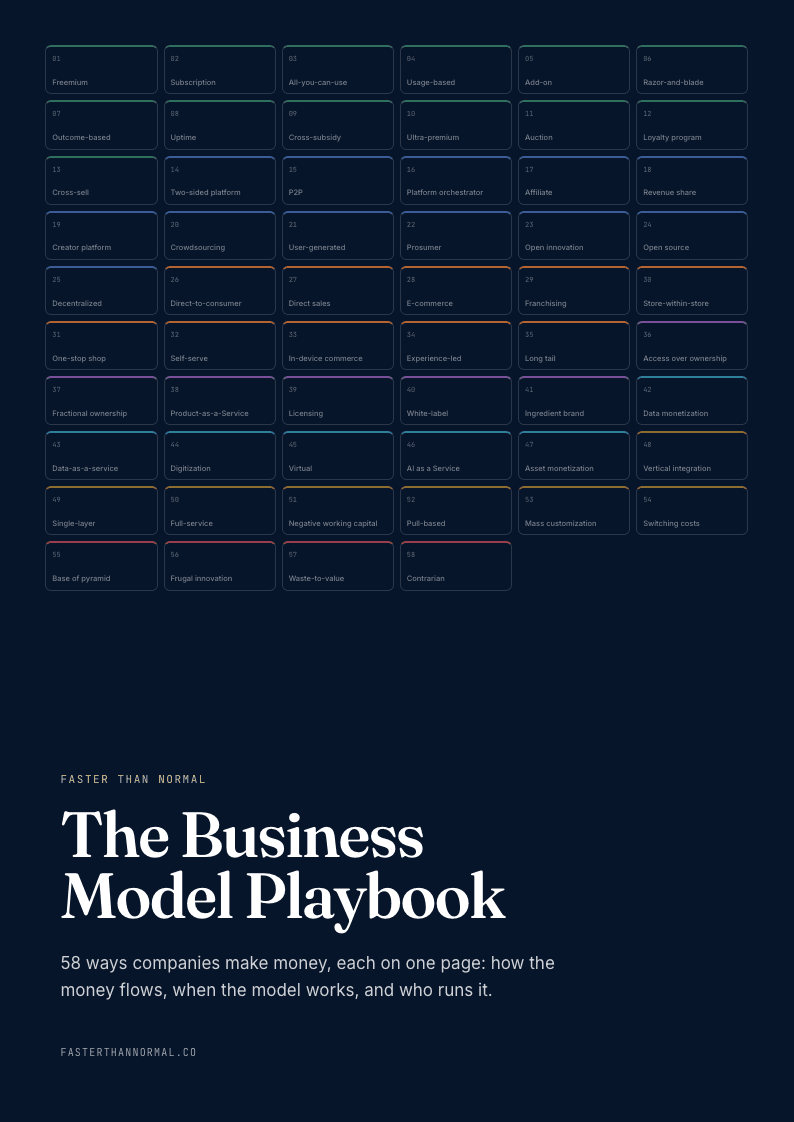
Get The Business Model Playbook
58 business models, one visual page each: how the money flows, the metrics that matter, and who runs it. Free when you join the Faster Than Normal email.
Free. No spam. Unsubscribe anytime.