

Contents
Book summary
Sol Price: Retail Revolutionary and Social Innovator
by Robert E. Price
The Core Premise
Sol Price discovered that the secret to retail domination wasn't selling more to each customer—it was selling less. By deliberately limiting selection, stripping away services, and charging customers an annual fee for the privilege of shopping in a warehouse, Price created the membership club model that revolutionized retail and spawned imitators worth hundreds of billions today. His counterintuitive insight: customers will pay for access to lower prices, even if it means sacrificing convenience.
Price's "membership warehouse" concept emerged from his legal background and a keen understanding of volume economics. After building the FedMart discount chain in the 1950s and losing control to German investors, Price doubled down on an even more radical approach with Price Club in 1976. He targeted small business owners who needed bulk quantities, charging them $25 annually to shop in a converted airplane hangar with concrete floors and merchandise stacked on industrial shelves. The "treasure hunt" shopping experience—where inventory constantly changed and customers never knew what they'd find—became a feature, not a bug. Price proved that scarcity and unpredictability could drive loyalty as effectively as convenience.
The numbers validated Price's contrarian thesis. Price Club generated higher sales per square foot than traditional retailers while operating on gross margins of just 8-10 percent versus the industry standard of 25-30 percent. The membership fees provided a predictable revenue stream that allowed Price to price merchandise at near-wholesale levels. When Walmart's Sam Walton visited Price Club in 1983, he spent two days studying every detail before launching Sam's Club. Costco co-founder James Sinegal worked directly under Price, absorbing the operational philosophy that he later scaled globally. Price's model didn't just influence competitors—it created entirely new categories of retail.
Beyond retail innovation, Price embedded progressive labor practices and social responsibility into his business model decades before these became corporate buzzwords. He paid above-market wages, provided comprehensive benefits, and promoted from within, understanding that employee satisfaction directly correlated with customer experience. Price Club stores became laboratories for sustainable business practices, proving that treating workers well enhanced rather than undermined profitability. His "stakeholder capitalism" approach—balancing shareholder returns with employee welfare and community impact—demonstrated that social innovation and business success were complementary, not competing objectives.
For modern executives, Price's legacy offers a masterclass in contrarian positioning and long-term thinking. His willingness to charge customers for access while simultaneously offering them lower prices seems paradoxical, yet it created deeper customer loyalty than traditional retail relationships. The membership model has since been applied across industries, from software subscriptions to premium services, because Price proved that customers will pay upfront for ongoing value. His focus on operational efficiency over marketing spend, employee development over cost-cutting, and customer lifetime value over transaction optimization provides a blueprint for building enduring competitive advantages in any market where trust and consistency matter more than flash and convenience.
"Sol Price: Retail Revolutionary and Social Innovator, recounts the extraordinary life of a man who profoundly impacted the shopping habits of consumers in the United States and throughout much of the world. Written by Sol's son Robert Price, this narrative--part biography and part memoir--provides a unique insight into his father's life... As a retail revolutionary, Sol's creative brilliance changed the way we shop, first with FedMart in 1954, the retail format copied by Walmart, Kmart, and Target in 1962, and then, with the Price Club, the warehouse club format adopted by Costco and Sam's Club in 1983. Self-service shopping in large florescent-lit buildings has become part of the American culture and is now the predominant mode of shopping thought most of the world" --Dust jacket.
Sol Price: Retail Revolutionary and Social Innovator by Robert E. Price belongs on the short shelf of books that change how you notice decisions in the wild. Whether you agree with every claim or not, the frame it offers is portable: you can apply it in meetings, investing, hiring, and personal trade-offs without carrying the whole volume.
Many readers return to this book because it names patterns that felt familiar but unnamed. Naming is leverage: once you can point to a mechanism, you can design around it. One through-line is “Membership Warehouse Model: Customers pay an annual fee to access wholesale prices in a no-frills warehouse environment. This creates predictable revenue streams while enabling razor-thin margins on m” and its implications for judgment under uncertainty.
If you are reading for execution, translate each chapter into a testable habit: one prompt before a big decision, one review question after a project, one constraint you will respect next quarter. Theory becomes useful when it shows up in calendars, not only in margins.
Finally, pair this book with opposing voices. The strongest readers stress-test the thesis against cases where the advice fails, note the boundary conditions, and keep a short list of when not to use this lens. That discipline is how summaries become judgment.
Long-form books reward spaced attention: read a chapter, sleep, then write a half-page memo titled “What would I do differently on Monday?” If you cannot answer with specifics, the idea has not yet landed.
Use Sol Price: Retail Revolutionary and Social Innovator as a conversation starter with peers who have different incentives. The disagreements often reveal which parts of the book are robust and which are fragile when power, risk, and time horizons change.
Key Ideas and Arguments
Membership Warehouse Model: Customers pay an annual fee to access wholesale prices in a no-frills warehouse environment. This creates predictable revenue streams while enabling razor-thin margins on merchandise, as demonstrated by Price Club's 8-10% gross margins versus traditional retail's 25-30%.. This idea shows up repeatedly in Sol Price: Retail Revolutionary and Social Innovator: separate the definition from the examples, then ask where the author's evidence is strongest and where anecdotes do most of the work. Consider writing a counterexample: a situation where applying the idea literally would misfire, and what guardrail you would add.
Treasure Hunt Shopping: Constantly rotating inventory creates urgency and excitement, turning scarcity into a customer acquisition tool. Price Club deliberately varied product selection to encourage frequent visits and impulse purchases.. This idea shows up repeatedly in Sol Price: Retail Revolutionary and Social Innovator: separate the definition from the examples, then ask where the author's evidence is strongest and where anecdotes do most of the work. Consider writing a counterexample: a situation where applying the idea literally would misfire, and what guardrail you would add.
Volume Economics: High inventory turnover and bulk purchasing power enable lower prices despite reduced margins. Price focused on moving merchandise quickly rather than maximizing profit per unit.. This idea shows up repeatedly in Sol Price: Retail Revolutionary and Social Innovator: separate the definition from the examples, then ask where the author's evidence is strongest and where anecdotes do most of the work. Consider writing a counterexample: a situation where applying the idea literally would misfire, and what guardrail you would add.
Stakeholder Capitalism: Balancing shareholder returns with employee welfare and community impact creates sustainable competitive advantages. Price Club's above-market wages and comprehensive benefits improved customer service and reduced turnover.. This idea shows up repeatedly in Sol Price: Retail Revolutionary and Social Innovator: separate the definition from the examples, then ask where the author's evidence is strongest and where anecdotes do most of the work. Consider writing a counterexample: a situation where applying the idea literally would misfire, and what guardrail you would add.
Limited SKU Strategy: Restricting product selection to 3,000-4,000 items versus traditional retailers' 50,000+ reduces complexity and increases buying power. Fewer choices paradoxically improve customer satisfaction by eliminating decision fatigue.. This idea shows up repeatedly in Sol Price: Retail Revolutionary and Social Innovator: separate the definition from the examples, then ask where the author's evidence is strongest and where anecdotes do most of the work. Consider writing a counterexample: a situation where applying the idea literally would misfire, and what guardrail you would add.
Fee-for-Value Exchange: Charging customers upfront for access to benefits creates psychological commitment and higher lifetime value. The annual membership fee acts as both revenue source and customer retention mechanism.. This idea shows up repeatedly in Sol Price: Retail Revolutionary and Social Innovator: separate the definition from the examples, then ask where the author's evidence is strongest and where anecdotes do most of the work. Consider writing a counterexample: a situation where applying the idea literally would misfire, and what guardrail you would add.
Operational Transparency: Exposing warehouse operations and wholesale economics to customers builds trust and justifies the membership model. Price showed customers exactly where their savings came from.. This idea shows up repeatedly in Sol Price: Retail Revolutionary and Social Innovator: separate the definition from the examples, then ask where the author's evidence is strongest and where anecdotes do most of the work. Consider writing a counterexample: a situation where applying the idea literally would misfire, and what guardrail you would add.
Deeper Themes and Context
Sol Price: Retail Revolutionary and Social Innovator is not only a catalogue of claims; it is a stance on how to interpret success, failure, and ambiguity. Readers who engage charitably still ask: which recommendations are universal, which are culturally situated, and which require institutional support you do not have?
Comparing the book's prescriptions to your own context is part of the work. A strategy that assumes abundant capital, patient stakeholders, or long feedback loops will read differently if you are resource-constrained, early in a career, or operating under regulatory pressure. Translation beats transcription.
The book also invites you to notice what it does not say. Silences can be instructive: topics the author avoids, counterexamples that never appear, or metrics that are praised without definition. A serious reader keeps a missing-evidence note alongside a to-try note.
Historically, the most influential business and biography titles survive because they double as vocabulary. Teams that share a phrase from Sol Price: Retail Revolutionary and Social Innovator move faster only when they also share a definition and a worked example, otherwise they talk past each other with the same words.
How to Apply the Lessons
Connected Mental Models
Who Should Read This
Start here if you want a serious, book-length argument rather than a thread of bullet points. Sol Price: Retail Revolutionary and Social Innovator rewards readers who will sketch their own examples, argue back in the margins, and connect chapters to decisions they are facing this quarter.
It is also useful as a shared vocabulary for teams: a common chapter reference can shorten debate if everyone agrees what the term means in practice. If your team only shares the title, not the definition, expect confusion.
Skip or skim if you need a narrow tactical recipe with no theory; this summary preserves the ideas, but the book's value is often in the extended case material and the author's sequencing.
Analyst's Take
Test Yourself
Check your grasp of the book’s moves
A colleague quotes Sol Price: Retail Revolutionary and Social Innovator to justify a risky decision. What should you verify first?
You finished Sol Price: Retail Revolutionary and Social Innovator and want behaviour change this week.
Further Reading
Continue exploring


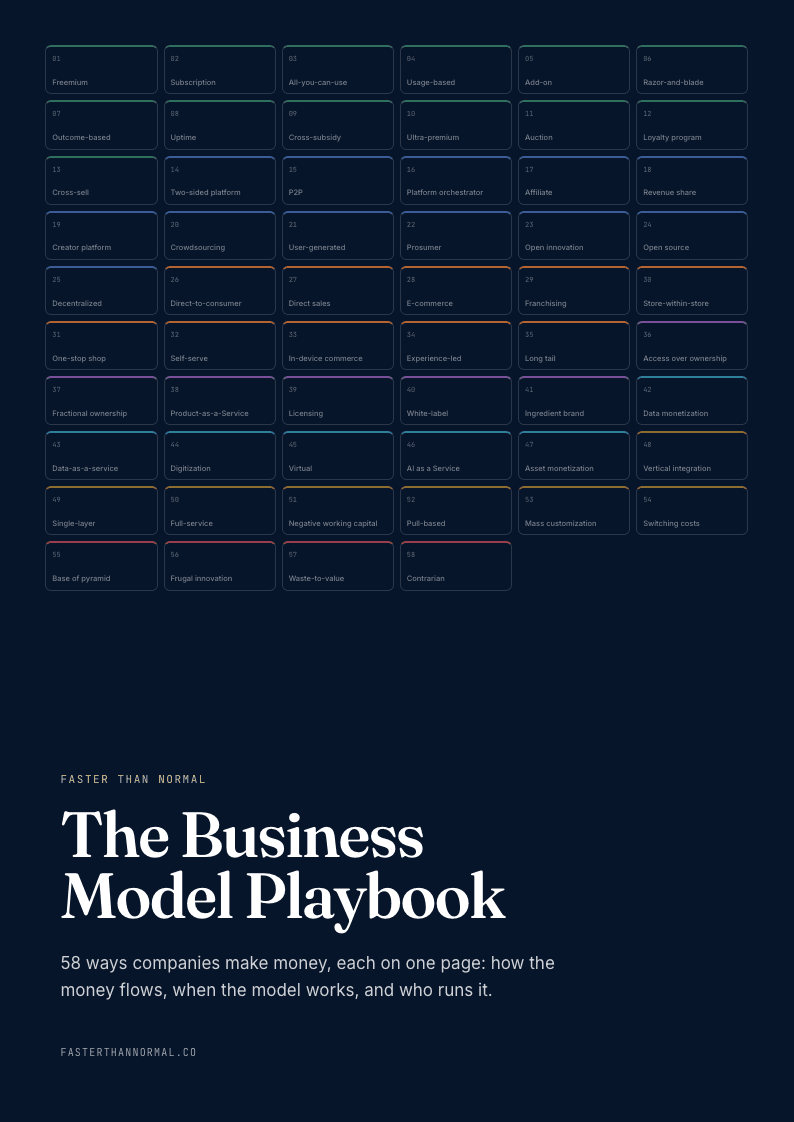
Free playbook
Get The Business Model Playbook
58 business models, one visual page each: how the money flows, the metrics that matter, and who runs it. Free when you join the Faster Than Normal email.
Free. No spam. Unsubscribe anytime.