

Contents
Book summary
Softwar: An Intimate Portrait of Larry Ellison and Oracle
by Matthew Symonds
The Core Premise
Larry Ellison built Oracle into a database empire not through superior technology alone, but by weaponizing paranoia, aggression, and an obsessive focus on beating competitors rather than pleasing customers. Matthew Symonds' unprecedented access to Ellison reveals a CEO who views business as literal warfare, where the goal isn't just winning but crushing enemies so thoroughly they never recover. This isn't another Silicon Valley success story about vision and innovation—it's a masterclass in corporate combat from one of tech's most ruthless tacticians.
Ellison's "Softwar" philosophy centers on three core principles that violate conventional business wisdom. First, the Paranoia Principle: assume every competitor is plotting your destruction and act accordingly. Ellison built Oracle's culture around the belief that IBM, Microsoft, and later Amazon weren't just competitors but existential threats requiring total vigilance. Second, the Aggression Doctrine: attack competitors' weaknesses relentlessly, even when you're winning. When Oracle dominated the database market in the 1990s, Ellison didn't coast—he launched brutal marketing campaigns against Sybase and Informix, driving both into irrelevance. Third, the Control Imperative: own the entire technology stack to eliminate dependencies on potential enemies. This led to Oracle's controversial acquisitions of Sun Microsystems and dozens of software companies, creating an integrated empire that could survive without relying on competitors.
Symonds documents how Ellison's warfare mentality produced both spectacular victories and near-fatal blunders. The Network Computer initiative of the late 1990s exemplified Ellison's strategic thinking: rather than competing directly with Microsoft's desktop dominance, he attempted to make PCs obsolete by creating thin clients that accessed everything through Oracle servers. The strategy failed commercially but forced Microsoft to respond, diverting resources from other initiatives. More successful was Oracle's assault on the enterprise software market through acquisitions like PeopleSoft and Siebel. Ellison didn't just buy these companies for their technology—he eliminated them as competitive threats while absorbing their customer bases. The PeopleSoft acquisition particularly demonstrated Ellison's warfare principles: he pursued the hostile takeover for 18 months, raising his bid five times not because PeopleSoft was worth the final $10.3 billion price, but because losing would signal weakness to other competitors.
The book reveals Ellison's unique approach to leadership through what Symonds terms "Managed Chaos"—deliberately creating internal competition and uncertainty to keep the organization sharp. Ellison routinely reorganized Oracle's structure, changed executives' responsibilities without warning, and encouraged competing product teams to cannibalize each other's work. This approach horrified traditional management consultants but produced remarkable innovation under pressure. Oracle's engineers knew that failing to outperform internal rivals meant losing resources to more aggressive teams. The chaos wasn't random—Ellison carefully monitored these internal battles to identify the strongest products and people while eliminating weakness before competitors could exploit it.
For executives, Ellison's warfare principles offer a controversial but powerful alternative to collaborative business strategies. His methods work best in winner-take-all markets where being second means being irrelevant. The key insight isn't that every CEO should adopt Ellison's extreme aggression, but that conventional wisdom about "win-win" outcomes often leads to mediocrity in highly competitive environments. Ellison proved that treating business as warfare—with clear enemies, decisive battles, and total victory as the only acceptable outcome—can build enduring competitive advantages that purely customer-focused strategies cannot match. The question isn't whether Ellison's approach is morally comfortable, but whether leaders facing existential competitive threats can afford to ignore his proven tactics.
A history of the computer company Oracle chronicles its rise to become one of the industry's most powerful and profitable companies, noting its penchant for reinventing itself in pursuit of new goals.
Softwar: An Intimate Portrait of Larry Ellison and Oracle by Matthew Symonds belongs on the short shelf of books that change how you notice decisions in the wild. Whether you agree with every claim or not, the frame it offers is portable: you can apply it in meetings, investing, hiring, and personal trade-offs without carrying the whole volume.
Many readers return to this book because it names patterns that felt familiar but unnamed. Naming is leverage: once you can point to a mechanism, you can design around it. One through-line is “The Paranoia Principle: Ellison built Oracle's strategy around assuming every competitor was actively plotting Oracle's destruction, requiring constant vigilance and preemptive strikes. This wasn't ne” and its implications for judgment under uncertainty.
If you are reading for execution, translate each chapter into a testable habit: one prompt before a big decision, one review question after a project, one constraint you will respect next quarter. Theory becomes useful when it shows up in calendars, not only in margins.
Finally, pair this book with opposing voices. The strongest readers stress-test the thesis against cases where the advice fails, note the boundary conditions, and keep a short list of when not to use this lens. That discipline is how summaries become judgment.
Long-form books reward spaced attention: read a chapter, sleep, then write a half-page memo titled “What would I do differently on Monday?” If you cannot answer with specifics, the idea has not yet landed.
Use Softwar: An Intimate Portrait of Larry Ellison and Oracle as a conversation starter with peers who have different incentives. The disagreements often reveal which parts of the book are robust and which are fragile when power, risk, and time horizons change.
Key Ideas and Arguments
The Paranoia Principle: Ellison built Oracle's strategy around assuming every competitor was actively plotting Oracle's destruction, requiring constant vigilance and preemptive strikes. This wasn't neurosis but calculated strategy—by treating IBM and Microsoft as existential threats, Oracle developed defensive capabilities and attack strategies that smaller, more trusting companies couldn't match.. This idea shows up repeatedly in Softwar: An Intimate Portrait of Larry Ellison and Oracle: separate the definition from the examples, then ask where the author's evidence is strongest and where anecdotes do most of the work. Consider writing a counterexample: a situation where applying the idea literally would misfire, and what guardrail you would add.
Softwar Philosophy: Business competition as literal warfare where the goal is completely defeating enemies, not just winning market share. Ellison viewed Oracle's battles with IBM, Microsoft, and SAP as zero-sum conflicts where compromise meant eventual defeat, leading to strategies focused on destroying competitors' capabilities rather than just outperforming them.. This idea shows up repeatedly in Softwar: An Intimate Portrait of Larry Ellison and Oracle: separate the definition from the examples, then ask where the author's evidence is strongest and where anecdotes do most of the work. Consider writing a counterexample: a situation where applying the idea literally would misfire, and what guardrail you would add.
Managed Chaos Leadership: Ellison deliberately created internal competition and organizational uncertainty to keep Oracle sharp and innovative. He regularly reorganized divisions, changed executives' roles without warning, and encouraged competing teams to cannibalize each other's work, believing that internal warfare prevented external competitors from finding weaknesses.. This idea shows up repeatedly in Softwar: An Intimate Portrait of Larry Ellison and Oracle: separate the definition from the examples, then ask where the author's evidence is strongest and where anecdotes do most of the work. Consider writing a counterexample: a situation where applying the idea literally would misfire, and what guardrail you would add.
The Control Imperative: Oracle's strategy of owning the entire technology stack to eliminate dependencies on potential competitors. This drove acquisitions like Sun Microsystems and PeopleSoft—not just for their technology, but to prevent competitors from using those companies against Oracle in future battles.. This idea shows up repeatedly in Softwar: An Intimate Portrait of Larry Ellison and Oracle: separate the definition from the examples, then ask where the author's evidence is strongest and where anecdotes do most of the work. Consider writing a counterexample: a situation where applying the idea literally would misfire, and what guardrail you would add.
Strategic Acquisition Warfare: Using mergers and acquisitions primarily as weapons to eliminate competitive threats rather than just gaining technology or customers. The PeopleSoft hostile takeover exemplified this—Ellison pursued it for 18 months not because of PeopleSoft's value, but because losing the battle would signal weakness to other competitors.. This idea shows up repeatedly in Softwar: An Intimate Portrait of Larry Ellison and Oracle: separate the definition from the examples, then ask where the author's evidence is strongest and where anecdotes do most of the work. Consider writing a counterexample: a situation where applying the idea literally would misfire, and what guardrail you would add.
Market Disruption Through Stack Control: Ellison's belief that controlling hardware, software, and services in integrated stacks creates unbeatable competitive advantages. This philosophy led to Oracle's transformation from a database company into a full-stack enterprise technology provider that competitors couldn't easily attack or replicate.. This idea shows up repeatedly in Softwar: An Intimate Portrait of Larry Ellison and Oracle: separate the definition from the examples, then ask where the author's evidence is strongest and where anecdotes do most of the work. Consider writing a counterexample: a situation where applying the idea literally would misfire, and what guardrail you would add.
Deeper Themes and Context
Softwar: An Intimate Portrait of Larry Ellison and Oracle is not only a catalogue of claims; it is a stance on how to interpret success, failure, and ambiguity. Readers who engage charitably still ask: which recommendations are universal, which are culturally situated, and which require institutional support you do not have?
Comparing the book's prescriptions to your own context is part of the work. A strategy that assumes abundant capital, patient stakeholders, or long feedback loops will read differently if you are resource-constrained, early in a career, or operating under regulatory pressure. Translation beats transcription.
The book also invites you to notice what it does not say. Silences can be instructive: topics the author avoids, counterexamples that never appear, or metrics that are praised without definition. A serious reader keeps a missing-evidence note alongside a to-try note.
Historically, the most influential business and biography titles survive because they double as vocabulary. Teams that share a phrase from Softwar: An Intimate Portrait of Larry Ellison and Oracle move faster only when they also share a definition and a worked example, otherwise they talk past each other with the same words.
How to Apply the Lessons
Connected Mental Models
Who Should Read This
Start here if you want a serious, book-length argument rather than a thread of bullet points. Softwar: An Intimate Portrait of Larry Ellison and Oracle rewards readers who will sketch their own examples, argue back in the margins, and connect chapters to decisions they are facing this quarter.
It is also useful as a shared vocabulary for teams: a common chapter reference can shorten debate if everyone agrees what the term means in practice. If your team only shares the title, not the definition, expect confusion.
Skip or skim if you need a narrow tactical recipe with no theory; this summary preserves the ideas, but the book's value is often in the extended case material and the author's sequencing.
Analyst's Take
Test Yourself
Check your grasp of the book’s moves
A colleague quotes Softwar: An Intimate Portrait of Larry Ellison and Oracle to justify a risky decision. What should you verify first?
You finished Softwar: An Intimate Portrait of Larry Ellison and Oracle and want behaviour change this week.
Further Reading
Continue exploring


Free playbook
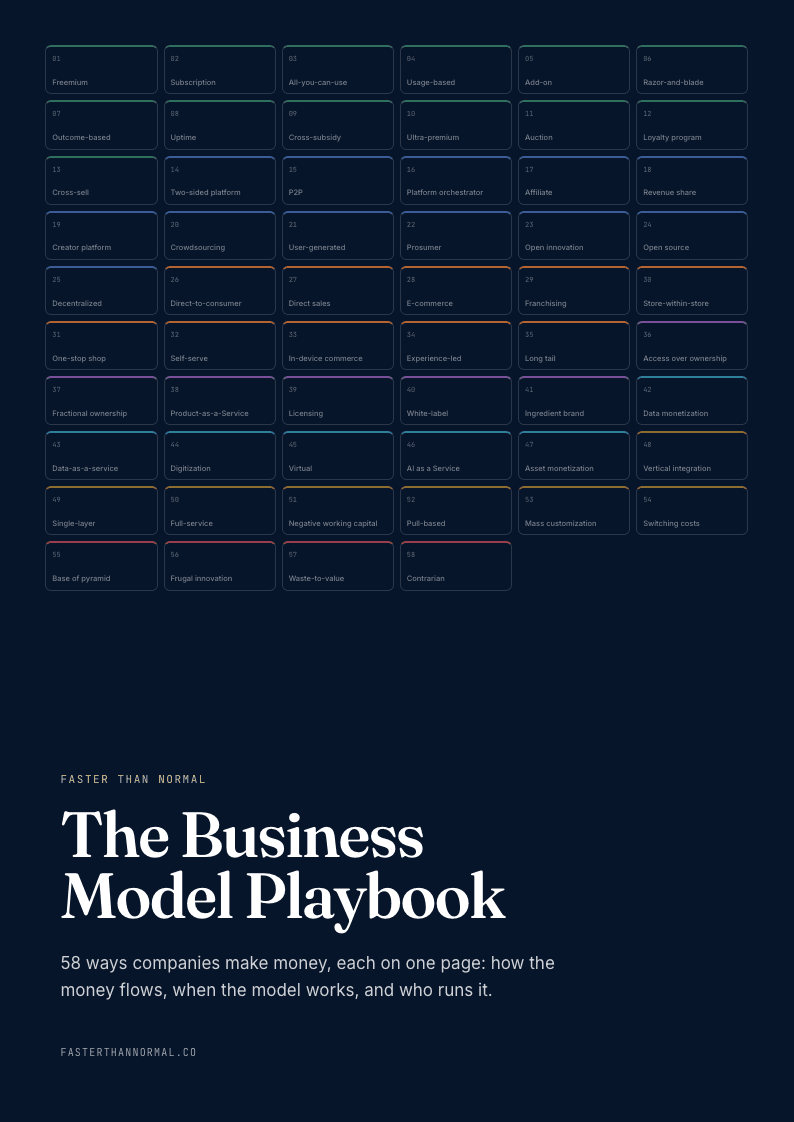
Get The Business Model Playbook
58 business models, one visual page each: how the money flows, the metrics that matter, and who runs it. Free when you join the Faster Than Normal email.
Free. No spam. Unsubscribe anytime.