

Contents
Book summary
Reach for the Skies: Ballooning, Birdmen, and Blasting into Space
by Richard Branson
The Core Premise
Aviation's greatest breakthroughs happened when mavericks ignored conventional wisdom and risked everything on seemingly impossible ventures. Richard Branson makes this case through his own aerial adventures and the stories of aviation pioneers who shared his philosophy: that calculated risk-taking and relentless optimism can overcome seemingly insurmountable technical and financial obstacles. From his record-breaking Atlantic balloon crossings to Virgin Galactic's space tourism ambitions, Branson demonstrates how entrepreneurs can use extreme challenges as laboratories for innovation and brand building.
Branson's "Adventure Capitalism" framework combines business strategy with physical risk to create what he calls "authentic marketing moments." When Virgin needed to compete against British Airways' massive advertising budget in the 1980s, Branson chose balloon crossings and speedboat attempts that generated millions in free publicity while positioning Virgin as the daring alternative to stodgy incumbents. Each attempt, whether successful or not, reinforced Virgin's brand message that the company would go further than competitors. His failed Pacific balloon crossing in 1998, which required a dramatic helicopter rescue, actually strengthened Virgin's reputation because it demonstrated genuine commitment rather than mere publicity stunts.
The book reveals Branson's "Acceptable Loss Principle" — the practice of taking enormous personal risks while carefully limiting business exposure. During his Virgin Atlantic balloon crossing, Branson risked his life but structured the attempt so that failure wouldn't destroy Virgin's core business operations. He contrasts this with the Wright Brothers' methodical approach at Kitty Hawk, showing how different risk profiles suit different types of ventures. When developing Virgin Galactic, Branson applied the same principle by partnering with Scaled Composites rather than building aerospace capabilities internally, limiting Virgin's financial exposure while maintaining the ability to capture upside.
Branson's "First Mover's Paradise" concept explains why he consistently targets industries dominated by complacent monopolies or duopolies. Aviation, telecommunications, and space tourism all featured established players who had stopped innovating and started exploiting customers. By entering these markets with better service and entrepreneurial energy, Virgin could capture disproportionate attention and market share. The book details how Virgin America's mood lighting and entertainment systems seem trivial but actually represented a fundamental philosophy: that industries dismissing customer experience as unimportant create massive opportunities for disruptors.
For executives, Branson's approach offers a template for using bold initiatives to accelerate brand building and team development. His aerial adventures weren't just personal pursuits but leadership development exercises that taught Virgin employees to attempt the impossible. The same mindset that enabled his balloon crossings drove Virgin's expansion into industries where the company had no obvious expertise. Branson proves that companies can manufacture their own luck by consistently attempting projects at the edge of feasibility, knowing that occasional spectacular successes will more than compensate for frequent failures.
Richard Branson looks at the history of flight through the stories and people who have inspired him. These are tales of miraculousrescues, surprising feats of endurance and survival, and of records made and broken.
Reach for the Skies: Ballooning, Birdmen, and Blasting into Space by Richard Branson belongs on the short shelf of books that change how you notice decisions in the wild. Whether you agree with every claim or not, the frame it offers is portable: you can apply it in meetings, investing, hiring, and personal trade-offs without carrying the whole volume.
Many readers return to this book because it names patterns that felt familiar but unnamed. Naming is leverage: once you can point to a mechanism, you can design around it. One through-line is “Adventure Capitalism: Branson's strategy of combining high-profile physical risks with business objectives to generate authentic marketing moments. His balloon crossings cost a fraction of traditional” and its implications for judgment under uncertainty.
If you are reading for execution, translate each chapter into a testable habit: one prompt before a big decision, one review question after a project, one constraint you will respect next quarter. Theory becomes useful when it shows up in calendars, not only in margins.
Finally, pair this book with opposing voices. The strongest readers stress-test the thesis against cases where the advice fails, note the boundary conditions, and keep a short list of when not to use this lens. That discipline is how summaries become judgment.
Long-form books reward spaced attention: read a chapter, sleep, then write a half-page memo titled “What would I do differently on Monday?” If you cannot answer with specifics, the idea has not yet landed.
Use Reach for the Skies: Ballooning, Birdmen, and Blasting into Space as a conversation starter with peers who have different incentives. The disagreements often reveal which parts of the book are robust and which are fragile when power, risk, and time horizons change.
Key Ideas and Arguments
Adventure Capitalism: Branson's strategy of combining high-profile physical risks with business objectives to generate authentic marketing moments. His balloon crossings cost a fraction of traditional advertising but created deeper brand engagement because audiences witnessed genuine commitment rather than paid messaging.. This idea shows up repeatedly in Reach for the Skies: Ballooning, Birdmen, and Blasting into Space: separate the definition from the examples, then ask where the author's evidence is strongest and where anecdotes do most of the work. Consider writing a counterexample: a situation where applying the idea literally would misfire, and what guardrail you would add.
Acceptable Loss Principle: Taking enormous personal or reputational risks while carefully limiting business exposure through partnerships, staged investments, and clear exit strategies. Branson risked his life crossing the Pacific but structured Virgin Galactic to avoid betting the entire company on space tourism.. This idea shows up repeatedly in Reach for the Skies: Ballooning, Birdmen, and Blasting into Space: separate the definition from the examples, then ask where the author's evidence is strongest and where anecdotes do most of the work. Consider writing a counterexample: a situation where applying the idea literally would misfire, and what guardrail you would add.
First Mover's Paradise: Branson's framework for identifying industries where incumbent monopolies or duopolies have become complacent about customer service, creating opportunities for disruptors to capture disproportionate attention and market share through superior experience.. This idea shows up repeatedly in Reach for the Skies: Ballooning, Birdmen, and Blasting into Space: separate the definition from the examples, then ask where the author's evidence is strongest and where anecdotes do most of the work. Consider writing a counterexample: a situation where applying the idea literally would misfire, and what guardrail you would add.
Calculated Recklessness: The practice of attempting seemingly impossible challenges while maintaining rigorous safety protocols and contingency planning. Branson's balloon attempts appeared spontaneous but involved months of technical preparation and risk mitigation.. This idea shows up repeatedly in Reach for the Skies: Ballooning, Birdmen, and Blasting into Space: separate the definition from the examples, then ask where the author's evidence is strongest and where anecdotes do most of the work. Consider writing a counterexample: a situation where applying the idea literally would misfire, and what guardrail you would add.
Authentic Marketing Moments: Events that generate publicity because they represent genuine company values rather than manufactured PR campaigns. Virgin's transportation challenges reinforced the brand's core message that it would go further than competitors literally and figuratively.. This idea shows up repeatedly in Reach for the Skies: Ballooning, Birdmen, and Blasting into Space: separate the definition from the examples, then ask where the author's evidence is strongest and where anecdotes do most of the work. Consider writing a counterexample: a situation where applying the idea literally would misfire, and what guardrail you would add.
Technical Optimism: Branson's belief that engineering challenges become solvable once you commit fully to attempting them, attracting the right talent and resources. Virgin Galactic's development accelerated when Branson made public commitments that forced rapid problem-solving.. This idea shows up repeatedly in Reach for the Skies: Ballooning, Birdmen, and Blasting into Space: separate the definition from the examples, then ask where the author's evidence is strongest and where anecdotes do most of the work. Consider writing a counterexample: a situation where applying the idea literally would misfire, and what guardrail you would add.
Brand Stretch Strategy: Using extreme challenges in one domain to establish credibility for expansion into unrelated industries. Branson's aviation successes provided permission to enter telecommunications, space tourism, and other sectors where Virgin had no obvious expertise.. This idea shows up repeatedly in Reach for the Skies: Ballooning, Birdmen, and Blasting into Space: separate the definition from the examples, then ask where the author's evidence is strongest and where anecdotes do most of the work. Consider writing a counterexample: a situation where applying the idea literally would misfire, and what guardrail you would add.
Leadership Through Example: Branson's approach of personally undertaking the risks he asks employees and customers to accept, building organizational culture through shared extreme experiences rather than abstract values statements.. This idea shows up repeatedly in Reach for the Skies: Ballooning, Birdmen, and Blasting into Space: separate the definition from the examples, then ask where the author's evidence is strongest and where anecdotes do most of the work. Consider writing a counterexample: a situation where applying the idea literally would misfire, and what guardrail you would add.
Deeper Themes and Context
Reach for the Skies: Ballooning, Birdmen, and Blasting into Space is not only a catalogue of claims; it is a stance on how to interpret success, failure, and ambiguity. Readers who engage charitably still ask: which recommendations are universal, which are culturally situated, and which require institutional support you do not have?
Comparing the book's prescriptions to your own context is part of the work. A strategy that assumes abundant capital, patient stakeholders, or long feedback loops will read differently if you are resource-constrained, early in a career, or operating under regulatory pressure. Translation beats transcription.
The book also invites you to notice what it does not say. Silences can be instructive: topics the author avoids, counterexamples that never appear, or metrics that are praised without definition. A serious reader keeps a missing-evidence note alongside a to-try note.
Historically, the most influential business and biography titles survive because they double as vocabulary. Teams that share a phrase from Reach for the Skies: Ballooning, Birdmen, and Blasting into Space move faster only when they also share a definition and a worked example, otherwise they talk past each other with the same words.
How to Apply the Lessons
Connected Mental Models
Who Should Read This
Start here if you want a serious, book-length argument rather than a thread of bullet points. Reach for the Skies: Ballooning, Birdmen, and Blasting into Space rewards readers who will sketch their own examples, argue back in the margins, and connect chapters to decisions they are facing this quarter.
It is also useful as a shared vocabulary for teams: a common chapter reference can shorten debate if everyone agrees what the term means in practice. If your team only shares the title, not the definition, expect confusion.
Skip or skim if you need a narrow tactical recipe with no theory; this summary preserves the ideas, but the book's value is often in the extended case material and the author's sequencing.
Analyst's Take
Test Yourself
Check your grasp of the book’s moves
A colleague quotes Reach for the Skies: Ballooning, Birdmen, and Blasting into Space to justify a risky decision. What should you verify first?
You finished Reach for the Skies: Ballooning, Birdmen, and Blasting into Space and want behaviour change this week.
Further Reading
Continue exploring


Free playbook
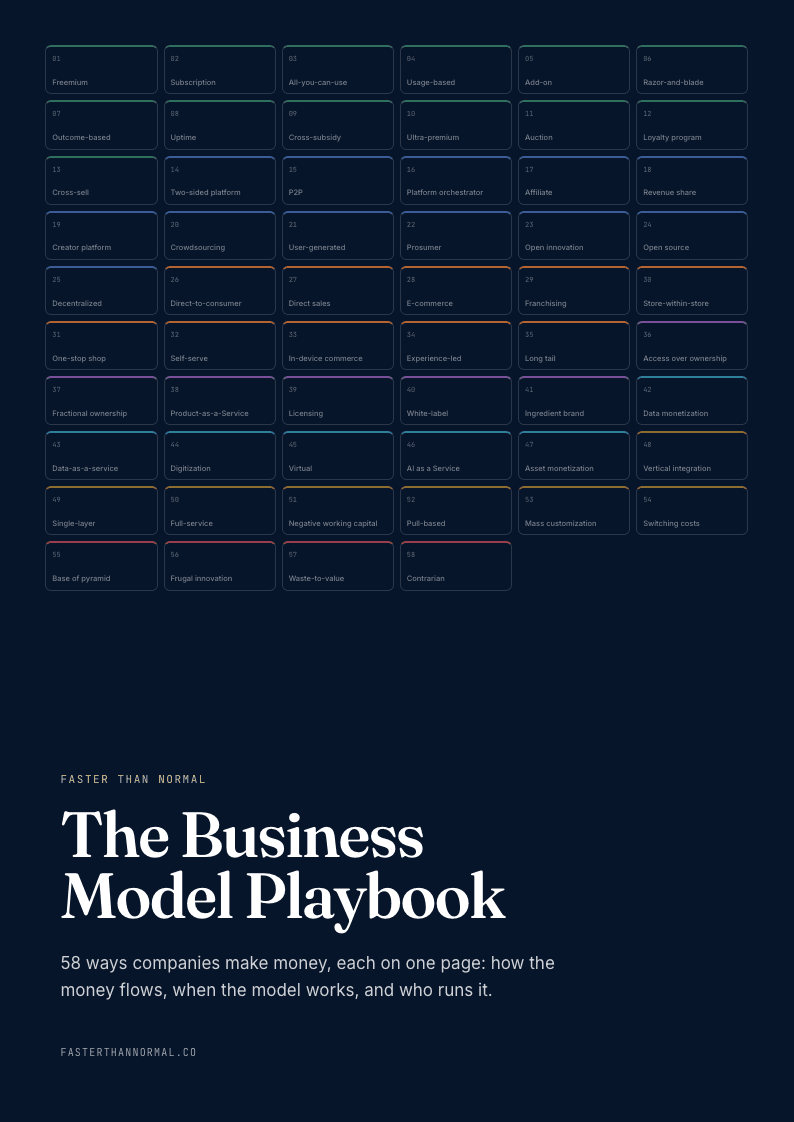
Get The Business Model Playbook
58 business models, one visual page each: how the money flows, the metrics that matter, and who runs it. Free when you join the Faster Than Normal email.
Free. No spam. Unsubscribe anytime.