

Contents
Book summary
Power Play: Tesla, Elon Musk, and the Bet of the Century
by Tim Higgins
The Core Premise
Tesla's near-death experiences weren't bugs in Elon Musk's system—they were features. Tim Higgins reveals how Musk weaponized chaos, turning Tesla's constant crises into competitive advantages that traditional automakers couldn't replicate. While Ford and GM optimized for predictable quarterly earnings, Musk built a company that thrived on existential deadlines and impossible targets, creating what Higgins calls "manufactured urgency" as Tesla's core operational philosophy.
The Model 3 production crisis of 2018 exemplifies Musk's Crisis-as-Strategy approach. When Tesla hit "production hell," missing targets by 90% while burning $1 billion per quarter, Musk didn't hire consultants or restructure operations. Instead, he slept on the factory floor, personally troubleshooting bottlenecks and creating what employees called "surge mode"—a state of permanent emergency that eliminated bureaucratic friction. Traditional automakers dismissed this as amateur hour, but Higgins demonstrates how this manufactured chaos allowed Tesla to compress normal 5-year development cycles into 18-month sprints. The company that nearly went bankrupt became the world's most valuable automaker precisely because it operated like it was always going bankrupt.
Higgins identifies Musk's "Reality Distortion Field 2.0"—a systematic approach to making impossible timelines feel inevitable. Unlike Steve Jobs' version, which focused on product perfection, Musk's distortion field weaponizes public promises as internal forcing functions. When Musk announced Tesla would produce 500,000 cars annually by 2018 (a 10x increase from current production), this wasn't delusion—it was strategic constraint creation. The public commitment eliminated the option of gradual scaling, forcing breakthrough innovations rather than incremental improvements. Engineers couldn't optimize existing processes; they had to invent entirely new manufacturing approaches.
The book exposes Tesla's "Asymmetric Information Warfare" against traditional competitors. While GM and Ford published detailed quarterly guidance, Tesla operated in controlled opacity, revealing progress through dramatic unveilings and Musk's Twitter pronouncements. This information asymmetry prevented competitors from accurately assessing Tesla's true capabilities or timeline threats. When Tesla unveiled the Cybertruck's radical design, competitors couldn't determine whether this represented genuine breakthrough engineering or elaborate vaporware—paralyzing their response strategies. Higgins shows how this uncertainty became Tesla's moat, forcing incumbents to hedge their bets rather than commit fully to electric vehicle transitions.
For executives, Tesla's model offers a provocative alternative to traditional scaling strategies. Rather than building robust processes that minimize risk, Musk created antifragile systems that gained strength from volatility. The key insight isn't that chaos is inherently good, but that manufactured urgency can unlock organizational capabilities that steady-state operations cannot access. However, Higgins warns this approach requires leaders willing to absorb personal and reputational costs that would destroy conventional executives—making Tesla's playbook powerful but difficult to replicate without accepting extreme personal risk.
A Wall Street Journal Business Bestseller 'A deeply reported and business-savvy chronicle of Tesla's wild ride' --Walter Isaacson 'A masterclass in narrative journalism' --Bradley Hope 'Exemplary' --The Times 'An exceptional work' --Washington Post Inside the outrageous, come-from-behind story of Elon Musk and Tesla's bid to build the world's greatest car and the race to drive the future. Elon Musk is among the most controversial titans of Silicon Valley. To some he's a genius and a visionary and to others he's a mercurial huckster. Billions of dollars have been gained and lost on his tweets and his personal exploits are the stuff of tabloids. But for all his outrageous talk of mind-uploading and space travel, his most audacious vision is the one closest to the ground: the electric car. When Tesla was founded in the 2000s, electric cars were novelties, trotted out and thrown on the scrap heap by carmakers for more than a century. But where most onlookers saw only failure, a small band of Silicon Valley engineers and entrepreneurs saw potential and they pitted themselves against the biggest, fiercest business rivals in the world, setting out to make a car that was quicker, sexier,…
Power Play: Tesla, Elon Musk, and the Bet of the Century by Tim Higgins belongs on the short shelf of books that change how you notice decisions in the wild. Whether you agree with every claim or not, the frame it offers is portable: you can apply it in meetings, investing, hiring, and personal trade-offs without carrying the whole volume.
Many readers return to this book because it names patterns that felt familiar but unnamed. Naming is leverage: once you can point to a mechanism, you can design around it. One through-line is “Manufactured Urgency: Musk deliberately created artificial deadlines and impossible targets to eliminate organizational slack and bureaucratic friction. This forced teams to find breakthrough solution” and its implications for judgment under uncertainty.
If you are reading for execution, translate each chapter into a testable habit: one prompt before a big decision, one review question after a project, one constraint you will respect next quarter. Theory becomes useful when it shows up in calendars, not only in margins.
Finally, pair this book with opposing voices. The strongest readers stress-test the thesis against cases where the advice fails, note the boundary conditions, and keep a short list of when not to use this lens. That discipline is how summaries become judgment.
Long-form books reward spaced attention: read a chapter, sleep, then write a half-page memo titled “What would I do differently on Monday?” If you cannot answer with specifics, the idea has not yet landed.
Use Power Play: Tesla, Elon Musk, and the Bet of the Century as a conversation starter with peers who have different incentives. The disagreements often reveal which parts of the book are robust and which are fragile when power, risk, and time horizons change.
Key Ideas and Arguments
Manufactured Urgency: Musk deliberately created artificial deadlines and impossible targets to eliminate organizational slack and bureaucratic friction. This forced teams to find breakthrough solutions rather than optimize existing processes, compressing typical automotive development timelines from years to months.. This idea shows up repeatedly in Power Play: Tesla, Elon Musk, and the Bet of the Century: separate the definition from the examples, then ask where the author's evidence is strongest and where anecdotes do most of the work. Consider writing a counterexample: a situation where applying the idea literally would misfire, and what guardrail you would add.
Crisis-as-Strategy: Tesla used near-bankruptcy conditions as competitive advantages, operating in permanent emergency mode that allowed rapid decision-making and resource reallocation. While competitors optimized for stability, Tesla optimized for crisis response capabilities.. This idea shows up repeatedly in Power Play: Tesla, Elon Musk, and the Bet of the Century: separate the definition from the examples, then ask where the author's evidence is strongest and where anecdotes do most of the work. Consider writing a counterexample: a situation where applying the idea literally would misfire, and what guardrail you would add.
Reality Distortion Field 2.0: Unlike Jobs' perfectionist version, Musk's reality distortion field weaponized public promises as internal forcing functions. Bold announcements eliminated gradual scaling options, forcing teams to achieve breakthrough innovations rather than incremental improvements.. This idea shows up repeatedly in Power Play: Tesla, Elon Musk, and the Bet of the Century: separate the definition from the examples, then ask where the author's evidence is strongest and where anecdotes do most of the work. Consider writing a counterexample: a situation where applying the idea literally would misfire, and what guardrail you would add.
Asymmetric Information Warfare: Tesla maintained strategic opacity about capabilities and timelines while competitors published detailed guidance. This information asymmetry prevented accurate competitive assessment and paralyzed incumbent response strategies.. This idea shows up repeatedly in Power Play: Tesla, Elon Musk, and the Bet of the Century: separate the definition from the examples, then ask where the author's evidence is strongest and where anecdotes do most of the work. Consider writing a counterexample: a situation where applying the idea literally would misfire, and what guardrail you would add.
Antifragile Scaling: Rather than building robust processes that minimize volatility, Tesla created systems that gained strength from chaos and uncertainty. The organization became stronger during crises, turning traditional business weaknesses into competitive moats.. This idea shows up repeatedly in Power Play: Tesla, Elon Musk, and the Bet of the Century: separate the definition from the examples, then ask where the author's evidence is strongest and where anecdotes do most of the work. Consider writing a counterexample: a situation where applying the idea literally would misfire, and what guardrail you would add.
Surge Mode Operations: Tesla's ability to rapidly mobilize entire organizations around specific bottlenecks or challenges, eliminating normal hierarchical decision-making. This allowed unprecedented resource concentration and problem-solving speed.. This idea shows up repeatedly in Power Play: Tesla, Elon Musk, and the Bet of the Century: separate the definition from the examples, then ask where the author's evidence is strongest and where anecdotes do most of the work. Consider writing a counterexample: a situation where applying the idea literally would misfire, and what guardrail you would add.
Public Commitment Leverage: Using external promises and announcements to create internal constraints that forced breakthrough performance. Public deadlines eliminated the organizational tendency toward safe, incremental progress.. This idea shows up repeatedly in Power Play: Tesla, Elon Musk, and the Bet of the Century: separate the definition from the examples, then ask where the author's evidence is strongest and where anecdotes do most of the work. Consider writing a counterexample: a situation where applying the idea literally would misfire, and what guardrail you would add.
Deeper Themes and Context
Power Play: Tesla, Elon Musk, and the Bet of the Century is not only a catalogue of claims; it is a stance on how to interpret success, failure, and ambiguity. Readers who engage charitably still ask: which recommendations are universal, which are culturally situated, and which require institutional support you do not have?
Comparing the book's prescriptions to your own context is part of the work. A strategy that assumes abundant capital, patient stakeholders, or long feedback loops will read differently if you are resource-constrained, early in a career, or operating under regulatory pressure. Translation beats transcription.
The book also invites you to notice what it does not say. Silences can be instructive: topics the author avoids, counterexamples that never appear, or metrics that are praised without definition. A serious reader keeps a missing-evidence note alongside a to-try note.
Historically, the most influential business and biography titles survive because they double as vocabulary. Teams that share a phrase from Power Play: Tesla, Elon Musk, and the Bet of the Century move faster only when they also share a definition and a worked example, otherwise they talk past each other with the same words.
How to Apply the Lessons
Connected Mental Models
Who Should Read This
Start here if you want a serious, book-length argument rather than a thread of bullet points. Power Play: Tesla, Elon Musk, and the Bet of the Century rewards readers who will sketch their own examples, argue back in the margins, and connect chapters to decisions they are facing this quarter.
It is also useful as a shared vocabulary for teams: a common chapter reference can shorten debate if everyone agrees what the term means in practice. If your team only shares the title, not the definition, expect confusion.
Skip or skim if you need a narrow tactical recipe with no theory; this summary preserves the ideas, but the book's value is often in the extended case material and the author's sequencing.
Analyst's Take
Test Yourself
Check your grasp of the book’s moves
A colleague quotes Power Play: Tesla, Elon Musk, and the Bet of the Century to justify a risky decision. What should you verify first?
You finished Power Play: Tesla, Elon Musk, and the Bet of the Century and want behaviour change this week.
Further Reading
Continue exploring


Free playbook
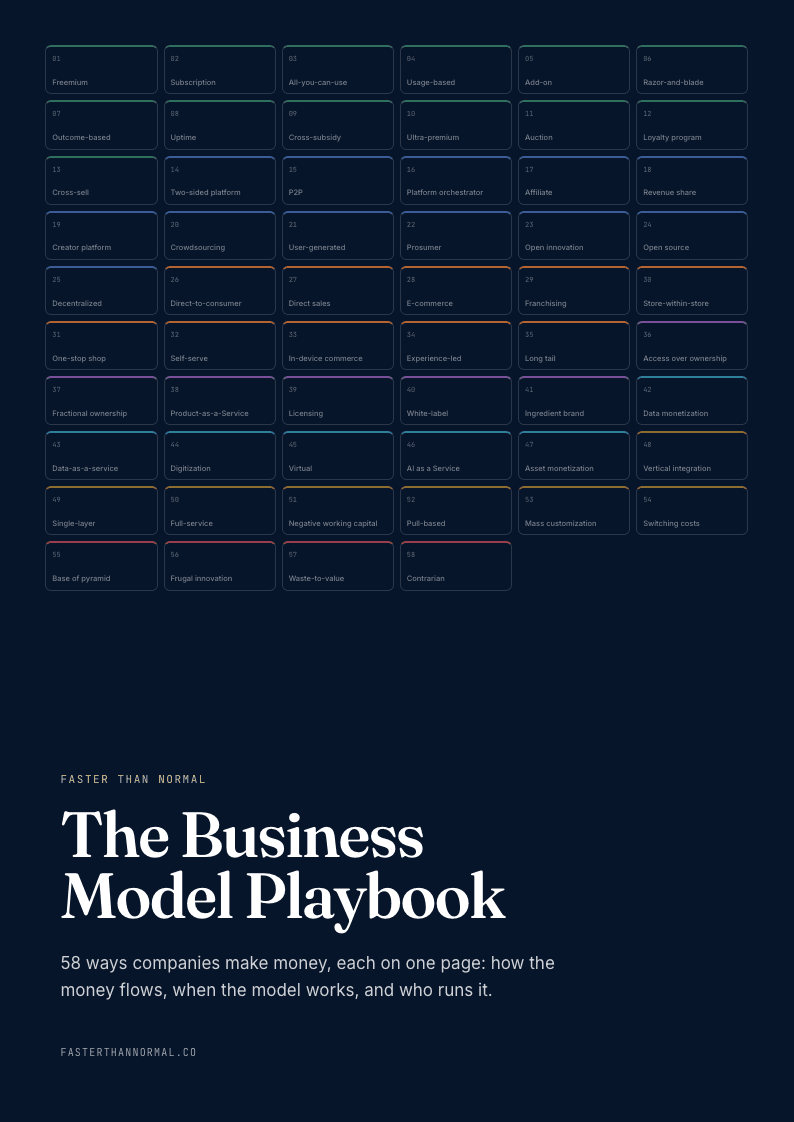
Get The Business Model Playbook
58 business models, one visual page each: how the money flows, the metrics that matter, and who runs it. Free when you join the Faster Than Normal email.
Free. No spam. Unsubscribe anytime.