

Contents
Book summary
Painfully Rich
by John Pearson
The Core Premise
Wealth doesn't corrupt character—it reveals it. John Pearson's forensic examination of the Getty family fortune demonstrates how extreme wealth amplifies existing personality traits while creating entirely new psychological pressures that can destroy families across generations. The Getty billions became a laboratory for human nature under extreme conditions, producing a dynasty marked by paranoia, isolation, and spectacular self-destruction.
Pearson introduces the concept of "wealth psychosis"—the mental distortion that occurs when money removes all normal constraints on behavior. J. Paul Getty, the family patriarch, exhibited classic symptoms: pathological frugality despite immense wealth, inability to form genuine relationships, and a compulsive need to control family members through financial manipulation. Getty installed pay phones in his mansion for guests while simultaneously accumulating the world's largest private fortune. This wasn't eccentricity—it was the systematic dehumanization that extreme wealth can inflict on its possessor. Pearson documents how Getty's wealth created what he terms "gilded isolation," cutting him off from authentic human connection and normal social feedback loops.
The Getty family's tragedy reached its peak with the 1973 kidnapping of sixteen-year-old John Paul Getty III in Italy. When the kidnappers demanded $17 million in ransom, the grandfather famously refused to pay, claiming it would encourage copycat crimes against his other grandchildren. Only after the boy's ear was severed and mailed to a newspaper did Getty Sr. agree to pay $2.2 million—the maximum tax-deductible amount. He loaned the remaining sum to his son at 4% interest. This incident crystallizes Pearson's central thesis about "transactional thinking"—how extreme wealth transforms even family relationships into financial calculations. The psychological damage from this betrayal rippled through subsequent generations, contributing to drug addiction, early death, and family fragmentation.
Pearson's analysis reveals the "succession paradox" that plagues wealthy dynasties: the skills required to build great wealth often make someone incapable of raising healthy children or maintaining family cohesion. Getty Sr.'s obsessive focus on business expansion, tax optimization, and asset protection created emotional voids in his children that money couldn't fill. Each generation became progressively more dysfunctional as inherited wealth removed the necessity for purpose-driven work while amplifying every character flaw. The book serves as a cautionary tale for modern entrepreneurs building significant wealth—demonstrating that financial success without intentional character development and family systems creates predictable pathologies that compound across generations.
The story of J. Paul Getty and how his enormous wealth, $4 billion divided between nineteen heirs, wreaked havoc with the lives of his family.
Painfully Rich by John Pearson belongs on the short shelf of books that change how you notice decisions in the wild. Whether you agree with every claim or not, the frame it offers is portable: you can apply it in meetings, investing, hiring, and personal trade-offs without carrying the whole volume.
Many readers return to this book because it names patterns that felt familiar but unnamed. Naming is leverage: once you can point to a mechanism, you can design around it. One through-line is “Wealth Psychosis: The systematic mental distortion that occurs when extreme wealth removes normal behavioral constraints and social feedback loops. Getty Sr. exhibited this through pathological frugal” and its implications for judgment under uncertainty.
If you are reading for execution, translate each chapter into a testable habit: one prompt before a big decision, one review question after a project, one constraint you will respect next quarter. Theory becomes useful when it shows up in calendars, not only in margins.
Finally, pair this book with opposing voices. The strongest readers stress-test the thesis against cases where the advice fails, note the boundary conditions, and keep a short list of when not to use this lens. That discipline is how summaries become judgment.
Long-form books reward spaced attention: read a chapter, sleep, then write a half-page memo titled “What would I do differently on Monday?” If you cannot answer with specifics, the idea has not yet landed.
Use Painfully Rich as a conversation starter with peers who have different incentives. The disagreements often reveal which parts of the book are robust and which are fragile when power, risk, and time horizons change.
Key Ideas and Arguments
Wealth Psychosis: The systematic mental distortion that occurs when extreme wealth removes normal behavioral constraints and social feedback loops. Getty Sr. exhibited this through pathological frugality, emotional isolation, and treating family relationships as financial transactions.. This idea shows up repeatedly in Painfully Rich: separate the definition from the examples, then ask where the author's evidence is strongest and where anecdotes do most of the work. Consider writing a counterexample: a situation where applying the idea literally would misfire, and what guardrail you would add.
Gilded Isolation: The phenomenon where great wealth cuts individuals off from authentic human connection and honest feedback. Getty lived in mansions surrounded by employees who depended on him financially, creating an echo chamber that reinforced his worst impulses.. This idea shows up repeatedly in Painfully Rich: separate the definition from the examples, then ask where the author's evidence is strongest and where anecdotes do most of the work. Consider writing a counterexample: a situation where applying the idea literally would misfire, and what guardrail you would add.
Transactional Thinking: The transformation of personal relationships into financial calculations that extreme wealth can trigger. Getty's decision to loan ransom money to his son at interest exemplifies this dehumanizing mindset.. This idea shows up repeatedly in Painfully Rich: separate the definition from the examples, then ask where the author's evidence is strongest and where anecdotes do most of the work. Consider writing a counterexample: a situation where applying the idea literally would misfire, and what guardrail you would add.
Succession Paradox: The contradiction where skills needed to build great wealth often make someone incapable of raising emotionally healthy children. Getty's business obsession created the family dysfunction that destroyed his legacy.. This idea shows up repeatedly in Painfully Rich: separate the definition from the examples, then ask where the author's evidence is strongest and where anecdotes do most of the work. Consider writing a counterexample: a situation where applying the idea literally would misfire, and what guardrail you would add.
Generational Wealth Decay: The pattern where each generation of inherited wealth becomes progressively more dysfunctional as money removes purpose while amplifying character flaws. The Getty children and grandchildren exhibited escalating problems with addiction and early death.. This idea shows up repeatedly in Painfully Rich: separate the definition from the examples, then ask where the author's evidence is strongest and where anecdotes do most of the work. Consider writing a counterexample: a situation where applying the idea literally would misfire, and what guardrail you would add.
Financial Control Dynamics: How wealthy patriarchs use money as a tool for psychological manipulation and control over family members. Getty structured trusts and financial arrangements to maintain power even from the grave.. This idea shows up repeatedly in Painfully Rich: separate the definition from the examples, then ask where the author's evidence is strongest and where anecdotes do most of the work. Consider writing a counterexample: a situation where applying the idea literally would misfire, and what guardrail you would add.
Inherited Trauma Amplification: The way wealth-related family trauma compounds across generations when combined with unlimited resources for self-destructive behavior. Getty III's addiction problems stemmed partly from his kidnapping experience and family abandonment.. This idea shows up repeatedly in Painfully Rich: separate the definition from the examples, then ask where the author's evidence is strongest and where anecdotes do most of the work. Consider writing a counterexample: a situation where applying the idea literally would misfire, and what guardrail you would add.
Deeper Themes and Context
Painfully Rich is not only a catalogue of claims; it is a stance on how to interpret success, failure, and ambiguity. Readers who engage charitably still ask: which recommendations are universal, which are culturally situated, and which require institutional support you do not have?
Comparing the book's prescriptions to your own context is part of the work. A strategy that assumes abundant capital, patient stakeholders, or long feedback loops will read differently if you are resource-constrained, early in a career, or operating under regulatory pressure. Translation beats transcription.
The book also invites you to notice what it does not say. Silences can be instructive: topics the author avoids, counterexamples that never appear, or metrics that are praised without definition. A serious reader keeps a missing-evidence note alongside a to-try note.
Historically, the most influential business and biography titles survive because they double as vocabulary. Teams that share a phrase from Painfully Rich move faster only when they also share a definition and a worked example, otherwise they talk past each other with the same words.
How to Apply the Lessons
Connected Mental Models
Who Should Read This
Start here if you want a serious, book-length argument rather than a thread of bullet points. Painfully Rich rewards readers who will sketch their own examples, argue back in the margins, and connect chapters to decisions they are facing this quarter.
It is also useful as a shared vocabulary for teams: a common chapter reference can shorten debate if everyone agrees what the term means in practice. If your team only shares the title, not the definition, expect confusion.
Skip or skim if you need a narrow tactical recipe with no theory; this summary preserves the ideas, but the book's value is often in the extended case material and the author's sequencing.
Analyst's Take
Test Yourself
Check your grasp of the book’s moves
A colleague quotes Painfully Rich to justify a risky decision. What should you verify first?
You finished Painfully Rich and want behaviour change this week.
Further Reading
Continue exploring


Free playbook
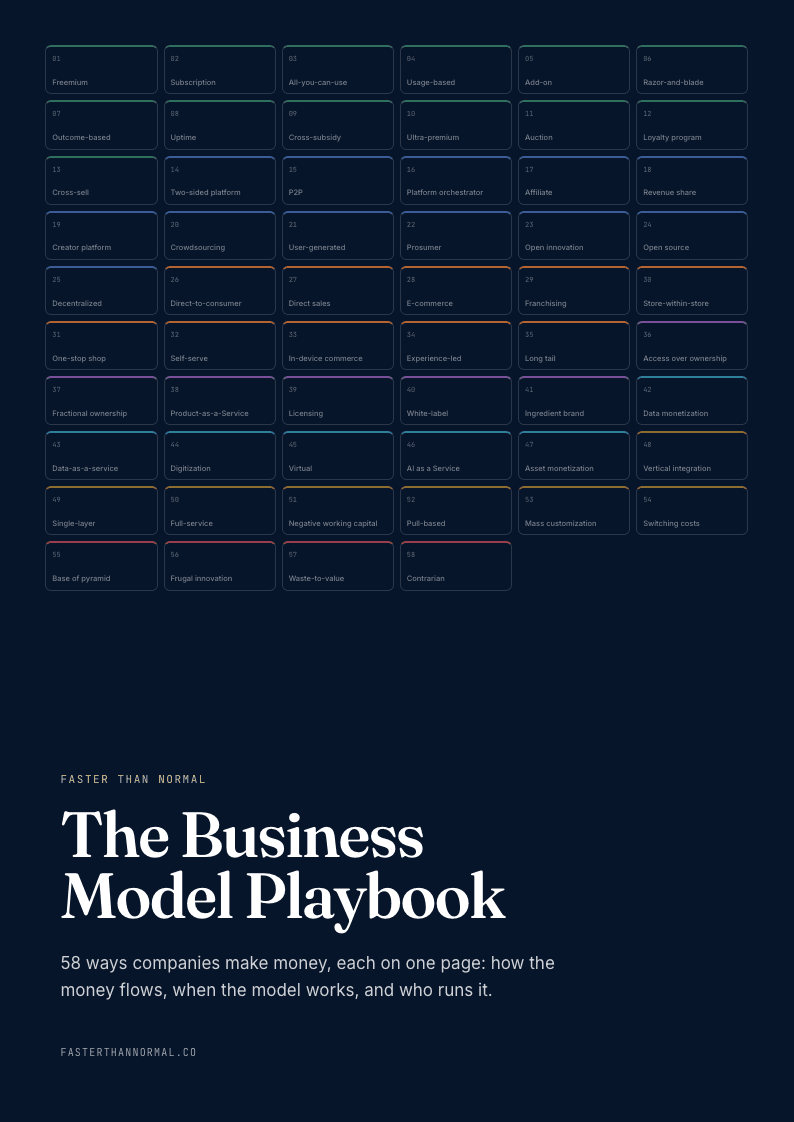
Get The Business Model Playbook
58 business models, one visual page each: how the money flows, the metrics that matter, and who runs it. Free when you join the Faster Than Normal email.
Free. No spam. Unsubscribe anytime.