

Contents
Book summary
Losing My Virginity
by Richard Branson
The Core Premise
Richard Branson built a $5 billion empire by systematically violating every rule taught in business schools. While MBAs learn to minimize risk and maximize predictability, Branson throws himself into industries he knows nothing about, hires based on personality over credentials, and treats customers like family members rather than revenue streams. His Virgin Group methodology proves that entrepreneurial intuition, properly channeled, beats analytical rigor in markets ripe for disruption.
Branson's "Screw It, Let's Do It" philosophy drives his decision-making framework across Virgin's 400+ companies. When British Airways dominated the London-New York route with terrible service and high prices, Branson didn't conduct market research or hire aviation consultants. He leased a single Boeing 747, painted it red, installed bars and entertainment systems, and launched Virgin Atlantic with borrowed money and boundless confidence. The airline succeeded because Branson focused obsessively on the customer experience gaps that incumbent airlines ignored. His Virgin Atlantic case study reveals how entrepreneurs can identify market inefficiencies by experiencing them as frustrated customers rather than studying spreadsheets.
The Virgin brand architecture operates on what Branson calls the "branded venture capital" model. Instead of building one massive corporation, Virgin functions as a portfolio of independent companies sharing brand values but maintaining operational autonomy. Virgin Mobile entered the telecom industry by partnering with existing network operators rather than building infrastructure from scratch. This asset-light approach allowed Virgin to focus on customer service and marketing while established players handled technical operations. Branson discovered that Virgin's brand equity could be leveraged across industries when customer pain points aligned with Virgin's core values: fun, value, and challenging the status quo.
Branson's leadership philosophy centers on hiring for attitude and cultural fit rather than specific skills or experience. He promotes employees based on their ability to embody Virgin's entrepreneurial spirit, often placing young, enthusiastic team members in senior roles ahead of industry veterans. When Virgin launched Virgin Cola to challenge Coca-Cola, Branson didn't hire beverage industry executives. Instead, he assembled a team of marketing rebels who understood that Virgin Cola's success depended on brand differentiation and guerrilla marketing tactics rather than distribution muscle. The Cola venture ultimately failed against Coke's entrenched position, but the experience taught Branson when brand alone isn't sufficient to overcome structural industry advantages.
The practical applications for modern founders emerge from Branson's systematic approach to industry disruption. His market entry framework begins with identifying customer frustration in established industries, particularly where incumbents have grown complacent. Branson then applies Virgin's core differentiators—superior customer service, transparent pricing, and irreverent marketing—to create competitive advantage. For executives leading transformation initiatives, Branson's emphasis on company culture as a strategic asset provides a blueprint for building organizations that can adapt quickly to market changes. His willingness to admit failures and pivot rapidly demonstrates that entrepreneurial velocity often matters more than initial strategy perfection.
Losing my virginity is the unusual, frequently outrageous autobiography of one of the great business geniuses of our time.
Losing My Virginity by Richard Branson belongs on the short shelf of books that change how you notice decisions in the wild. Whether you agree with every claim or not, the frame it offers is portable: you can apply it in meetings, investing, hiring, and personal trade-offs without carrying the whole volume.
Many readers return to this book because it names patterns that felt familiar but unnamed. Naming is leverage: once you can point to a mechanism, you can design around it. One through-line is “Branded Venture Capital Model: Virgin operates as a portfolio of independent companies sharing brand values but maintaining operational autonomy. This allows rapid market entry with minimal capital in” and its implications for judgment under uncertainty.
If you are reading for execution, translate each chapter into a testable habit: one prompt before a big decision, one review question after a project, one constraint you will respect next quarter. Theory becomes useful when it shows up in calendars, not only in margins.
Finally, pair this book with opposing voices. The strongest readers stress-test the thesis against cases where the advice fails, note the boundary conditions, and keep a short list of when not to use this lens. That discipline is how summaries become judgment.
Long-form books reward spaced attention: read a chapter, sleep, then write a half-page memo titled “What would I do differently on Monday?” If you cannot answer with specifics, the idea has not yet landed.
Use Losing My Virginity as a conversation starter with peers who have different incentives. The disagreements often reveal which parts of the book are robust and which are fragile when power, risk, and time horizons change.
Key Ideas and Arguments
Branded Venture Capital Model: Virgin operates as a portfolio of independent companies sharing brand values but maintaining operational autonomy. This allows rapid market entry with minimal capital investment while leveraging established brand equity across diverse industries.. This idea shows up repeatedly in Losing My Virginity: separate the definition from the examples, then ask where the author's evidence is strongest and where anecdotes do most of the work. Consider writing a counterexample: a situation where applying the idea literally would misfire, and what guardrail you would add.
Screw It, Let's Do It Philosophy: Branson's decision-making framework prioritizes action over analysis, betting that market feedback from real customers provides better intelligence than theoretical research. This approach works best in industries with clear customer pain points and complacent incumbents.. This idea shows up repeatedly in Losing My Virginity: separate the definition from the examples, then ask where the author's evidence is strongest and where anecdotes do most of the work. Consider writing a counterexample: a situation where applying the idea literally would misfire, and what guardrail you would add.
Customer Experience Gap Analysis: Virgin identifies market opportunities by focusing on industries where established players deliver poor customer service or ignore obvious customer needs. Success depends on Virgin's ability to deliver superior experience rather than superior products.. This idea shows up repeatedly in Losing My Virginity: separate the definition from the examples, then ask where the author's evidence is strongest and where anecdotes do most of the work. Consider writing a counterexample: a situation where applying the idea literally would misfire, and what guardrail you would add.
Asset-Light Market Entry: Rather than building infrastructure from scratch, Virgin partners with existing operators while focusing on brand, marketing, and customer service. This strategy reduces capital requirements but limits control over operational quality.. This idea shows up repeatedly in Losing My Virginity: separate the definition from the examples, then ask where the author's evidence is strongest and where anecdotes do most of the work. Consider writing a counterexample: a situation where applying the idea literally would misfire, and what guardrail you would add.
Culture-First Hiring: Branson hires for personality and cultural fit rather than industry experience, promoting based on entrepreneurial attitude rather than traditional qualifications. This approach builds adaptable teams but requires strong training and mentorship systems.. This idea shows up repeatedly in Losing My Virginity: separate the definition from the examples, then ask where the author's evidence is strongest and where anecdotes do most of the work. Consider writing a counterexample: a situation where applying the idea literally would misfire, and what guardrail you would add.
Failure as Market Intelligence: Branson treats business failures as valuable data about market dynamics and strategic limitations. Failed ventures like Virgin Cola and Virgin Brides provided insights that improved subsequent market entries.. This idea shows up repeatedly in Losing My Virginity: separate the definition from the examples, then ask where the author's evidence is strongest and where anecdotes do most of the work. Consider writing a counterexample: a situation where applying the idea literally would misfire, and what guardrail you would add.
Brand Values as Strategy Filter: Virgin's core values—fun, value, and challenging the status quo—serve as decision-making criteria for market entry and operational choices. This consistency builds brand recognition but can limit opportunities in more traditional industries.. This idea shows up repeatedly in Losing My Virginity: separate the definition from the examples, then ask where the author's evidence is strongest and where anecdotes do most of the work. Consider writing a counterexample: a situation where applying the idea literally would misfire, and what guardrail you would add.
Deeper Themes and Context
Losing My Virginity is not only a catalogue of claims; it is a stance on how to interpret success, failure, and ambiguity. Readers who engage charitably still ask: which recommendations are universal, which are culturally situated, and which require institutional support you do not have?
Comparing the book's prescriptions to your own context is part of the work. A strategy that assumes abundant capital, patient stakeholders, or long feedback loops will read differently if you are resource-constrained, early in a career, or operating under regulatory pressure. Translation beats transcription.
The book also invites you to notice what it does not say. Silences can be instructive: topics the author avoids, counterexamples that never appear, or metrics that are praised without definition. A serious reader keeps a missing-evidence note alongside a to-try note.
Historically, the most influential business and biography titles survive because they double as vocabulary. Teams that share a phrase from Losing My Virginity move faster only when they also share a definition and a worked example, otherwise they talk past each other with the same words.
How to Apply the Lessons
Connected Mental Models
Who Should Read This
Start here if you want a serious, book-length argument rather than a thread of bullet points. Losing My Virginity rewards readers who will sketch their own examples, argue back in the margins, and connect chapters to decisions they are facing this quarter.
It is also useful as a shared vocabulary for teams: a common chapter reference can shorten debate if everyone agrees what the term means in practice. If your team only shares the title, not the definition, expect confusion.
Skip or skim if you need a narrow tactical recipe with no theory; this summary preserves the ideas, but the book's value is often in the extended case material and the author's sequencing.
Analyst's Take
Test Yourself
Check your grasp of the book’s moves
A colleague quotes Losing My Virginity to justify a risky decision. What should you verify first?
You finished Losing My Virginity and want behaviour change this week.
Further Reading
Continue exploring


Free playbook
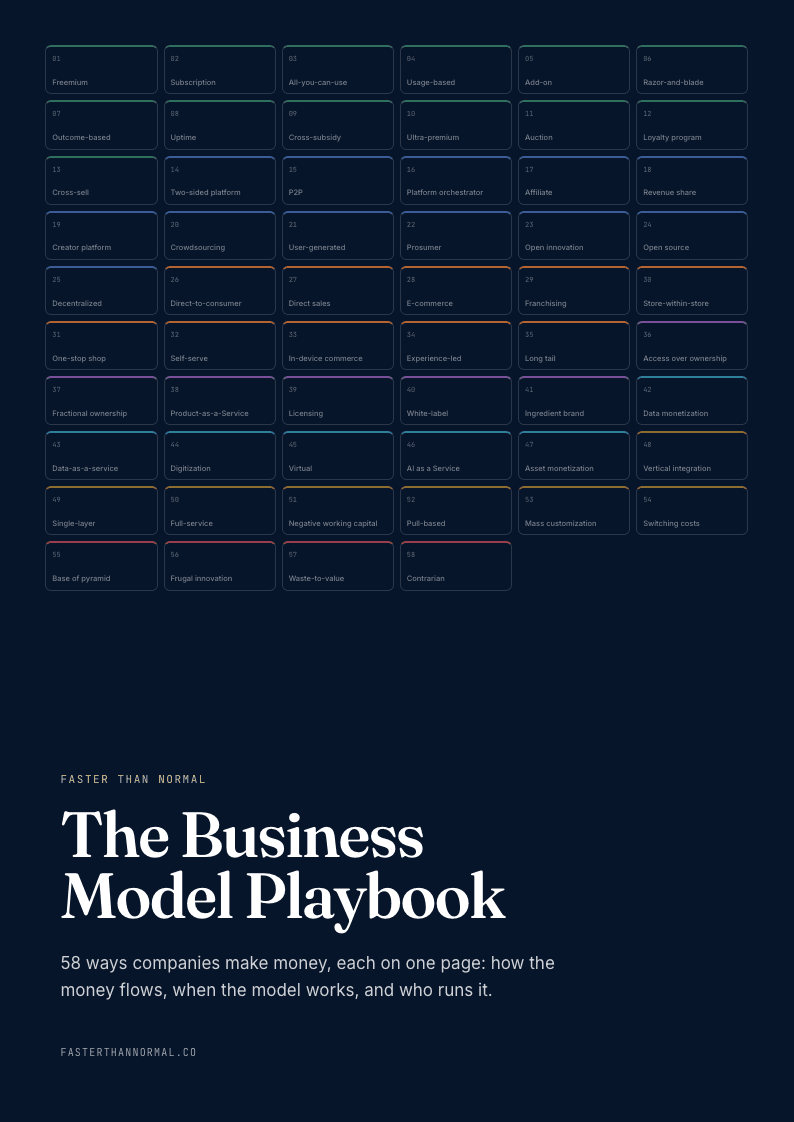
Get The Business Model Playbook
58 business models, one visual page each: how the money flows, the metrics that matter, and who runs it. Free when you join the Faster Than Normal email.
Free. No spam. Unsubscribe anytime.