

Contents
Book summary
Like a Virgin: Secrets They Won't Teach You at Business School
by Richard Branson
The Core Premise
While Harvard MBAs obsess over five-year strategic plans and competitive analysis frameworks, Richard Branson built a $25 billion empire by breaking every rule they teach. The Virgin founder's approach to business reads like a masterclass in controlled chaos: hire for personality over credentials, enter industries where customers hate the incumbents, and never let fear of failure prevent bold moves into uncharted territory.
Branson's "Screw It, Let's Do It" philosophy underpins his most audacious ventures. When British Airways dominated the transatlantic route with terrible service and sky-high prices, Virgin Atlantic entered with lie-flat beds, onboard massages, and a punk rock attitude. The lesson wasn't just about customer service—it demonstrated Branson's core principle of finding markets where large corporations have grown complacent and customers feel trapped. He applied this same logic to mobile phones with Virgin Mobile, challenging established telecom giants by offering contract-free service and irreverent marketing that spoke to younger consumers ignored by the industry.
The Virgin Way operates on what Branson calls "employee first, customer second" thinking, a deliberate inversion of conventional business wisdom. He argues that truly happy employees create exceptional customer experiences naturally, while companies that prioritize customers over staff create fake enthusiasm that customers instantly detect. This philosophy shaped Virgin's famous company culture, where flight attendants are encouraged to crack jokes, customer service reps have real authority to solve problems, and mistakes are treated as learning opportunities rather than firing offenses. The result: Virgin consistently ranks among the world's most admired brands despite operating in traditionally unglamorous industries.
Branson's decision-making process deliberately bypasses traditional business school analytics. He relies on gut instinct, personal passion for the venture, and what he terms the "brand stretch" test—whether a new business fits Virgin's rebel-with-a-cause identity. When Virgin entered the space tourism market with Virgin Galactic, the decision wasn't driven by market research or financial projections but by Branson's childhood fascination with space exploration and his belief that Virgin could democratize an experience previously reserved for astronauts. This intuitive approach extends to leadership style: Branson advocates for visible, accessible leadership where executives regularly work alongside frontline employees and customers.
For executives trapped in corporate bureaucracy, Branson's methods offer a radical alternative to committee-driven decision making and risk-averse corporate culture. His emphasis on rapid experimentation, genuine employee empowerment, and brand-driven market entry provides a blueprint for companies seeking to recapture entrepreneurial agility. The key insight: sustainable competitive advantage comes not from superior strategy or operational excellence, but from building organizations that customers and employees genuinely love—a goal that requires throwing out most of what business schools teach about professional management.
It’s business school, the Branson way. Whether you’re interested in starting your own business, improving your leadership skills, or simply looking for inspiration from one of the greatest entrepreneurs of our time, Richard Branson has the answers. Like a Virgin brings together some of his best advice, distilling the experiences and insights that have made him one of the world’s most recognized and respected business leaders. In his trademark thoughtful and encouraging voice, Branson shares his knowledge like a close friend. He’ll teach you how to be more innovative, how to lead by listening, how to enjoy your work, and much more. In hindsight, Branson is thankful he never went to business school. Had he conformed to the conventional dos and don’ts of starting a business, would there have been a Virgin Records? A Virgin Atlantic? So many of Branson’s achievements are due to his unyielding determination to break the rules and rewrite them himself. Here’s how he does it.
Like a Virgin: Secrets They Won't Teach You at Business School by Richard Branson belongs on the short shelf of books that change how you notice decisions in the wild. Whether you agree with every claim or not, the frame it offers is portable: you can apply it in meetings, investing, hiring, and personal trade-offs without carrying the whole volume.
Many readers return to this book because it names patterns that felt familiar but unnamed. Naming is leverage: once you can point to a mechanism, you can design around it. One through-line is “Screw It, Let's Do It Philosophy: Branson's approach to seizing opportunities immediately rather than endless planning and analysis. When he saw poor airline service on transatlantic routes, he starte” and its implications for judgment under uncertainty.
If you are reading for execution, translate each chapter into a testable habit: one prompt before a big decision, one review question after a project, one constraint you will respect next quarter. Theory becomes useful when it shows up in calendars, not only in margins.
Finally, pair this book with opposing voices. The strongest readers stress-test the thesis against cases where the advice fails, note the boundary conditions, and keep a short list of when not to use this lens. That discipline is how summaries become judgment.
Long-form books reward spaced attention: read a chapter, sleep, then write a half-page memo titled “What would I do differently on Monday?” If you cannot answer with specifics, the idea has not yet landed.
Use Like a Virgin: Secrets They Won't Teach You at Business School as a conversation starter with peers who have different incentives. The disagreements often reveal which parts of the book are robust and which are fragile when power, risk, and time horizons change.
Key Ideas and Arguments
Screw It, Let's Do It Philosophy: Branson's approach to seizing opportunities immediately rather than endless planning and analysis. When he saw poor airline service on transatlantic routes, he started Virgin Atlantic within months rather than spending years on market research and strategic planning.. This idea shows up repeatedly in Like a Virgin: Secrets They Won't Teach You at Business School: separate the definition from the examples, then ask where the author's evidence is strongest and where anecdotes do most of the work. Consider writing a counterexample: a situation where applying the idea literally would misfire, and what guardrail you would add.
Brand Stretch Test: Virgin's framework for evaluating new business opportunities based on whether they align with the company's rebel identity and values. The concept explains why Virgin successfully expanded from music to airlines to space tourism while maintaining brand coherence.. This idea shows up repeatedly in Like a Virgin: Secrets They Won't Teach You at Business School: separate the definition from the examples, then ask where the author's evidence is strongest and where anecdotes do most of the work. Consider writing a counterexample: a situation where applying the idea literally would misfire, and what guardrail you would add.
Employee First, Customer Second: The counterintuitive management principle that prioritizing employee happiness and empowerment ultimately creates better customer experiences. Virgin's high customer satisfaction ratings stem from genuinely engaged employees rather than scripted service protocols.. This idea shows up repeatedly in Like a Virgin: Secrets They Won't Teach You at Business School: separate the definition from the examples, then ask where the author's evidence is strongest and where anecdotes do most of the work. Consider writing a counterexample: a situation where applying the idea literally would misfire, and what guardrail you would add.
Underdog Market Entry: Branson's strategy of entering established industries where large incumbents have grown complacent and customers feel underserved. This approach worked in airlines, mobile phones, and financial services by positioning Virgin as the customer champion against corporate giants.. This idea shows up repeatedly in Like a Virgin: Secrets They Won't Teach You at Business School: separate the definition from the examples, then ask where the author's evidence is strongest and where anecdotes do most of the work. Consider writing a counterexample: a situation where applying the idea literally would misfire, and what guardrail you would add.
Visible Leadership: The practice of leaders working directly with frontline employees and customers rather than managing from boardrooms. Branson regularly flies Virgin flights, works in Virgin stores, and personally handles customer complaints to stay connected to business realities.. This idea shows up repeatedly in Like a Virgin: Secrets They Won't Teach You at Business School: separate the definition from the examples, then ask where the author's evidence is strongest and where anecdotes do most of the work. Consider writing a counterexample: a situation where applying the idea literally would misfire, and what guardrail you would add.
Controlled Risk-Taking: Virgin's approach to managing downside while pursuing upside in new ventures. Branson structures deals to limit Virgin's financial exposure while maintaining significant upside potential, allowing bold moves without betting the company.. This idea shows up repeatedly in Like a Virgin: Secrets They Won't Teach You at Business School: separate the definition from the examples, then ask where the author's evidence is strongest and where anecdotes do most of the work. Consider writing a counterexample: a situation where applying the idea literally would misfire, and what guardrail you would add.
Deeper Themes and Context
Like a Virgin: Secrets They Won't Teach You at Business School is not only a catalogue of claims; it is a stance on how to interpret success, failure, and ambiguity. Readers who engage charitably still ask: which recommendations are universal, which are culturally situated, and which require institutional support you do not have?
Comparing the book's prescriptions to your own context is part of the work. A strategy that assumes abundant capital, patient stakeholders, or long feedback loops will read differently if you are resource-constrained, early in a career, or operating under regulatory pressure. Translation beats transcription.
The book also invites you to notice what it does not say. Silences can be instructive: topics the author avoids, counterexamples that never appear, or metrics that are praised without definition. A serious reader keeps a missing-evidence note alongside a to-try note.
Historically, the most influential business and biography titles survive because they double as vocabulary. Teams that share a phrase from Like a Virgin: Secrets They Won't Teach You at Business School move faster only when they also share a definition and a worked example, otherwise they talk past each other with the same words.
How to Apply the Lessons
Connected Mental Models
Who Should Read This
Start here if you want a serious, book-length argument rather than a thread of bullet points. Like a Virgin: Secrets They Won't Teach You at Business School rewards readers who will sketch their own examples, argue back in the margins, and connect chapters to decisions they are facing this quarter.
It is also useful as a shared vocabulary for teams: a common chapter reference can shorten debate if everyone agrees what the term means in practice. If your team only shares the title, not the definition, expect confusion.
Skip or skim if you need a narrow tactical recipe with no theory; this summary preserves the ideas, but the book's value is often in the extended case material and the author's sequencing.
Analyst's Take
Test Yourself
Check your grasp of the book’s moves
A colleague quotes Like a Virgin: Secrets They Won't Teach You at Business School to justify a risky decision. What should you verify first?
You finished Like a Virgin: Secrets They Won't Teach You at Business School and want behaviour change this week.
Further Reading
Continue exploring


Free playbook
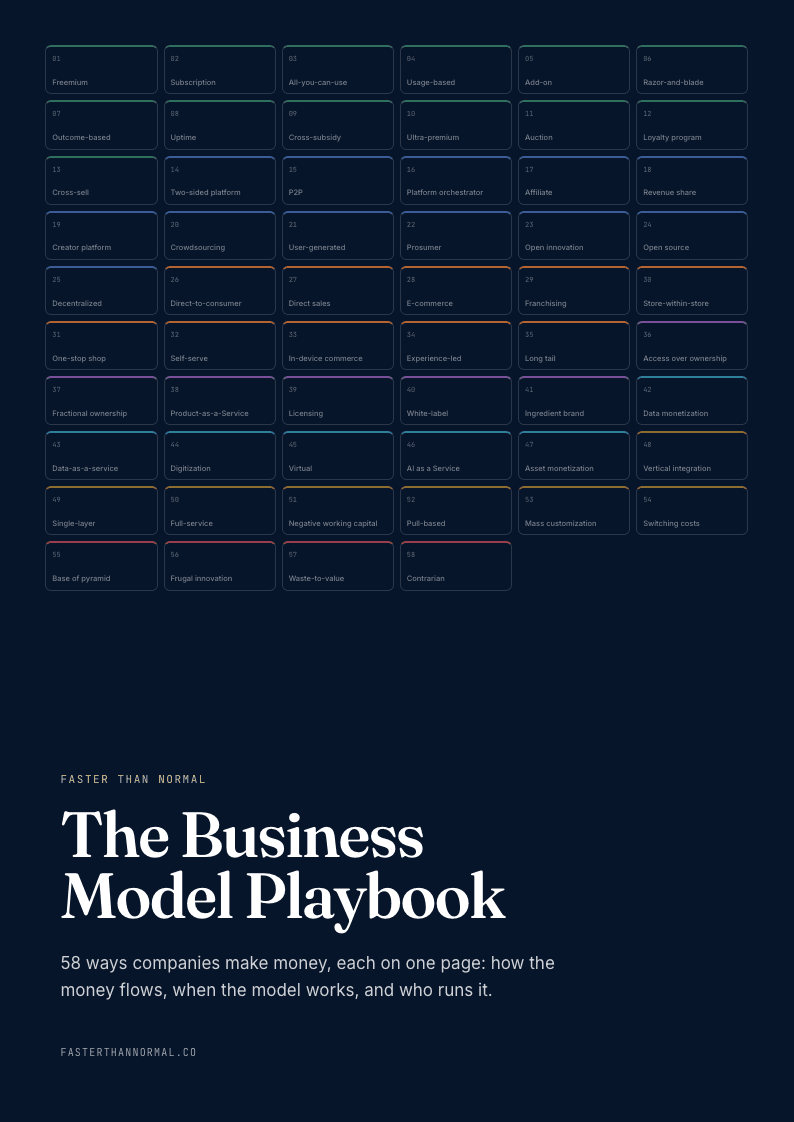
Get The Business Model Playbook
58 business models, one visual page each: how the money flows, the metrics that matter, and who runs it. Free when you join the Faster Than Normal email.
Free. No spam. Unsubscribe anytime.