

Contents
Book summary
Land's Polaroid: A Company and the Man Who Invented It
by Peter C. Wensberg
The Core Premise
Edwin Land built Polaroid around a radical premise that most modern entrepreneurs would consider insane: ignore market research entirely and create products so unprecedented that customers don't yet know they want them. While conventional business wisdom preaches customer validation and iterative development, Land operated from pure scientific curiosity, spending decades and enormous sums developing instant photography simply because the technical challenge fascinated him. This approach produced one of the most successful companies of the mid-20th century—and one of its most spectacular collapses.
Land's "invention-driven innovation" model defied every rule of prudent business management. He routinely bet the entire company on moonshot projects, most famously the SX-70 instant camera, which required inventing new chemistry, optics, and manufacturing processes simultaneously. The project consumed nearly a decade and hundreds of millions of dollars, with no guarantee of success. Land's team had to create light-sensitive dyes that had never existed, engineer a camera mechanism of unprecedented complexity, and solve manufacturing challenges that pushed the boundaries of what was technically possible. The SX-70 launch in 1972 vindicated this approach spectacularly—Polaroid's stock soared and the camera became a cultural phenomenon.
The Polaroid Way, as Land called his management philosophy, created an organization unlike any other. Engineers worked without budgets or deadlines on problems that interested them scientifically. Land believed that artificial constraints killed creativity, so project teams operated with extraordinary autonomy. He famously told employees to "do what's never been done before" rather than optimize existing products. This philosophy attracted brilliant scientists who might have felt constrained in traditional corporate environments. The company became a magnet for PhDs who wanted to solve fundamental problems in chemistry and optics rather than incrementally improve existing products.
Yet Land's greatest strength became Polaroid's fatal weakness. His contempt for market research blinded him to the digital photography revolution brewing in the 1980s. Despite Polaroid's engineers developing early digital imaging technology, Land dismissed electronic photography as inferior to chemical processes. He couldn't imagine customers preferring the convenience of digital over the superior image quality of film. This blind spot proved catastrophic—by the time digital cameras achieved acceptable quality, Polaroid had missed the transition entirely. The company that once defined innovation filed for bankruptcy in 2001.
For modern executives, Land's story offers a nuanced lesson about innovation strategy. His approach worked brilliantly in emerging markets where no established players existed, but failed when disruptive technologies threatened Polaroid's core business. The key insight isn't to copy Land's methods wholesale, but to understand when invention-driven innovation makes strategic sense. Companies facing truly novel problems—artificial intelligence, quantum computing, synthetic biology—might benefit from Land's patience with long development cycles and tolerance for technical uncertainty. But organizations in mature markets ignore customer signals at their peril.
The unauthorized story of the enigmatic man who created a world-class organization in his own image and then lost control of it. 24 pages of photographs.
Land's Polaroid: A Company and the Man Who Invented It by Peter C. Wensberg belongs on the short shelf of books that change how you notice decisions in the wild. Whether you agree with every claim or not, the frame it offers is portable: you can apply it in meetings, investing, hiring, and personal trade-offs without carrying the whole volume.
Many readers return to this book because it names patterns that felt familiar but unnamed. Naming is leverage: once you can point to a mechanism, you can design around it. One through-line is “Invention-Driven Innovation: Land's approach to creating products based on scientific curiosity rather than market demand. He believed breakthrough innovations required solving problems customers didn” and its implications for judgment under uncertainty.
If you are reading for execution, translate each chapter into a testable habit: one prompt before a big decision, one review question after a project, one constraint you will respect next quarter. Theory becomes useful when it shows up in calendars, not only in margins.
Finally, pair this book with opposing voices. The strongest readers stress-test the thesis against cases where the advice fails, note the boundary conditions, and keep a short list of when not to use this lens. That discipline is how summaries become judgment.
Long-form books reward spaced attention: read a chapter, sleep, then write a half-page memo titled “What would I do differently on Monday?” If you cannot answer with specifics, the idea has not yet landed.
Use Land's Polaroid: A Company and the Man Who Invented It as a conversation starter with peers who have different incentives. The disagreements often reveal which parts of the book are robust and which are fragile when power, risk, and time horizons change.
Key Ideas and Arguments
Invention-Driven Innovation: Land's approach to creating products based on scientific curiosity rather than market demand. He believed breakthrough innovations required solving problems customers didn't know they had, exemplified by instant photography which no consumer had requested.. This idea shows up repeatedly in Land's Polaroid: A Company and the Man Who Invented It: separate the definition from the examples, then ask where the author's evidence is strongest and where anecdotes do most of the work. Consider writing a counterexample: a situation where applying the idea literally would misfire, and what guardrail you would add.
The Polaroid Way: Land's management philosophy that eliminated traditional corporate constraints like budgets and deadlines to maximize scientific creativity. Teams worked on fundamental problems without artificial time pressure, attracting top PhD talent who might have been constrained elsewhere.. This idea shows up repeatedly in Land's Polaroid: A Company and the Man Who Invented It: separate the definition from the examples, then ask where the author's evidence is strongest and where anecdotes do most of the work. Consider writing a counterexample: a situation where applying the idea literally would misfire, and what guardrail you would add.
Technical Convergence: Land's method of solving multiple unprecedented technical challenges simultaneously rather than sequentially. The SX-70 required inventing new chemistry, optics, and manufacturing processes concurrently, creating higher risk but potentially revolutionary outcomes.. This idea shows up repeatedly in Land's Polaroid: A Company and the Man Who Invented It: separate the definition from the examples, then ask where the author's evidence is strongest and where anecdotes do most of the work. Consider writing a counterexample: a situation where applying the idea literally would misfire, and what guardrail you would add.
Market Research Paradox: Land's belief that asking customers about revolutionary products was counterproductive because they couldn't envision radical departures from existing solutions. He argued that true innovations created markets rather than serving existing ones.. This idea shows up repeatedly in Land's Polaroid: A Company and the Man Who Invented It: separate the definition from the examples, then ask where the author's evidence is strongest and where anecdotes do most of the work. Consider writing a counterexample: a situation where applying the idea literally would misfire, and what guardrail you would add.
Scientific Entrepreneurship: Land's integration of rigorous scientific method with commercial product development. Unlike typical R&D, Polaroid's labs focused on fundamental scientific problems that could become breakthrough products rather than incremental improvements.. This idea shows up repeatedly in Land's Polaroid: A Company and the Man Who Invented It: separate the definition from the examples, then ask where the author's evidence is strongest and where anecdotes do most of the work. Consider writing a counterexample: a situation where applying the idea literally would misfire, and what guardrail you would add.
The Perfectionist's Trap: Land's inability to release products before achieving his vision of technical perfection. This strength enabled breakthrough innovations like instant photography but became a weakness when facing fast-moving digital disruption.. This idea shows up repeatedly in Land's Polaroid: A Company and the Man Who Invented It: separate the definition from the examples, then ask where the author's evidence is strongest and where anecdotes do most of the work. Consider writing a counterexample: a situation where applying the idea literally would misfire, and what guardrail you would add.
Deeper Themes and Context
Land's Polaroid: A Company and the Man Who Invented It is not only a catalogue of claims; it is a stance on how to interpret success, failure, and ambiguity. Readers who engage charitably still ask: which recommendations are universal, which are culturally situated, and which require institutional support you do not have?
Comparing the book's prescriptions to your own context is part of the work. A strategy that assumes abundant capital, patient stakeholders, or long feedback loops will read differently if you are resource-constrained, early in a career, or operating under regulatory pressure. Translation beats transcription.
The book also invites you to notice what it does not say. Silences can be instructive: topics the author avoids, counterexamples that never appear, or metrics that are praised without definition. A serious reader keeps a missing-evidence note alongside a to-try note.
Historically, the most influential business and biography titles survive because they double as vocabulary. Teams that share a phrase from Land's Polaroid: A Company and the Man Who Invented It move faster only when they also share a definition and a worked example, otherwise they talk past each other with the same words.
How to Apply the Lessons
Connected Mental Models
Who Should Read This
Start here if you want a serious, book-length argument rather than a thread of bullet points. Land's Polaroid: A Company and the Man Who Invented It rewards readers who will sketch their own examples, argue back in the margins, and connect chapters to decisions they are facing this quarter.
It is also useful as a shared vocabulary for teams: a common chapter reference can shorten debate if everyone agrees what the term means in practice. If your team only shares the title, not the definition, expect confusion.
Skip or skim if you need a narrow tactical recipe with no theory; this summary preserves the ideas, but the book's value is often in the extended case material and the author's sequencing.
Analyst's Take
Test Yourself
Check your grasp of the book’s moves
A colleague quotes Land's Polaroid: A Company and the Man Who Invented It to justify a risky decision. What should you verify first?
You finished Land's Polaroid: A Company and the Man Who Invented It and want behaviour change this week.
Further Reading
Continue exploring


Free playbook
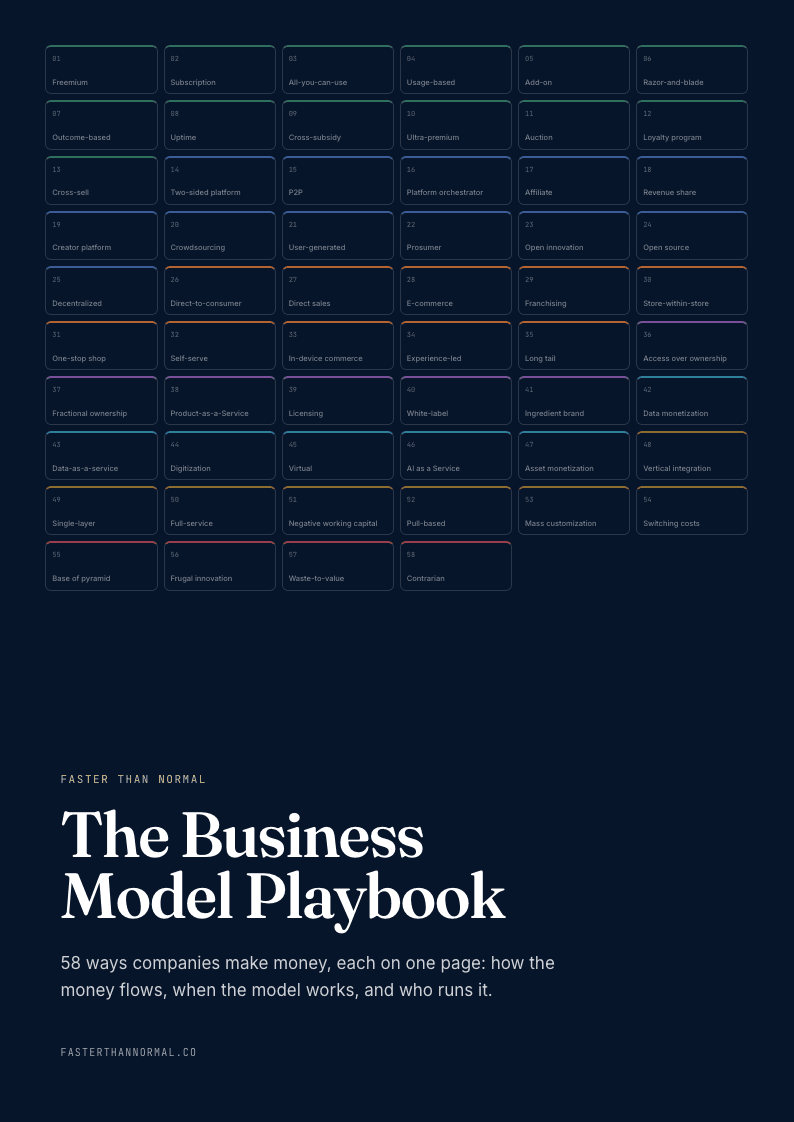
Get The Business Model Playbook
58 business models, one visual page each: how the money flows, the metrics that matter, and who runs it. Free when you join the Faster Than Normal email.
Free. No spam. Unsubscribe anytime.