

Contents
Book summary
Jony Ive: The Genius Behind Apple's Greatest Products
by Leander Kahney
The Core Premise
The most influential designer of the 21st century operates by a counterintuitive principle: the best technology disappears entirely. Jony Ive transformed Apple from near-bankruptcy to the world's most valuable company not through engineering prowess, but by making computers, phones, and tablets feel inevitable—as if they had always existed and were simply waiting to be discovered. His design philosophy centers on what he calls "simplicity" and "honesty," concepts that sound abstract but translate into ruthlessly specific product decisions that redefined entire industries.
Ive's partnership with Steve Jobs created what Kahney terms the "Design-First Culture"—a management philosophy that inverts traditional corporate hierarchies by placing design decisions above engineering constraints, marketing demands, and even cost considerations. When developing the original iMac in 1998, Ive insisted on translucent Bondi Blue plastic despite engineering protests about manufacturing complexity and cost overruns. The decision saved Apple. The iMac's success proved that consumers would pay premium prices for products that felt emotionally resonant, not just functionally superior. This established Ive's "Emotional Functionality" framework, where technical specifications serve aesthetic and emotional goals rather than the reverse.
The iPhone development process reveals Ive's most powerful tool: what he calls "Iterative Obsession." His team built hundreds of prototypes, testing minute variations in button placement, material thickness, and edge curvature. For the iPhone's home button alone, Ive's team created 67 different versions, examining how each felt under different finger pressures and usage scenarios. This wasn't perfectionism for its own sake—each iteration taught the team something fundamental about human behavior. The final home button design trained users to interact with their phones in entirely new ways, establishing touch-based navigation as the mobile standard.
Kahney demonstrates how Ive's "Materials-First" approach drives innovation by starting with physical properties rather than functional requirements. The MacBook Air began not with performance specifications but with Ive's fascination with aircraft aluminum and his conviction that laptops should feel weightless. His team spent months perfecting the aluminum unibody manufacturing process, creating structural integrity that allowed extreme thinness without sacrificing durability. This materials obsession extended to packaging—Ive's team spent eight months designing the iPhone box, ensuring the unboxing experience created what he calls "Ceremony"—a ritualistic moment that transforms product purchase into emotional event.
For executives, Ive's methodology offers a blueprint for building design-driven organizations. His "Collaborative Isolation" model—small, secretive teams with unlimited resources and direct CEO access—enables rapid iteration while protecting breakthrough ideas from corporate bureaucracy. The key insight: premium markets reward emotional differentiation over technical superiority, but achieving emotional resonance requires technical excellence as a foundation. Companies following Ive's approach must be willing to sacrifice short-term efficiency for long-term market transformation, betting that superior design will command premium pricing and customer loyalty that more than compensate for higher development costs.
An intimate look at the legendary British designer behind Apple's most iconic products - including the Apple Watch With the death of Steve Jobs in 2011, JONY IVE has become the most important person at Apple. Some would argue he always was. Steve Jobs discovered Ive in 1997, when he found the scruffy British designer toiling away in a studio surrounded by hundreds of sketches and prototypes. Jobs instantly realised he had found a talent who could reverse Apple's decline, and become his 'spiritual partner'. Their collaboration produced iconic products including the iMac, iPod, iPad and iPhone. Designs that overturned entire industries and created the world's most powerful brand. Little has been known about this shy, softly-spoken designer. Until now. This riveting book tells the story of a creative genius, from his early interest in industrial design to his meteoric rise, as well as the principles and practices that led Ive to become the designer of his generation. 'Sheds new light on technology's most-watched design team' Observer 'A real pleasure' GQ Leander Kahney has covered Apple for more than a dozen years and has written three popular books about Apple and the culture of its …
Jony Ive: The Genius Behind Apple's Greatest Products by Leander Kahney belongs on the short shelf of books that change how you notice decisions in the wild. Whether you agree with every claim or not, the frame it offers is portable: you can apply it in meetings, investing, hiring, and personal trade-offs without carrying the whole volume.
Many readers return to this book because it names patterns that felt familiar but unnamed. Naming is leverage: once you can point to a mechanism, you can design around it. One through-line is “Design-First Culture: Organizational structure where design decisions override engineering, marketing, and cost constraints. Apple's executive meetings began with design presentations, requiring all o” and its implications for judgment under uncertainty.
If you are reading for execution, translate each chapter into a testable habit: one prompt before a big decision, one review question after a project, one constraint you will respect next quarter. Theory becomes useful when it shows up in calendars, not only in margins.
Finally, pair this book with opposing voices. The strongest readers stress-test the thesis against cases where the advice fails, note the boundary conditions, and keep a short list of when not to use this lens. That discipline is how summaries become judgment.
Long-form books reward spaced attention: read a chapter, sleep, then write a half-page memo titled “What would I do differently on Monday?” If you cannot answer with specifics, the idea has not yet landed.
Use Jony Ive: The Genius Behind Apple's Greatest Products as a conversation starter with peers who have different incentives. The disagreements often reveal which parts of the book are robust and which are fragile when power, risk, and time horizons change.
Key Ideas and Arguments
Design-First Culture: Organizational structure where design decisions override engineering, marketing, and cost constraints. Apple's executive meetings began with design presentations, requiring all other departments to adapt their strategies to support design vision rather than compromise it.. This idea shows up repeatedly in Jony Ive: The Genius Behind Apple's Greatest Products: separate the definition from the examples, then ask where the author's evidence is strongest and where anecdotes do most of the work. Consider writing a counterexample: a situation where applying the idea literally would misfire, and what guardrail you would add.
Emotional Functionality: Product features that serve psychological and aesthetic needs alongside technical requirements. The iPhone's smooth scrolling physics serve no functional purpose but create user satisfaction that drives brand loyalty and premium pricing.. This idea shows up repeatedly in Jony Ive: The Genius Behind Apple's Greatest Products: separate the definition from the examples, then ask where the author's evidence is strongest and where anecdotes do most of the work. Consider writing a counterexample: a situation where applying the idea literally would misfire, and what guardrail you would add.
Iterative Obsession: Systematic creation of hundreds of physical prototypes to explore minute variations in form, materials, and user interaction. Ive's team built 2,000+ prototypes during iPhone development to perfect touch sensitivity and visual feedback.. This idea shows up repeatedly in Jony Ive: The Genius Behind Apple's Greatest Products: separate the definition from the examples, then ask where the author's evidence is strongest and where anecdotes do most of the work. Consider writing a counterexample: a situation where applying the idea literally would misfire, and what guardrail you would add.
Materials-First Innovation: Beginning product development with deep exploration of physical materials and manufacturing processes rather than functional specifications. The MacBook's aluminum unibody emerged from studying aircraft construction, not laptop requirements.. This idea shows up repeatedly in Jony Ive: The Genius Behind Apple's Greatest Products: separate the definition from the examples, then ask where the author's evidence is strongest and where anecdotes do most of the work. Consider writing a counterexample: a situation where applying the idea literally would misfire, and what guardrail you would add.
Ceremony Design: Intentional creation of ritualistic moments around product interaction, from packaging to first use. Apple's packaging requires specific opening sequences that build anticipation and transform purchase into emotional experience.. This idea shows up repeatedly in Jony Ive: The Genius Behind Apple's Greatest Products: separate the definition from the examples, then ask where the author's evidence is strongest and where anecdotes do most of the work. Consider writing a counterexample: a situation where applying the idea literally would misfire, and what guardrail you would add.
Collaborative Isolation: Small, secretive teams with unlimited resources and direct executive access, protected from corporate interference. Ive's Industrial Design Group operated independently, reporting directly to Jobs while maintaining absolute project secrecy.. This idea shows up repeatedly in Jony Ive: The Genius Behind Apple's Greatest Products: separate the definition from the examples, then ask where the author's evidence is strongest and where anecdotes do most of the work. Consider writing a counterexample: a situation where applying the idea literally would misfire, and what guardrail you would add.
Progressive Disclosure: Interface design that reveals complexity gradually as users develop expertise. iOS hides advanced features behind simple interactions, allowing novices and experts to use the same interface effectively.. This idea shows up repeatedly in Jony Ive: The Genius Behind Apple's Greatest Products: separate the definition from the examples, then ask where the author's evidence is strongest and where anecdotes do most of the work. Consider writing a counterexample: a situation where applying the idea literally would misfire, and what guardrail you would add.
Deeper Themes and Context
Jony Ive: The Genius Behind Apple's Greatest Products is not only a catalogue of claims; it is a stance on how to interpret success, failure, and ambiguity. Readers who engage charitably still ask: which recommendations are universal, which are culturally situated, and which require institutional support you do not have?
Comparing the book's prescriptions to your own context is part of the work. A strategy that assumes abundant capital, patient stakeholders, or long feedback loops will read differently if you are resource-constrained, early in a career, or operating under regulatory pressure. Translation beats transcription.
The book also invites you to notice what it does not say. Silences can be instructive: topics the author avoids, counterexamples that never appear, or metrics that are praised without definition. A serious reader keeps a missing-evidence note alongside a to-try note.
Historically, the most influential business and biography titles survive because they double as vocabulary. Teams that share a phrase from Jony Ive: The Genius Behind Apple's Greatest Products move faster only when they also share a definition and a worked example, otherwise they talk past each other with the same words.
How to Apply the Lessons
Connected Mental Models
Who Should Read This
Start here if you want a serious, book-length argument rather than a thread of bullet points. Jony Ive: The Genius Behind Apple's Greatest Products rewards readers who will sketch their own examples, argue back in the margins, and connect chapters to decisions they are facing this quarter.
It is also useful as a shared vocabulary for teams: a common chapter reference can shorten debate if everyone agrees what the term means in practice. If your team only shares the title, not the definition, expect confusion.
Skip or skim if you need a narrow tactical recipe with no theory; this summary preserves the ideas, but the book's value is often in the extended case material and the author's sequencing.
Analyst's Take
Test Yourself
Check your grasp of the book’s moves
A colleague quotes Jony Ive: The Genius Behind Apple's Greatest Products to justify a risky decision. What should you verify first?
You finished Jony Ive: The Genius Behind Apple's Greatest Products and want behaviour change this week.
Further Reading
Continue exploring


Free playbook
Get The Business Model Playbook
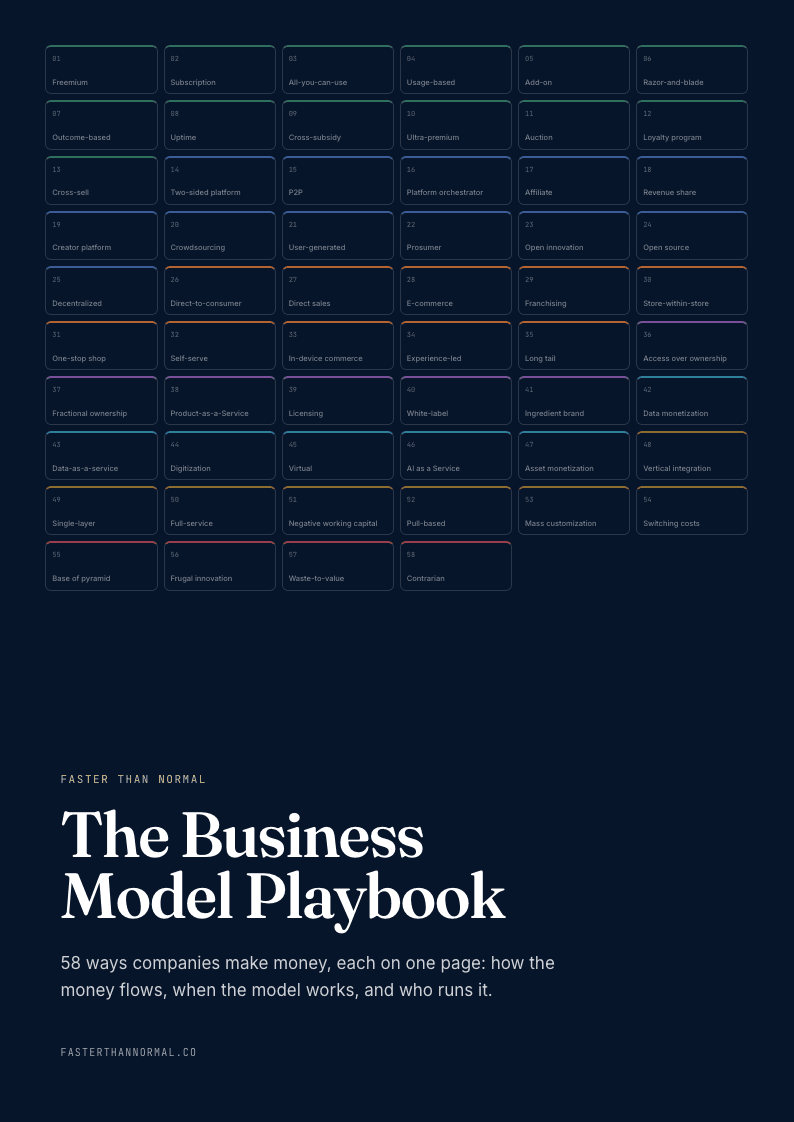
58 business models, one visual page each: how the money flows, the metrics that matter, and who runs it. Free when you join the Faster Than Normal email.
Free. No spam. Unsubscribe anytime.