
Contents
Book summary
John D. Rockefeller on Making and Sharing Wealth
by John D. Rockefeller
The Core Premise
John D. Rockefeller transformed himself from a bookkeeper earning $50 per month into the world's first billionaire by mastering a deceptively simple principle: systematic capital allocation combined with methodical reinvestment creates compound wealth that transcends individual lifespans. His approach to building Standard Oil wasn't built on innovation or charisma, but on relentless operational efficiency and what he called "economical management" — the disciplined practice of cutting costs while scaling operations through vertical integration and strategic acquisitions.
Rockefeller's Systematic Consolidation Strategy revolutionized how monopolies could be built legally and sustainably. Rather than crushing competitors through price wars, he absorbed them through calculated offers that made resistance economically irrational. When independent oil refiners faced transportation cost disadvantages, Rockefeller offered them partnerships or buyouts at fair market value, then immediately implemented his standardized operational systems to cut their costs by 30-40%. This wasn't predatory capitalism — it was industrial choreography. He proved that market dominance comes not from destroying competition, but from making competition irrelevant through superior systems.
The wealth creation principles Rockefeller articulated extend far beyond oil refining into what he termed "productive philanthropy." His Giving While Living Philosophy rejected the Carnegie model of accumulating wealth for decades before donating. Instead, Rockefeller began systematic charitable giving while actively building his fortune, treating philanthropy as another form of capital allocation requiring the same analytical rigor as business investments. The Rockefeller Foundation's approach to eradicating hookworm disease demonstrates this methodology: rather than simply funding treatment, they invested in comprehensive educational campaigns and infrastructure improvements that eliminated the disease's root causes across entire regions.
For executives, Rockefeller's most transferable insight lies in his Integrated Systems Thinking — the recognition that sustainable competitive advantages come from controlling multiple interdependent processes rather than excelling at isolated functions. Modern platform businesses mirror Rockefeller's vertical integration strategy: Amazon controls logistics, cloud infrastructure, and retail interfaces not to monopolize each market, but to create systemic efficiencies impossible for competitors to replicate. His methods for evaluating acquisition targets based on operational synergies rather than market valuations remain startlingly relevant for growth-stage companies building defensible moats through strategic consolidation.
"No Help Wanted" signs decorated the doors of Cleveland storekeepers and merchants in early September, 1855, when sixteen-year-old John Rockefeller set out to seek employment for his budding talents. It was a hard year in the West. For days and weeks the youth tramped the streets, grave, self-centered, tenacious in his quest. -from "A Pious Youth Gets a Flying Start" What was the world's first billionaire really like? This highly entertaining work, by an acclaimed business biographer, seeks to explode the "shadowy myth" of John D. Rockefeller and reveal the "rare and astonishing personality" behind it. From his humble roots in Ohio, where he learned thrift and industry as the bookkeeper of a dockside warehouse, to the death threats this "modern Machiavelli" received during the early years of Standard Oil, to his ascendancy to the rank of "the most detested man in the country"-when churches refused his donations as tainted money-and his subsequent formation of the philanthropic Rockefeller Foundation, this is a knowingly ironic and subtly witty work of biography. JOHN K. WINKLER is also the author of W.R. Hearst: An American Phenomenon (1928) and Morgan the Magnificent, or The Life …
John D. Rockefeller on Making and Sharing Wealth by John D. Rockefeller belongs on the short shelf of books that change how you notice decisions in the wild. Whether you agree with every claim or not, the frame it offers is portable: you can apply it in meetings, investing, hiring, and personal trade-offs without carrying the whole volume.
Many readers return to this book because it names patterns that felt familiar but unnamed. Naming is leverage: once you can point to a mechanism, you can design around it. One through-line is “Systematic Consolidation Strategy: Rockefeller's method of acquiring competitors through economic incentives rather than predatory pricing. He offered fair buyouts while demonstrating superior operati” and its implications for judgment under uncertainty.
If you are reading for execution, translate each chapter into a testable habit: one prompt before a big decision, one review question after a project, one constraint you will respect next quarter. Theory becomes useful when it shows up in calendars, not only in margins.
Finally, pair this book with opposing voices. The strongest readers stress-test the thesis against cases where the advice fails, note the boundary conditions, and keep a short list of when not to use this lens. That discipline is how summaries become judgment.
Long-form books reward spaced attention: read a chapter, sleep, then write a half-page memo titled “What would I do differently on Monday?” If you cannot answer with specifics, the idea has not yet landed.
Use John D. Rockefeller on Making and Sharing Wealth as a conversation starter with peers who have different incentives. The disagreements often reveal which parts of the book are robust and which are fragile when power, risk, and time horizons change.
Key Ideas and Arguments
Systematic Consolidation Strategy: Rockefeller's method of acquiring competitors through economic incentives rather than predatory pricing. He offered fair buyouts while demonstrating superior operational systems, making resistance economically irrational and creating willing partnerships instead of bitter enemies.. This idea shows up repeatedly in John D. Rockefeller on Making and Sharing Wealth: separate the definition from the examples, then ask where the author's evidence is strongest and where anecdotes do most of the work. Consider writing a counterexample: a situation where applying the idea literally would misfire, and what guardrail you would add.
Economical Management Philosophy: The practice of simultaneously cutting operational costs while scaling production through standardized systems. Rockefeller achieved 30-40% cost reductions in acquired refineries by implementing uniform processes, equipment, and quality standards across all operations.. This idea shows up repeatedly in John D. Rockefeller on Making and Sharing Wealth: separate the definition from the examples, then ask where the author's evidence is strongest and where anecdotes do most of the work. Consider writing a counterexample: a situation where applying the idea literally would misfire, and what guardrail you would add.
Productive Philanthropy Framework: Rockefeller's approach to charitable giving as active capital allocation requiring analytical rigor. Rather than treating philanthropy as wealth disposal, he applied business principles to maximize social impact per dollar invested.. This idea shows up repeatedly in John D. Rockefeller on Making and Sharing Wealth: separate the definition from the examples, then ask where the author's evidence is strongest and where anecdotes do most of the work. Consider writing a counterexample: a situation where applying the idea literally would misfire, and what guardrail you would add.
Vertical Integration Strategy: Controlling multiple interdependent processes in the supply chain to create systemic competitive advantages. Rockefeller owned oil wells, refineries, transportation networks, and retail distribution to eliminate external dependencies and maximize profit margins.. This idea shows up repeatedly in John D. Rockefeller on Making and Sharing Wealth: separate the definition from the examples, then ask where the author's evidence is strongest and where anecdotes do most of the work. Consider writing a counterexample: a situation where applying the idea literally would misfire, and what guardrail you would add.
Giving While Living Philosophy: The practice of distributing wealth systematically during one's active earning years rather than accumulating for posthumous donation. Rockefeller began major philanthropic initiatives while building Standard Oil, treating charity as parallel capital deployment.. This idea shows up repeatedly in John D. Rockefeller on Making and Sharing Wealth: separate the definition from the examples, then ask where the author's evidence is strongest and where anecdotes do most of the work. Consider writing a counterexample: a situation where applying the idea literally would misfire, and what guardrail you would add.
Integrated Systems Thinking: Viewing business operations as interconnected networks where advantages compound across multiple functions. Success comes from optimizing the entire system rather than maximizing individual components in isolation.. This idea shows up repeatedly in John D. Rockefeller on Making and Sharing Wealth: separate the definition from the examples, then ask where the author's evidence is strongest and where anecdotes do most of the work. Consider writing a counterexample: a situation where applying the idea literally would misfire, and what guardrail you would add.
Deeper Themes and Context
John D. Rockefeller on Making and Sharing Wealth is not only a catalogue of claims; it is a stance on how to interpret success, failure, and ambiguity. Readers who engage charitably still ask: which recommendations are universal, which are culturally situated, and which require institutional support you do not have?
Comparing the book's prescriptions to your own context is part of the work. A strategy that assumes abundant capital, patient stakeholders, or long feedback loops will read differently if you are resource-constrained, early in a career, or operating under regulatory pressure. Translation beats transcription.
The book also invites you to notice what it does not say. Silences can be instructive: topics the author avoids, counterexamples that never appear, or metrics that are praised without definition. A serious reader keeps a missing-evidence note alongside a to-try note.
Historically, the most influential business and biography titles survive because they double as vocabulary. Teams that share a phrase from John D. Rockefeller on Making and Sharing Wealth move faster only when they also share a definition and a worked example, otherwise they talk past each other with the same words.
How to Apply the Lessons
Connected Mental Models
Who Should Read This
Start here if you want a serious, book-length argument rather than a thread of bullet points. John D. Rockefeller on Making and Sharing Wealth rewards readers who will sketch their own examples, argue back in the margins, and connect chapters to decisions they are facing this quarter.
It is also useful as a shared vocabulary for teams: a common chapter reference can shorten debate if everyone agrees what the term means in practice. If your team only shares the title, not the definition, expect confusion.
Skip or skim if you need a narrow tactical recipe with no theory; this summary preserves the ideas, but the book's value is often in the extended case material and the author's sequencing.
Analyst's Take
Test Yourself
Check your grasp of the book’s moves
A colleague quotes John D. Rockefeller on Making and Sharing Wealth to justify a risky decision. What should you verify first?
You finished John D. Rockefeller on Making and Sharing Wealth and want behaviour change this week.
Further Reading
Featured in
Continue exploring


Free playbook
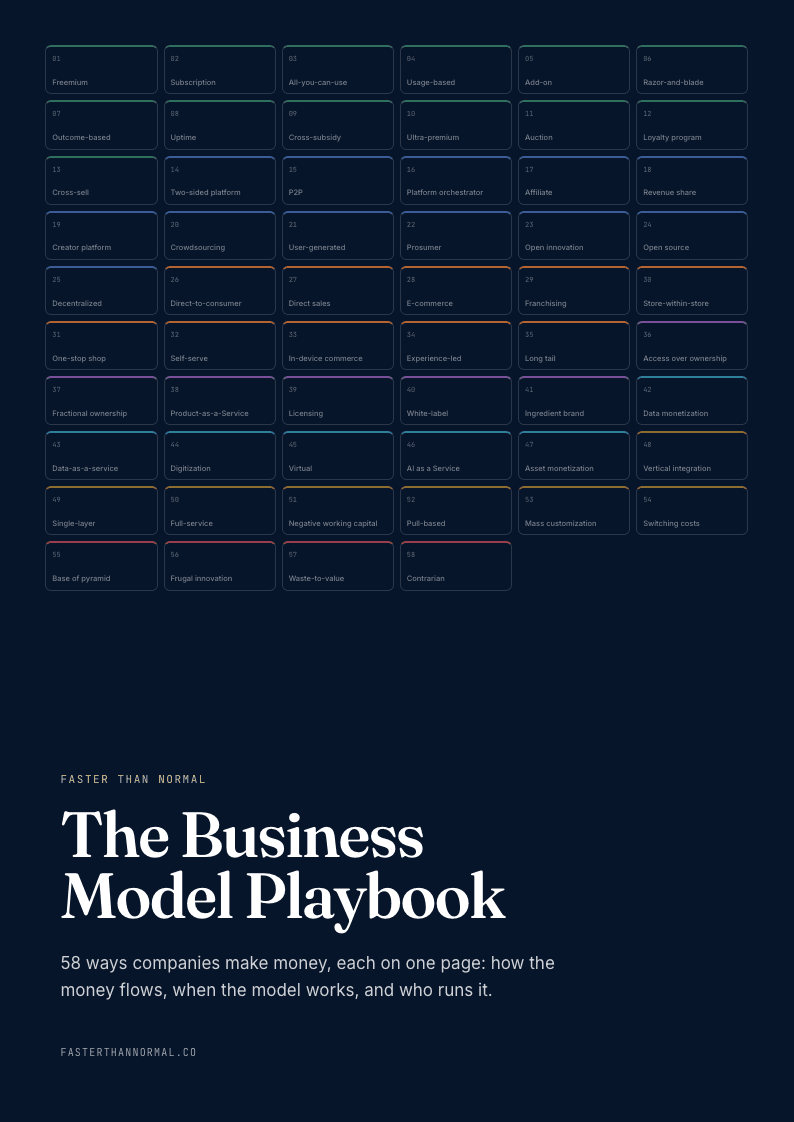
Get The Business Model Playbook
58 business models, one visual page each: how the money flows, the metrics that matter, and who runs it. Free when you join the Faster Than Normal email.
Free. No spam. Unsubscribe anytime.