

Contents
Book summary
John D. Rockefeller
by Hourly History
The Core Premise
Most business leaders today struggle with scale because they misunderstand power—treating it as domination rather than system design. John D. Rockefeller built the world's first modern monopoly not through raw aggression, but by reimagining entire industries as interconnected systems where control of chokepoints yielded exponential leverage. His approach reveals why Silicon Valley's platform monopolies follow patterns he established 150 years ago, and why understanding his methods remains essential for any executive seeking to build lasting competitive advantage.
Rockefeller's genius lay in what Hourly History identifies as his "systematic integration strategy"—the methodical acquisition and optimization of every component in the oil supply chain. While competitors focused on drilling or refining, Rockefeller recognized that transportation represented the industry's critical bottleneck. He negotiated exclusive railroad deals that gave Standard Oil shipping rates 50% below competitors, then used those savings to fund aggressive price wars that eliminated rivals. When Pennsylvania Railroad tried to bypass him by building its own refineries, Rockefeller had already locked up alternative shipping routes. This wasn't luck—it was architectural thinking about market structure.
The book reveals Rockefeller's "partnership absorption model," a sophisticated approach to eliminating competition that modern tech companies have adapted for the digital age. Rather than simply crushing competitors, Rockefeller offered struggling refiners two choices: bankruptcy through continued price wars, or profitable partnership through acquisition by Standard Oil. Most chose partnership. He retained existing management, preserved local operations, and gradually integrated the best practices across his expanding network. Amazon's acquisition strategy mirrors this approach—buying potential competitors like Zappos or Whole Foods, then slowly integrating their capabilities into Amazon's broader ecosystem.
Rockefeller's operational philosophy centered on what he called "waste elimination"—the relentless optimization of every process to extract maximum value from minimum resources. Standard Oil recovered and sold petroleum byproducts that competitors discarded as waste, turning cost centers into profit streams. The company's Cleveland refinery used exhaust heat to power additional processes, recycled barrel materials, and even sold the sludge from tank cleaning operations. This obsession with operational efficiency created cost advantages that became virtually insurmountable competitive moats. Tesla's vertical integration strategy follows identical logic—controlling battery production, software development, and charging infrastructure to optimize the entire customer experience while reducing costs.
For modern executives, Rockefeller's methods translate into specific strategies for building platform advantages and network effects. His systematic approach to industry restructuring—identifying bottlenecks, securing control of critical infrastructure, then using that leverage to reshape market dynamics—provides a blueprint for creating sustainable competitive positions. The key insight is that true market power comes not from superior products or brilliant marketing, but from controlling the underlying systems that determine how entire industries operate. Rockefeller understood that in business, as in physics, controlling the infrastructure is more valuable than competing within it.
John D. Rockefeller John D. Rockefeller, the wealthiest man of all time, amassed a fortune as he led the Standard Oil Company to an unprecedented position of power in the industrial markets. In addition to being a successful businessman, he was also a generous philanthropist. But somewhere between the money he earned and the money he gave away lies a mystery that remains unsolved. How could someone so generous have been so hated in his time? How could someone so successful have been so despised by the public, the press, and the government? Was Rockefeller a villain or a hero? The truth is that he was both. Inside you will read about... - The Son of Devil Bill and a Baptist Woman - Rockefeller Finds Black Gold - Standard Oil Company - The Only Game in Town - Give as Much as You Can - Life and Legacy And much more! In an era which saw American businessmen accrue unprecedented power and wealth by means of practices that would later be judged illegal by the Supreme Court, Rockefeller saw his opportunities as both a gift from God and a responsibility to the public, with a dash of Darwinian survival tactics thrown in for good measure. Today's captains of industry may not use the same tec…
John D. Rockefeller by Hourly History belongs on the short shelf of books that change how you notice decisions in the wild. Whether you agree with every claim or not, the frame it offers is portable: you can apply it in meetings, investing, hiring, and personal trade-offs without carrying the whole volume.
Many readers return to this book because it names patterns that felt familiar but unnamed. Naming is leverage: once you can point to a mechanism, you can design around it. One through-line is “Systematic Integration Strategy: Rockefeller's method of gaining control over every stage of the oil production and distribution process, from drilling to retail sales. This vertical integration creat” and its implications for judgment under uncertainty.
If you are reading for execution, translate each chapter into a testable habit: one prompt before a big decision, one review question after a project, one constraint you will respect next quarter. Theory becomes useful when it shows up in calendars, not only in margins.
Finally, pair this book with opposing voices. The strongest readers stress-test the thesis against cases where the advice fails, note the boundary conditions, and keep a short list of when not to use this lens. That discipline is how summaries become judgment.
Long-form books reward spaced attention: read a chapter, sleep, then write a half-page memo titled “What would I do differently on Monday?” If you cannot answer with specifics, the idea has not yet landed.
Use John D. Rockefeller as a conversation starter with peers who have different incentives. The disagreements often reveal which parts of the book are robust and which are fragile when power, risk, and time horizons change.
Key Ideas and Arguments
Systematic Integration Strategy: Rockefeller's method of gaining control over every stage of the oil production and distribution process, from drilling to retail sales. This vertical integration created cost advantages and eliminated dependencies on external suppliers, making Standard Oil nearly impossible to compete against.. This idea shows up repeatedly in John D. Rockefeller: separate the definition from the examples, then ask where the author's evidence is strongest and where anecdotes do most of the work. Consider writing a counterexample: a situation where applying the idea literally would misfire, and what guardrail you would add.
Transportation Leverage: The recognition that in commodity industries, controlling distribution channels often matters more than controlling production. Rockefeller's exclusive railroad deals gave him pricing power that allowed him to subsidize aggressive expansion into new markets.. This idea shows up repeatedly in John D. Rockefeller: separate the definition from the examples, then ask where the author's evidence is strongest and where anecdotes do most of the work. Consider writing a counterexample: a situation where applying the idea literally would misfire, and what guardrail you would add.
Partnership Absorption Model: Rather than simply destroying competitors, Rockefeller offered acquisition deals that preserved local management and operations while integrating them into Standard Oil's broader network. This approach reduced resistance and accelerated market consolidation.. This idea shows up repeatedly in John D. Rockefeller: separate the definition from the examples, then ask where the author's evidence is strongest and where anecdotes do most of the work. Consider writing a counterexample: a situation where applying the idea literally would misfire, and what guardrail you would add.
Waste Elimination Philosophy: The systematic optimization of every operational process to extract maximum value from minimum inputs. Standard Oil monetized petroleum byproducts that competitors discarded, turning waste streams into additional revenue sources.. This idea shows up repeatedly in John D. Rockefeller: separate the definition from the examples, then ask where the author's evidence is strongest and where anecdotes do most of the work. Consider writing a counterexample: a situation where applying the idea literally would misfire, and what guardrail you would add.
Infrastructure Control Strategy: The insight that controlling underlying industry infrastructure provides more sustainable competitive advantage than competing within existing market structures. Rockefeller built pipelines, storage facilities, and transportation networks that competitors had to use on his terms.. This idea shows up repeatedly in John D. Rockefeller: separate the definition from the examples, then ask where the author's evidence is strongest and where anecdotes do most of the work. Consider writing a counterexample: a situation where applying the idea literally would misfire, and what guardrail you would add.
Market Restructuring Approach: The methodical process of identifying industry bottlenecks, securing control of critical chokepoints, then using that leverage to reshape competitive dynamics across entire sectors.. This idea shows up repeatedly in John D. Rockefeller: separate the definition from the examples, then ask where the author's evidence is strongest and where anecdotes do most of the work. Consider writing a counterexample: a situation where applying the idea literally would misfire, and what guardrail you would add.
Deeper Themes and Context
John D. Rockefeller is not only a catalogue of claims; it is a stance on how to interpret success, failure, and ambiguity. Readers who engage charitably still ask: which recommendations are universal, which are culturally situated, and which require institutional support you do not have?
Comparing the book's prescriptions to your own context is part of the work. A strategy that assumes abundant capital, patient stakeholders, or long feedback loops will read differently if you are resource-constrained, early in a career, or operating under regulatory pressure. Translation beats transcription.
The book also invites you to notice what it does not say. Silences can be instructive: topics the author avoids, counterexamples that never appear, or metrics that are praised without definition. A serious reader keeps a missing-evidence note alongside a to-try note.
Historically, the most influential business and biography titles survive because they double as vocabulary. Teams that share a phrase from John D. Rockefeller move faster only when they also share a definition and a worked example, otherwise they talk past each other with the same words.
How to Apply the Lessons
Connected Mental Models
Who Should Read This
Start here if you want a serious, book-length argument rather than a thread of bullet points. John D. Rockefeller rewards readers who will sketch their own examples, argue back in the margins, and connect chapters to decisions they are facing this quarter.
It is also useful as a shared vocabulary for teams: a common chapter reference can shorten debate if everyone agrees what the term means in practice. If your team only shares the title, not the definition, expect confusion.
Skip or skim if you need a narrow tactical recipe with no theory; this summary preserves the ideas, but the book's value is often in the extended case material and the author's sequencing.
Analyst's Take
Test Yourself
Check your grasp of the book’s moves
A colleague quotes John D. Rockefeller to justify a risky decision. What should you verify first?
You finished John D. Rockefeller and want behaviour change this week.
Further Reading
Continue exploring


Free playbook
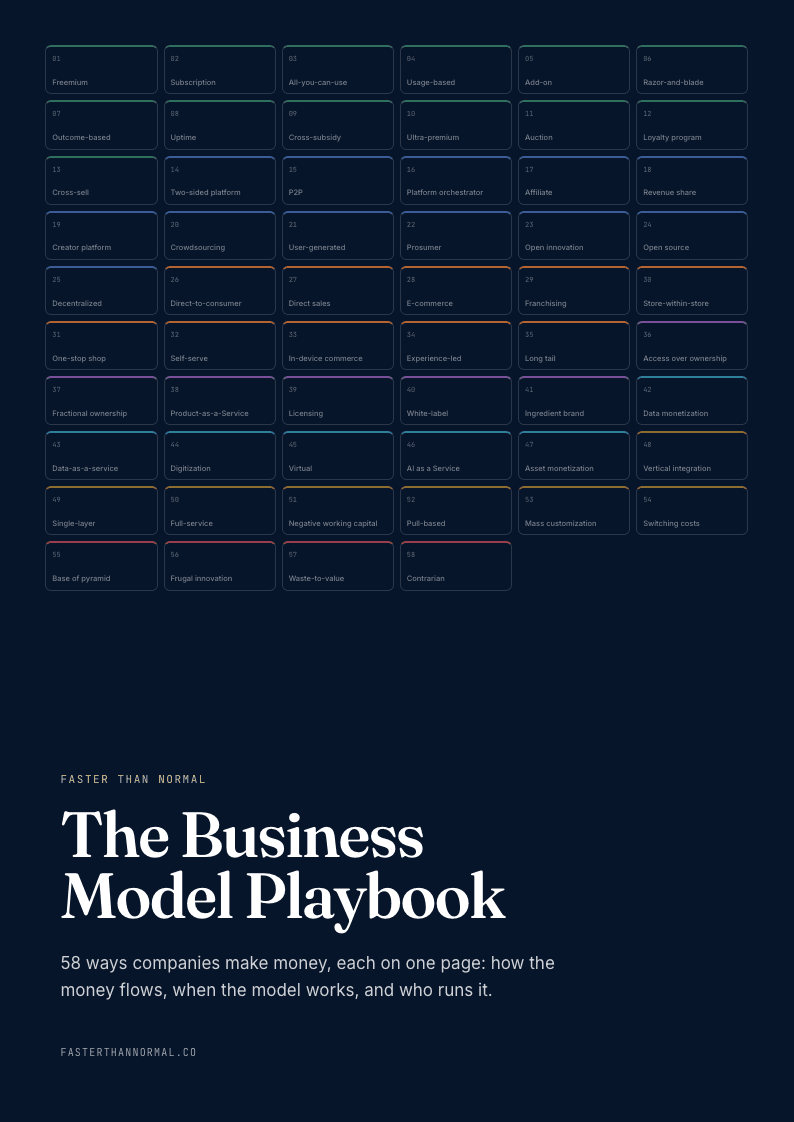
Get The Business Model Playbook
58 business models, one visual page each: how the money flows, the metrics that matter, and who runs it. Free when you join the Faster Than Normal email.
Free. No spam. Unsubscribe anytime.