
Contents
Book summary
Jay Gould
by Charles River Editors
The Core Premise
Jay Gould's genius lay not in building railroads or telegraph lines, but in understanding that information asymmetry was the ultimate competitive advantage in 19th-century America. While his contemporaries focused on operational excellence, Gould weaponized market intelligence, political connections, and financial engineering to accumulate power that dwarfed most industrial empires. His methods were ruthless, his reputation toxic, yet his strategic insights about leverage, timing, and control remain startlingly relevant for modern executives navigating complex, interconnected markets.
Gould's rise began with the Erie Railroad War of the 1860s, where he outmaneuvered Cornelius Vanderbilt through a combination of stock manipulation, political bribery, and legal maneuvering that would make modern private equity titans blush. The Charles River Editors demonstrate how Gould's Erie Strategy—flooding the market with new shares while simultaneously buying legislative protection—created a defensive moat that even Vanderbilt's superior capital couldn't breach. This wasn't mere financial trickery; Gould understood that in rapidly evolving industries, regulatory capture often matters more than operational efficiency. He systematically identified chokepoints where small investments in political influence could yield massive returns in market control.
The book's most illuminating case study involves Gould's telegraph empire, where he deployed what the editors call the "Network Consolidation Playbook." Rather than competing on service quality, Gould bought competing telegraph companies, manipulated their stock prices downward, then acquired them at distressed valuations. He understood that in network-effect businesses, winner-take-all dynamics make predatory consolidation more profitable than organic growth. His Western Union machinations revealed a prescient grasp of platform economics: control the infrastructure, control the information flow, control the market. Modern tech executives pursuing "growth at all costs" are essentially running Gould's playbook with venture capital instead of manipulated bonds.
Gould's Political Capital Theory deserves particular attention from today's leaders. He recognized that regulatory uncertainty creates arbitrage opportunities for those willing to invest in political relationships before they're needed. His systematic cultivation of judges, legislators, and bureaucrats wasn't corruption for its own sake—it was strategic infrastructure. The editors show how Gould's political investments generated measurable returns: every dollar spent on Albany legislators yielded roughly ten dollars in avoided regulatory costs or blocked competitor initiatives. This quantified approach to political risk management predates modern corporate government affairs by a century.
The book's central tension emerges in Gould's late career, when his reputation for manipulation began undermining his actual business achievements. His telegraphic innovations genuinely improved communication infrastructure, his railroad consolidations reduced wasteful competition, yet public hatred of his methods overshadowed these contributions. The editors argue that Gould's fatal flaw wasn't greed—it was his failure to invest in legitimacy as aggressively as he invested in control. Modern executives face the same trade-off: short-term competitive advantage through aggressive tactics versus long-term sustainability through stakeholder trust. Gould chose optionality over reputation, a decision that maximized his personal wealth while limiting his institutional legacy. The lesson isn't to avoid his methods entirely, but to understand their true cost.
*Includes pictures *Includes contemporary accounts *Includes online resources and a bibliography for further reading "It was the custom when men received nominations to come to me for contributions, and I made them and considered them good paying investments for the company. In a Republican district I was a strong Republican; in a Democratic district I was Democratic, and in doubtful districts I was doubtful. In politics I was an Erie Railroad man all the time." - Jay Gould The term robber baron has largely fallen into disuse in the 21st century but there was a time when it was a popular epithet that described the kind of man who, it was believed, built his fortune by taking things belonging to others. The Gilded Age and the dawn of the 20th century are often remembered as an era full of monopolies, trusts, and economic giants in heavy industries like oil and steel. Men like Andrew Carnegie built empires like Carnegie Steel, and financiers like J.P. Morgan merged and consolidated them. The era also made names like Astor, Cooke, and Vanderbilt instantly recognizable across the globe. Over time, the unfathomable wealth generated by the businesses made the individuals on top incredibl…
Jay Gould by Charles River Editors belongs on the short shelf of books that change how you notice decisions in the wild. Whether you agree with every claim or not, the frame it offers is portable: you can apply it in meetings, investing, hiring, and personal trade-offs without carrying the whole volume.
Many readers return to this book because it names patterns that felt familiar but unnamed. Naming is leverage: once you can point to a mechanism, you can design around it. One through-line is “Erie Strategy: Gould's method of defensive stock manipulation, where he flooded markets with new shares while buying political protection. When Vanderbilt tried to acquire the Erie Railroad, Gould iss” and its implications for judgment under uncertainty.
If you are reading for execution, translate each chapter into a testable habit: one prompt before a big decision, one review question after a project, one constraint you will respect next quarter. Theory becomes useful when it shows up in calendars, not only in margins.
Finally, pair this book with opposing voices. The strongest readers stress-test the thesis against cases where the advice fails, note the boundary conditions, and keep a short list of when not to use this lens. That discipline is how summaries become judgment.
Long-form books reward spaced attention: read a chapter, sleep, then write a half-page memo titled “What would I do differently on Monday?” If you cannot answer with specifics, the idea has not yet landed.
Use Jay Gould as a conversation starter with peers who have different incentives. The disagreements often reveal which parts of the book are robust and which are fragile when power, risk, and time horizons change.
Key Ideas and Arguments
Erie Strategy: Gould's method of defensive stock manipulation, where he flooded markets with new shares while buying political protection. When Vanderbilt tried to acquire the Erie Railroad, Gould issued millions in new stock, making a takeover prohibitively expensive while using the proceeds to purchase legal immunity.. This idea shows up repeatedly in Jay Gould: separate the definition from the examples, then ask where the author's evidence is strongest and where anecdotes do most of the work. Consider writing a counterexample: a situation where applying the idea literally would misfire, and what guardrail you would add.
Network Consolidation Playbook: A systematic approach to acquiring network-effect businesses by manipulating their valuations downward, then purchasing at distressed prices. Gould used this to build his telegraph empire, understanding that in infrastructure businesses, consolidation creates more value than competition.. This idea shows up repeatedly in Jay Gould: separate the definition from the examples, then ask where the author's evidence is strongest and where anecdotes do most of the work. Consider writing a counterexample: a situation where applying the idea literally would misfire, and what guardrail you would add.
Information Asymmetry Advantage: Gould's core insight that superior market intelligence trumps operational excellence in volatile industries. He positioned himself at information chokepoints—telegraph offices, railroad terminals, political backrooms—to trade on knowledge gaps.. This idea shows up repeatedly in Jay Gould: separate the definition from the examples, then ask where the author's evidence is strongest and where anecdotes do most of the work. Consider writing a counterexample: a situation where applying the idea literally would misfire, and what guardrail you would add.
Political Capital Theory: The systematic investment in regulatory relationships before they're needed, treating political influence as measurable infrastructure. Gould quantified returns on political spending, typically seeing 10:1 payoffs on legislative investments.. This idea shows up repeatedly in Jay Gould: separate the definition from the examples, then ask where the author's evidence is strongest and where anecdotes do most of the work. Consider writing a counterexample: a situation where applying the idea literally would misfire, and what guardrail you would add.
Chokepoint Control Strategy: Identifying and controlling the narrow passages where entire industries must flow. Rather than competing in open markets, Gould sought positions where he could tax or block competitors' access to essential infrastructure.. This idea shows up repeatedly in Jay Gould: separate the definition from the examples, then ask where the author's evidence is strongest and where anecdotes do most of the work. Consider writing a counterexample: a situation where applying the idea literally would misfire, and what guardrail you would add.
Legitimacy Deficit Risk: The long-term cost of prioritizing control over reputation. Gould's tactical successes created strategic vulnerabilities when public hatred began limiting his access to capital markets and political support.. This idea shows up repeatedly in Jay Gould: separate the definition from the examples, then ask where the author's evidence is strongest and where anecdotes do most of the work. Consider writing a counterexample: a situation where applying the idea literally would misfire, and what guardrail you would add.
Deeper Themes and Context
Jay Gould is not only a catalogue of claims; it is a stance on how to interpret success, failure, and ambiguity. Readers who engage charitably still ask: which recommendations are universal, which are culturally situated, and which require institutional support you do not have?
Comparing the book's prescriptions to your own context is part of the work. A strategy that assumes abundant capital, patient stakeholders, or long feedback loops will read differently if you are resource-constrained, early in a career, or operating under regulatory pressure. Translation beats transcription.
The book also invites you to notice what it does not say. Silences can be instructive: topics the author avoids, counterexamples that never appear, or metrics that are praised without definition. A serious reader keeps a missing-evidence note alongside a to-try note.
Historically, the most influential business and biography titles survive because they double as vocabulary. Teams that share a phrase from Jay Gould move faster only when they also share a definition and a worked example, otherwise they talk past each other with the same words.
How to Apply the Lessons
Connected Mental Models
Who Should Read This
Start here if you want a serious, book-length argument rather than a thread of bullet points. Jay Gould rewards readers who will sketch their own examples, argue back in the margins, and connect chapters to decisions they are facing this quarter.
It is also useful as a shared vocabulary for teams: a common chapter reference can shorten debate if everyone agrees what the term means in practice. If your team only shares the title, not the definition, expect confusion.
Skip or skim if you need a narrow tactical recipe with no theory; this summary preserves the ideas, but the book's value is often in the extended case material and the author's sequencing.
Analyst's Take
Test Yourself
Check your grasp of the book’s moves
A colleague quotes Jay Gould to justify a risky decision. What should you verify first?
You finished Jay Gould and want behaviour change this week.
Further Reading
Continue exploring


Free playbook
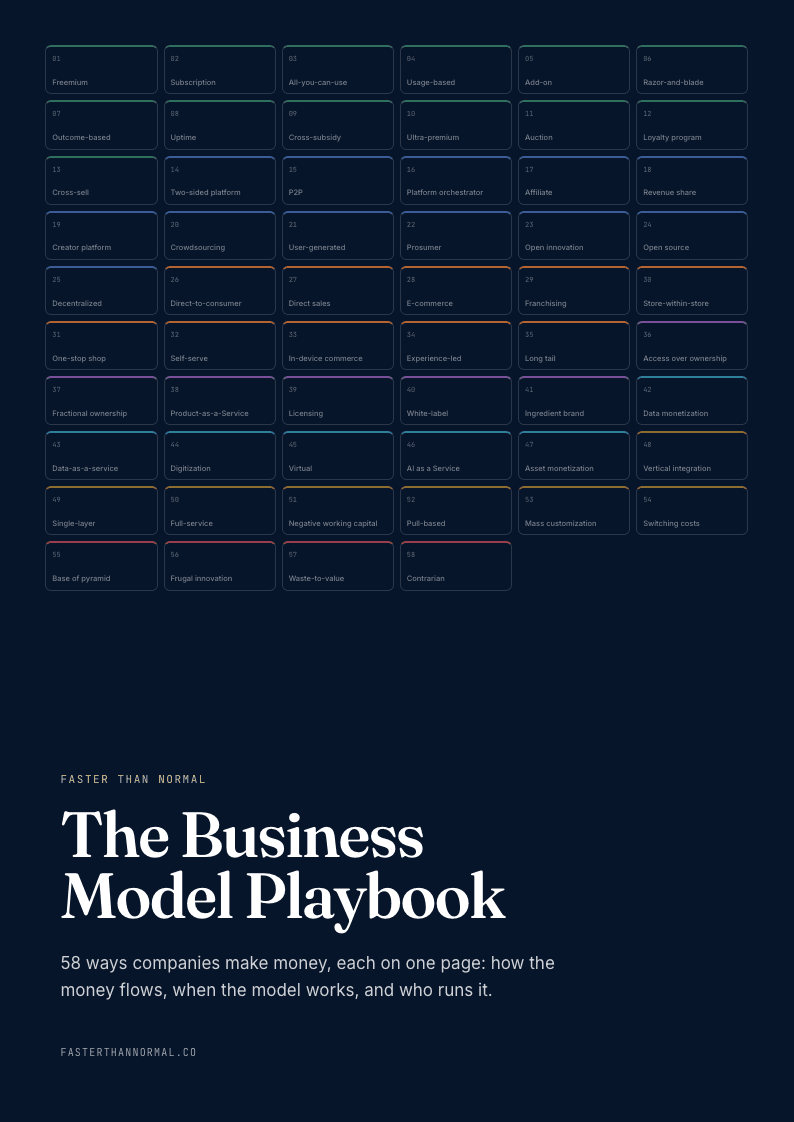
Get The Business Model Playbook
58 business models, one visual page each: how the money flows, the metrics that matter, and who runs it. Free when you join the Faster Than Normal email.
Free. No spam. Unsubscribe anytime.