

Contents
Book summary
High Output Management
by Andrew S. Grove
The Core Premise
Most management books preach vision and inspiration, but Andrew Grove demolished that fantasy with a simple declaration: management is production. The former Intel CEO built his framework on a manufacturing engineer's precision, treating every management function—meetings, decision-making, performance reviews—as measurable processes that either increase or decrease organizational output. Grove's "High Output Management" emerges from Intel's crucible during the memory crisis of the 1980s, when the company's survival depended on execution excellence rather than motivational speeches.
Grove's central insight revolves around managerial leverage—the multiplier effect of how a manager's activities influence the output of their organization. He quantifies this through a simple formula: a manager's output equals the output of their organization plus the output of neighboring organizations under their influence. This mathematical approach to management creates what Grove calls "management by objectives" (MBO), where every activity connects directly to measurable business results. Grove illustrates this with Intel's transformation from a memory company to a microprocessor giant, showing how middle managers who understood leverage principles drove the strategic shift faster than senior executives who focused on grand strategy.
The book's operational genius lies in Grove's systematic approach to the three core management activities: information gathering, decision-making, and nudging others. He treats meetings not as necessary evils but as the medium of managerial work, creating taxonomies for one-on-ones, staff meetings, and operational reviews. Grove's "Task-Relevant Maturity" model revolutionizes how managers adapt their style—high-TRM employees need minimal supervision and maximum delegation, while low-TRM employees require structured direction and frequent check-ins. When Grove managed Intel's transition away from memory chips, he used this framework to identify which teams could handle autonomous decision-making about product discontinuation versus which needed detailed guidance through the emotional and technical challenges.
Grove's performance management system transforms the traditional annual review into a continuous feedback mechanism built around output measurements and improvement plans. His approach to training treats it as one of the highest-leverage activities a manager can perform—training one person who then trains others creates exponential organizational capability. The book demonstrates this through Intel's legendary training culture, where senior engineers and executives spent significant time developing technical and management capabilities throughout the organization. Grove himself taught management courses to Intel employees, viewing this as a direct investment in organizational output rather than an HR obligation.
For founders and executives, Grove's frameworks provide immediate tactical value while building long-term organizational capability. His emphasis on indicators and measurement creates early warning systems for business problems, while his systematic approach to meetings and decision-making prevents the chaos that destroys scaling companies. Grove proved that management excellence stems from treating human organizations with the same analytical rigor applied to manufacturing processes—not through wishful thinking about culture and values, but through disciplined execution of measurable management practices.
High Output Management by Andrew S. Grove belongs on the short shelf of books that change how you notice decisions in the wild. Whether you agree with every claim or not, the frame it offers is portable: you can apply it in meetings, investing, hiring, and personal trade-offs without carrying the whole volume.
Many readers return to this book because it names patterns that felt familiar but unnamed. Naming is leverage: once you can point to a mechanism, you can design around it. One through-line is “Managerial Leverage: The multiplier effect where a manager's output equals their organization's output plus neighboring organizations under their influence. Grove demonstrates this through Intel's mem” and its implications for judgment under uncertainty.
If you are reading for execution, translate each chapter into a testable habit: one prompt before a big decision, one review question after a project, one constraint you will respect next quarter. Theory becomes useful when it shows up in calendars, not only in margins.
Finally, pair this book with opposing voices. The strongest readers stress-test the thesis against cases where the advice fails, note the boundary conditions, and keep a short list of when not to use this lens. That discipline is how summaries become judgment.
Long-form books reward spaced attention: read a chapter, sleep, then write a half-page memo titled “What would I do differently on Monday?” If you cannot answer with specifics, the idea has not yet landed.
Use High Output Management as a conversation starter with peers who have different incentives. The disagreements often reveal which parts of the book are robust and which are fragile when power, risk, and time horizons change.
Key Ideas and Arguments
Managerial Leverage: The multiplier effect where a manager's output equals their organization's output plus neighboring organizations under their influence. Grove demonstrates this through Intel's memory-to-microprocessor transition, where middle managers with high leverage accelerated the company's strategic pivot.. This idea shows up repeatedly in High Output Management: separate the definition from the examples, then ask where the author's evidence is strongest and where anecdotes do most of the work. Consider writing a counterexample: a situation where applying the idea literally would misfire, and what guardrail you would add.
Task-Relevant Maturity (TRM): An employee's experience and competence in a specific area, not their general capability. High-TRM employees need delegation and minimal oversight, while low-TRM employees require structured direction and frequent monitoring.. This idea shows up repeatedly in High Output Management: separate the definition from the examples, then ask where the author's evidence is strongest and where anecdotes do most of the work. Consider writing a counterexample: a situation where applying the idea literally would misfire, and what guardrail you would add.
Management by Objectives (MBO): A systematic approach where every management activity connects to measurable business outcomes. Grove used MBO at Intel to ensure that individual contributor goals aligned directly with corporate strategic objectives.. This idea shows up repeatedly in High Output Management: separate the definition from the examples, then ask where the author's evidence is strongest and where anecdotes do most of the work. Consider writing a counterexample: a situation where applying the idea literally would misfire, and what guardrail you would add.
Indicators vs. Outputs: Leading indicators predict future performance while outputs measure past results. Grove emphasizes tracking breakfast inventory levels to predict restaurant performance rather than waiting for daily sales reports.. This idea shows up repeatedly in High Output Management: separate the definition from the examples, then ask where the author's evidence is strongest and where anecdotes do most of the work. Consider writing a counterexample: a situation where applying the idea literally would misfire, and what guardrail you would add.
One-on-One Meetings: The fundamental building block of management communication, designed for information exchange, problem-solving, and performance coaching. Grove structured these as employee-driven conversations focused on current projects, future priorities, and skill development.. This idea shows up repeatedly in High Output Management: separate the definition from the examples, then ask where the author's evidence is strongest and where anecdotes do most of the work. Consider writing a counterexample: a situation where applying the idea literally would misfire, and what guardrail you would add.
Training as Leverage: Teaching skills to one person who teaches others creates exponential organizational capability. Grove calculated training ROI by measuring how improved performance propagated through the organization over time.. This idea shows up repeatedly in High Output Management: separate the definition from the examples, then ask where the author's evidence is strongest and where anecdotes do most of the work. Consider writing a counterexample: a situation where applying the idea literally would misfire, and what guardrail you would add.
Performance Reviews as Improvement Plans: Annual reviews become continuous feedback mechanisms focused on future performance enhancement rather than backward-looking evaluation. Grove integrated performance discussions with career development and skill-building initiatives.. This idea shows up repeatedly in High Output Management: separate the definition from the examples, then ask where the author's evidence is strongest and where anecdotes do most of the work. Consider writing a counterexample: a situation where applying the idea literally would misfire, and what guardrail you would add.
Deeper Themes and Context
High Output Management is not only a catalogue of claims; it is a stance on how to interpret success, failure, and ambiguity. Readers who engage charitably still ask: which recommendations are universal, which are culturally situated, and which require institutional support you do not have?
Comparing the book's prescriptions to your own context is part of the work. A strategy that assumes abundant capital, patient stakeholders, or long feedback loops will read differently if you are resource-constrained, early in a career, or operating under regulatory pressure. Translation beats transcription.
The book also invites you to notice what it does not say. Silences can be instructive: topics the author avoids, counterexamples that never appear, or metrics that are praised without definition. A serious reader keeps a missing-evidence note alongside a to-try note.
Historically, the most influential business and biography titles survive because they double as vocabulary. Teams that share a phrase from High Output Management move faster only when they also share a definition and a worked example, otherwise they talk past each other with the same words.
How to Apply the Lessons
Connected Mental Models
Who Should Read This
Start here if you want a serious, book-length argument rather than a thread of bullet points. High Output Management rewards readers who will sketch their own examples, argue back in the margins, and connect chapters to decisions they are facing this quarter.
It is also useful as a shared vocabulary for teams: a common chapter reference can shorten debate if everyone agrees what the term means in practice. If your team only shares the title, not the definition, expect confusion.
Skip or skim if you need a narrow tactical recipe with no theory; this summary preserves the ideas, but the book's value is often in the extended case material and the author's sequencing.
Analyst's Take
Test Yourself
Check your grasp of the book’s moves
A colleague quotes High Output Management to justify a risky decision. What should you verify first?
You finished High Output Management and want behaviour change this week.
Further Reading
Featured in
Continue exploring


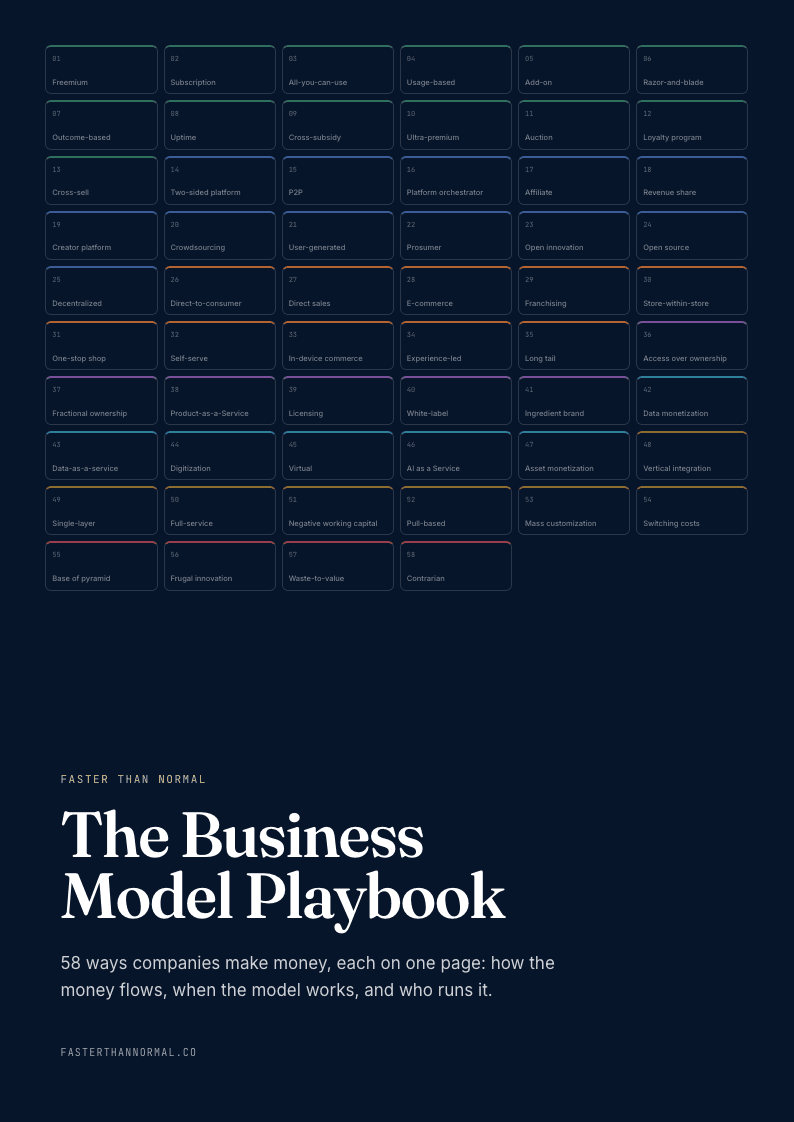
Free playbook
Get The Business Model Playbook
58 business models, one visual page each: how the money flows, the metrics that matter, and who runs it. Free when you join the Faster Than Normal email.
Free. No spam. Unsubscribe anytime.