

Contents
Book summary
Gym Launch Secrets
by Alex Hormozi
The Core Premise
Alex Hormozi discovered that the fitness industry's conventional wisdom about growing gyms was completely backward. While most gym owners obsess over getting new members through the door, Hormozi proved that the real money comes from perfecting what happens after someone signs up. His Gym Launch methodology transformed over 4,000 gyms by focusing on a counterintuitive principle: manufacture demand through scarcity, then deliver results so reliably that retention becomes automatic.
The core of Hormozi's system revolves around what he calls the "Grand Slam Offer" — a value proposition so compelling that customers feel stupid saying no. When he worked with a struggling gym in Texas, he restructured their membership from a standard $99/month unlimited access model to a 6-week challenge priced at $495 with a money-back guarantee tied to specific body composition results. The gym went from 200 struggling members to 800 profitable ones within six months. This wasn't about better marketing copy or slicker sales tactics. Hormozi engineered a psychological shift by removing risk from the customer while creating urgency through limited-time enrollment periods.
The Gym Launch system operates on three foundational pillars: the "Perfect Webinar" acquisition model, the "Newbie Gains" retention protocol, and what Hormozi terms "Value Arbitrage." The Perfect Webinar framework structures every sales presentation around a specific narrative arc — problem identification, solution revelation, and offer presentation — delivered through automated digital systems that convert at 15-20% rates compared to industry averages of 2-3%. The Newbie Gains protocol ensures every new member experiences measurable progress within their first two weeks through prescribed workout and nutrition protocols, eliminating the typical fitness club experience where members wander aimlessly until they quit.
Value Arbitrage represents Hormozi's most sophisticated insight: successful gyms don't compete on price or amenities but on certainty of outcome. When he analyzed his most successful gym transformations, he found that owners who guaranteed specific results — 20 pounds lost, bench press increased by 50 pounds, or fitting into a specific dress size — could charge 300-500% more than competitors while maintaining higher retention rates. This works because customers aren't buying gym access; they're buying transformation. The methodology requires gyms to become data-driven organizations that track member progress obsessively and intervene immediately when someone falls behind their expected trajectory.
For founders and executives outside fitness, Hormozi's principles translate directly to any recurring revenue business struggling with customer acquisition costs and churn. His "6-Week Sprint" model — intensive, time-bounded programs that deliver quick wins before transitioning customers to longer-term relationships — works equally well for consulting firms, software companies, and educational businesses. The key insight remains consistent across industries: customers will pay premium prices for certainty, and businesses that can systematically deliver predictable outcomes can charge accordingly while building sustainable competitive advantages through superior retention economics.
Gym Launch Secrets by Alex Hormozi belongs on the short shelf of books that change how you notice decisions in the wild. Whether you agree with every claim or not, the frame it offers is portable: you can apply it in meetings, investing, hiring, and personal trade-offs without carrying the whole volume.
Many readers return to this book because it names patterns that felt familiar but unnamed. Naming is leverage: once you can point to a mechanism, you can design around it. One through-line is “Grand Slam Offer: A value proposition structured around risk reversal and outcome guarantees rather than features or access. Hormozi transforms standard gym memberships into results-driven challenges ” and its implications for judgment under uncertainty.
If you are reading for execution, translate each chapter into a testable habit: one prompt before a big decision, one review question after a project, one constraint you will respect next quarter. Theory becomes useful when it shows up in calendars, not only in margins.
Finally, pair this book with opposing voices. The strongest readers stress-test the thesis against cases where the advice fails, note the boundary conditions, and keep a short list of when not to use this lens. That discipline is how summaries become judgment.
Long-form books reward spaced attention: read a chapter, sleep, then write a half-page memo titled “What would I do differently on Monday?” If you cannot answer with specifics, the idea has not yet landed.
Use Gym Launch Secrets as a conversation starter with peers who have different incentives. The disagreements often reveal which parts of the book are robust and which are fragile when power, risk, and time horizons change.
Key Ideas and Arguments
Grand Slam Offer: A value proposition structured around risk reversal and outcome guarantees rather than features or access. Hormozi transforms standard gym memberships into results-driven challenges where customers pay higher upfront fees but receive money-back guarantees tied to specific measurable outcomes, typically increasing conversion rates by 400-600%.. This idea shows up repeatedly in Gym Launch Secrets: separate the definition from the examples, then ask where the author's evidence is strongest and where anecdotes do most of the work. Consider writing a counterexample: a situation where applying the idea literally would misfire, and what guardrail you would add.
Value Arbitrage: The practice of charging premium prices by guaranteeing specific outcomes rather than competing on features or price. Successful gyms using this model track member progress obsessively and intervene immediately when someone falls behind their expected trajectory, allowing them to charge 3-5x more than competitors.. This idea shows up repeatedly in Gym Launch Secrets: separate the definition from the examples, then ask where the author's evidence is strongest and where anecdotes do most of the work. Consider writing a counterexample: a situation where applying the idea literally would misfire, and what guardrail you would add.
Perfect Webinar Framework: A structured sales presentation methodology that follows a specific narrative arc — problem identification, solution revelation, and offer presentation — delivered through automated systems. This framework consistently converts prospects at 15-20% rates compared to industry averages of 2-3%.. This idea shows up repeatedly in Gym Launch Secrets: separate the definition from the examples, then ask where the author's evidence is strongest and where anecdotes do most of the work. Consider writing a counterexample: a situation where applying the idea literally would misfire, and what guardrail you would add.
Newbie Gains Protocol: A systematic onboarding process ensuring every new member experiences measurable progress within their first two weeks through prescribed workout and nutrition protocols. This eliminates the typical fitness club experience where members wander aimlessly until they quit.. This idea shows up repeatedly in Gym Launch Secrets: separate the definition from the examples, then ask where the author's evidence is strongest and where anecdotes do most of the work. Consider writing a counterexample: a situation where applying the idea literally would misfire, and what guardrail you would add.
6-Week Sprint Model: Time-bounded intensive programs that deliver quick wins before transitioning customers to longer-term relationships. This model works by manufacturing scarcity through limited enrollment periods while providing enough time to demonstrate meaningful results.. This idea shows up repeatedly in Gym Launch Secrets: separate the definition from the examples, then ask where the author's evidence is strongest and where anecdotes do most of the work. Consider writing a counterexample: a situation where applying the idea literally would misfire, and what guardrail you would add.
Scarcity Manufacturing: Creating artificial urgency through limited-time enrollment periods and capacity constraints. Hormozi proves that gyms with open enrollment year-round struggle with commitment levels, while those with quarterly or bi-annual enrollment windows see dramatically higher completion rates.. This idea shows up repeatedly in Gym Launch Secrets: separate the definition from the examples, then ask where the author's evidence is strongest and where anecdotes do most of the work. Consider writing a counterexample: a situation where applying the idea literally would misfire, and what guardrail you would add.
Retention Economics: The principle that customer lifetime value improvements through better retention generate more profit than customer acquisition cost reductions. Hormozi demonstrates that a 10% retention improvement typically doubles profitability while a 10% acquisition cost reduction only improves margins by 15-20%.. This idea shows up repeatedly in Gym Launch Secrets: separate the definition from the examples, then ask where the author's evidence is strongest and where anecdotes do most of the work. Consider writing a counterexample: a situation where applying the idea literally would misfire, and what guardrail you would add.
Outcome Tracking Systems: Data-driven protocols that monitor member progress against expected trajectories and trigger interventions when performance lags. These systems enable guaranteed results by identifying and addressing problems before members become dissatisfied enough to quit.. This idea shows up repeatedly in Gym Launch Secrets: separate the definition from the examples, then ask where the author's evidence is strongest and where anecdotes do most of the work. Consider writing a counterexample: a situation where applying the idea literally would misfire, and what guardrail you would add.
Deeper Themes and Context
Gym Launch Secrets is not only a catalogue of claims; it is a stance on how to interpret success, failure, and ambiguity. Readers who engage charitably still ask: which recommendations are universal, which are culturally situated, and which require institutional support you do not have?
Comparing the book's prescriptions to your own context is part of the work. A strategy that assumes abundant capital, patient stakeholders, or long feedback loops will read differently if you are resource-constrained, early in a career, or operating under regulatory pressure. Translation beats transcription.
The book also invites you to notice what it does not say. Silences can be instructive: topics the author avoids, counterexamples that never appear, or metrics that are praised without definition. A serious reader keeps a missing-evidence note alongside a to-try note.
Historically, the most influential business and biography titles survive because they double as vocabulary. Teams that share a phrase from Gym Launch Secrets move faster only when they also share a definition and a worked example, otherwise they talk past each other with the same words.
How to Apply the Lessons
Connected Mental Models
Who Should Read This
Start here if you want a serious, book-length argument rather than a thread of bullet points. Gym Launch Secrets rewards readers who will sketch their own examples, argue back in the margins, and connect chapters to decisions they are facing this quarter.
It is also useful as a shared vocabulary for teams: a common chapter reference can shorten debate if everyone agrees what the term means in practice. If your team only shares the title, not the definition, expect confusion.
Skip or skim if you need a narrow tactical recipe with no theory; this summary preserves the ideas, but the book's value is often in the extended case material and the author's sequencing.
Analyst's Take
Test Yourself
Check your grasp of the book’s moves
A colleague quotes Gym Launch Secrets to justify a risky decision. What should you verify first?
You finished Gym Launch Secrets and want behaviour change this week.
Further Reading
Continue exploring


Free playbook
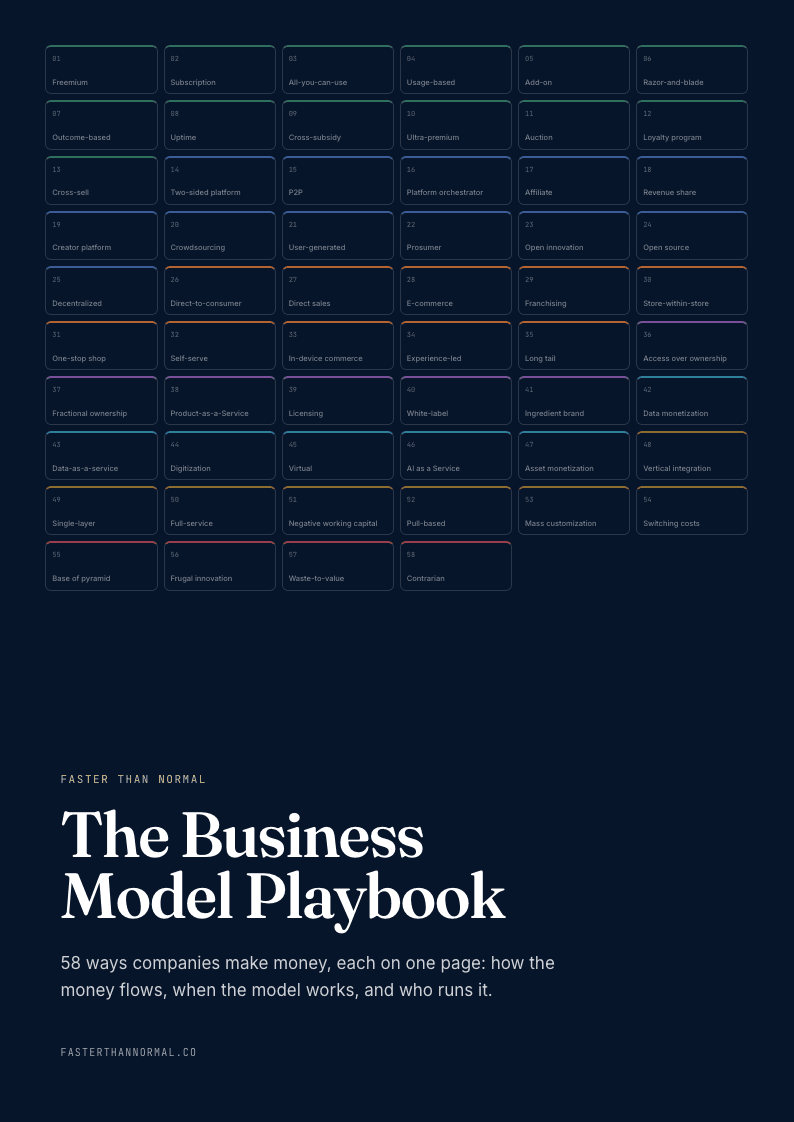
Get The Business Model Playbook
58 business models, one visual page each: how the money flows, the metrics that matter, and who runs it. Free when you join the Faster Than Normal email.
Free. No spam. Unsubscribe anytime.