

Contents
Book summary
Good to Great
by Jim Collins
The Core Premise
Most companies never escape mediocrity, not because they lack resources or smart people, but because they mistake the mechanics of success for its essence. Jim Collins and his research team discovered that greatness isn't about charismatic leadership, cutting-edge technology, or revolutionary strategies—it's about disciplined people making disciplined decisions within a disciplined system. After analyzing 1,435 companies over a 30-year period, Collins identified just 11 that made the leap from good performance to sustained greatness, delivering stock returns at least three times the market average for 15 consecutive years.
The transformation begins with what Collins calls Level 5 Leadership—executives who blend fierce professional will with personal humility. These leaders channel their ambition toward the company rather than themselves, often appearing unremarkable to outside observers. Darwin Smith of Kimberly-Clark exemplified this paradox: a quiet, unassuming CEO who transformed a sleepy paper company into the leading consumer products giant, outperforming Procter & Gamble while avoiding the spotlight entirely. Collins contrasts this with celebrity CEOs like Al Dunlap, whose dramatic cost-cutting at companies like Sunbeam generated headlines but destroyed long-term value. Level 5 leaders follow the Hedgehog Concept—they identify the single thing their organization can be best in the world at, what drives their economic engine, and what ignites their passion, then pursue that intersection with relentless consistency.
The research reveals that great companies confront brutal facts about their reality while maintaining unwavering faith in their ultimate success—what Collins terms the Stockdale Paradox, named after Vietnam POW Admiral James Stockdale. Wells Fargo embodied this principle during the banking deregulation of the 1980s. While competitors like Bank of America made flashy acquisitions and expanded internationally, Wells Fargo's leadership team acknowledged the harsh reality that deregulation would compress margins and increase competition. They systematically sold off international operations, avoided the acquisition frenzy, and focused obsessively on becoming the best bank in the western United States. This disciplined response to brutal facts, combined with unwavering faith in their chosen path, allowed Wells Fargo to outperform the market by over five times during the study period.
Collins demolishes several management myths through his research. Technology doesn't drive transformation—it accelerates momentum that disciplined companies have already built through the right people and systems. The good-to-great companies didn't pioneer breakthrough technologies; they thoughtfully applied existing technologies to advance their Hedgehog Concept. Executive compensation and change programs also prove irrelevant to sustained greatness. Instead, these companies implemented what Collins calls the Flywheel Effect—they identified their core business flywheel and kept pushing in a consistent direction until momentum built naturally. Circuit City understood that their flywheel turned on four key components: convenient locations, competitive prices, wide selection, and knowledgeable salespeople. By relentlessly improving each component while resisting the temptation to chase unrelated opportunities, they built unstoppable momentum that compounded over time.
For founders and executives, Collins provides a disciplined framework for organizational transformation. Start by getting the right people on the bus before determining direction—great people will adapt to almost any reasonable strategy, but the wrong people will undermine even brilliant plans. Confront the brutal facts about your market position, competitive advantages, and internal capabilities, then maintain absolute faith in your ability to create something great within those constraints. Most importantly, discover your Hedgehog Concept through rigorous analysis rather than wishful thinking, then align every decision and resource allocation to reinforce that single focus. The path from good to great isn't about dramatic transformation or visionary breakthroughs—it's about sustained discipline in executing the fundamentals better than anyone else in your chosen arena.
Good to Great by Jim Collins belongs on the short shelf of books that change how you notice decisions in the wild. Whether you agree with every claim or not, the frame it offers is portable: you can apply it in meetings, investing, hiring, and personal trade-offs without carrying the whole volume.
Many readers return to this book because it names patterns that felt familiar but unnamed. Naming is leverage: once you can point to a mechanism, you can design around it. One through-line is “Level 5 Leadership combines fierce professional will with deep personal humility. These leaders channel their ego and ambition into the company rather than themselves, often appearing modest while dri” and its implications for judgment under uncertainty.
If you are reading for execution, translate each chapter into a testable habit: one prompt before a big decision, one review question after a project, one constraint you will respect next quarter. Theory becomes useful when it shows up in calendars, not only in margins.
Finally, pair this book with opposing voices. The strongest readers stress-test the thesis against cases where the advice fails, note the boundary conditions, and keep a short list of when not to use this lens. That discipline is how summaries become judgment.
Long-form books reward spaced attention: read a chapter, sleep, then write a half-page memo titled “What would I do differently on Monday?” If you cannot answer with specifics, the idea has not yet landed.
Use Good to Great as a conversation starter with peers who have different incentives. The disagreements often reveal which parts of the book are robust and which are fragile when power, risk, and time horizons change.
Key Ideas and Arguments
Level 5 Leadership combines fierce professional will with deep personal humility. These leaders channel their ego and ambition into the company rather than themselves, often appearing modest while driving relentless results. Darwin Smith of Kimberly-Clark exemplified this by avoiding publicity while systematically outmaneuvering Procter & Gamble.. This idea shows up repeatedly in Good to Great: separate the definition from the examples, then ask where the author's evidence is strongest and where anecdotes do most of the work. Consider writing a counterexample: a situation where applying the idea literally would misfire, and what guardrail you would add.
The Hedgehog Concept identifies the intersection of three critical factors: what you can be best in the world at, what drives your economic engine, and what ignites your passion. Companies must discover this single focus through disciplined analysis, not wishful thinking. Walgreens discovered their hedgehog was convenient drugstores, leading them to focus obsessively on location strategy.. This idea shows up repeatedly in Good to Great: separate the definition from the examples, then ask where the author's evidence is strongest and where anecdotes do most of the work. Consider writing a counterexample: a situation where applying the idea literally would misfire, and what guardrail you would add.
The Stockdale Paradox requires confronting brutal facts about current reality while maintaining unwavering faith in ultimate success. Named after Vietnam POW Admiral James Stockdale, this principle separates companies that survive crises from those that don't. Wells Fargo exemplified this during banking deregulation by acknowledging harsh competitive realities while maintaining faith in their western US strategy.. This idea shows up repeatedly in Good to Great: separate the definition from the examples, then ask where the author's evidence is strongest and where anecdotes do most of the work. Consider writing a counterexample: a situation where applying the idea literally would misfire, and what guardrail you would add.
The Flywheel Effect describes how sustained momentum builds through consistent effort in a single direction rather than dramatic breakthroughs. Each turn of the flywheel builds on previous efforts, creating unstoppable momentum over time. Circuit City's flywheel turned on convenient locations, competitive prices, wide selection, and knowledgeable salespeople working in reinforcing concert.. This idea shows up repeatedly in Good to Great: separate the definition from the examples, then ask where the author's evidence is strongest and where anecdotes do most of the work. Consider writing a counterexample: a situation where applying the idea literally would misfire, and what guardrail you would add.
First Who, Then What means getting the right people on the bus before determining direction. Great companies focus on assembling the right team first, then figure out where to drive the bus. Wrong people will undermine even brilliant strategies, while right people will adapt to almost any reasonable direction.. This idea shows up repeatedly in Good to Great: separate the definition from the examples, then ask where the author's evidence is strongest and where anecdotes do most of the work. Consider writing a counterexample: a situation where applying the idea literally would misfire, and what guardrail you would add.
Technology Accelerators show that technology alone never drives transformation from good to great. Instead, great companies thoughtfully apply technology to accelerate momentum they've already built through disciplined people and systems. Technology becomes powerful only when it directly advances a company's Hedgehog Concept.. This idea shows up repeatedly in Good to Great: separate the definition from the examples, then ask where the author's evidence is strongest and where anecdotes do most of the work. Consider writing a counterexample: a situation where applying the idea literally would misfire, and what guardrail you would add.
Culture of Discipline combines entrepreneurial spirit with disciplined action within a consistent system. This isn't about tyrannical leadership or bureaucratic rules, but about disciplined people engaging in disciplined thought and taking disciplined action. Southwest Airlines exemplified this by maintaining disciplined focus on short-haul, low-cost flights while preserving entrepreneurial energy.. This idea shows up repeatedly in Good to Great: separate the definition from the examples, then ask where the author's evidence is strongest and where anecdotes do most of the work. Consider writing a counterexample: a situation where applying the idea literally would misfire, and what guardrail you would add.
Deeper Themes and Context
Good to Great is not only a catalogue of claims; it is a stance on how to interpret success, failure, and ambiguity. Readers who engage charitably still ask: which recommendations are universal, which are culturally situated, and which require institutional support you do not have?
Comparing the book's prescriptions to your own context is part of the work. A strategy that assumes abundant capital, patient stakeholders, or long feedback loops will read differently if you are resource-constrained, early in a career, or operating under regulatory pressure. Translation beats transcription.
The book also invites you to notice what it does not say. Silences can be instructive: topics the author avoids, counterexamples that never appear, or metrics that are praised without definition. A serious reader keeps a missing-evidence note alongside a to-try note.
Historically, the most influential business and biography titles survive because they double as vocabulary. Teams that share a phrase from Good to Great move faster only when they also share a definition and a worked example, otherwise they talk past each other with the same words.
How to Apply the Lessons
Connected Mental Models
Who Should Read This
Start here if you want a serious, book-length argument rather than a thread of bullet points. Good to Great rewards readers who will sketch their own examples, argue back in the margins, and connect chapters to decisions they are facing this quarter.
It is also useful as a shared vocabulary for teams: a common chapter reference can shorten debate if everyone agrees what the term means in practice. If your team only shares the title, not the definition, expect confusion.
Skip or skim if you need a narrow tactical recipe with no theory; this summary preserves the ideas, but the book's value is often in the extended case material and the author's sequencing.
Analyst's Take
Test Yourself
Check your grasp of the book’s moves
A colleague quotes Good to Great to justify a risky decision. What should you verify first?
You finished Good to Great and want behaviour change this week.
Further Reading
Featured in
Why this matters next
Continue exploring


Free playbook
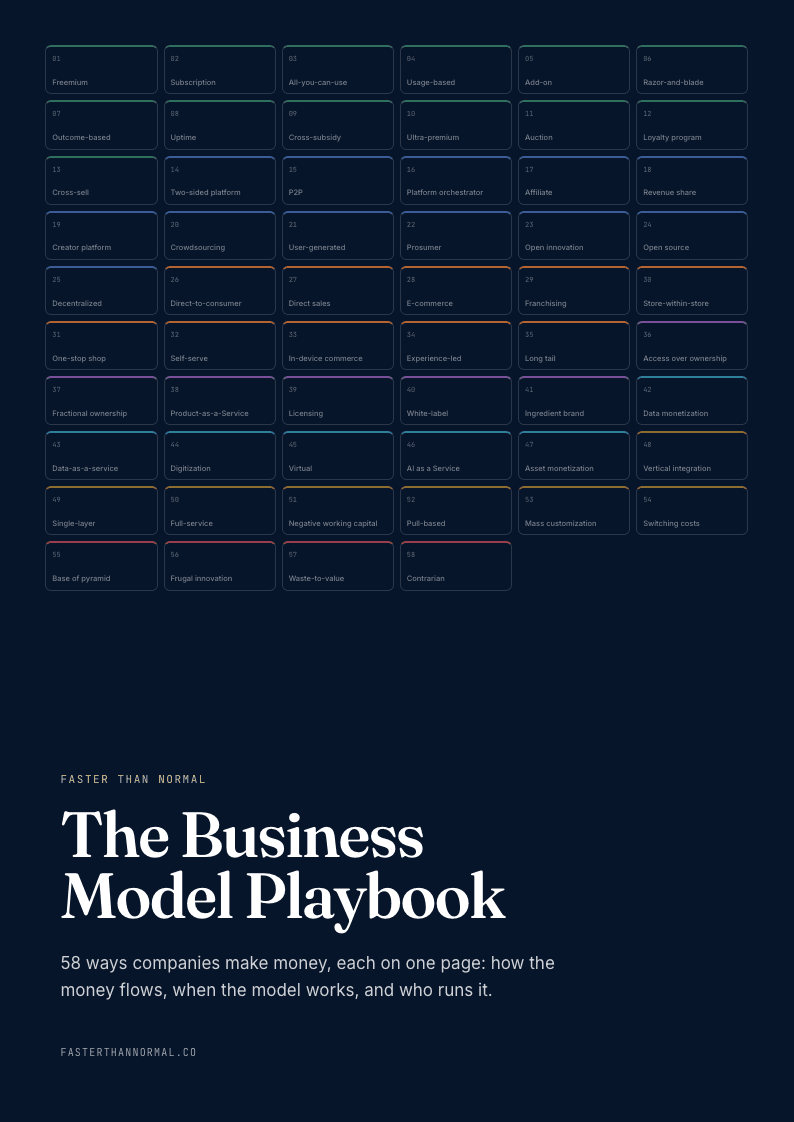
Get The Business Model Playbook
58 business models, one visual page each: how the money flows, the metrics that matter, and who runs it. Free when you join the Faster Than Normal email.
Free. No spam. Unsubscribe anytime.