

Contents
Book summary
Elon Musk: Tesla, SpaceX, and the Quest for a Fantastic Future
by Ashlee Vance
The Core Premise
Elon Musk operates under a principle that most executives would consider corporate suicide: set impossible deadlines, then work backward from the future you want to create. Ashlee Vance's biography reveals how Musk's companies consistently achieve breakthrough innovations not despite their punishing timelines and seemingly impossible goals, but because of them. The conventional wisdom says you should set realistic targets and beat them consistently. Musk proves that ambitious leaders create more value by missing audacious deadlines than by hitting conservative ones.
Vance documents Musk's application of what emerges as the "First Principles Framework" — the practice of breaking down problems to their fundamental physical laws and rebuilding solutions from the ground up, ignoring industry assumptions. When SpaceX needed cheaper rockets, most aerospace companies would optimize existing supply chains or manufacturing processes. Musk's team instead asked: what are rockets really made of? The answer was aluminum, titanium, carbon fiber, and other commodities that cost roughly 2% of a typical rocket's price. The other 98% was markup, legacy processes, and industry inertia. SpaceX vertically integrated manufacturing and built rockets for a fraction of industry costs, ultimately capturing contracts from Boeing and Lockheed Martin despite being decades younger.
The biography reveals Musk's "Iterative Manufacturing Philosophy," where production lines become laboratories for continuous experimentation. At Tesla's Fremont factory, Musk camped on the factory floor during Model 3 production hell, personally redesigning assembly line processes that weren't meeting targets. Rather than accepting the auto industry's standard 18-month development cycles, Tesla treats manufacturing as software development — rapid prototyping, constant iteration, and treating every production run as a beta test for the next improvement. This approach nearly killed the company multiple times but ultimately allowed Tesla to scale electric vehicle production faster than GM or Ford could pivot their century-old processes.
Vance captures how Musk's leadership operates through what could be called "Reality Distortion at Scale" — creating organizational cultures where teams regularly achieve things they previously considered impossible. When SpaceX engineers said certain rocket landing maneuvers violated physics, Musk didn't argue the science. Instead, he created small teams with concentrated ownership over specific technical problems and gave them direct access to testing resources. The Falcon 9's successful landing and reuse program emerged from engineers who stopped asking whether rocket recovery was possible and started asking what specific technical barriers needed solving. The key insight for executives: Musk doesn't motivate through inspiration speeches but by restructuring organizations so that breakthrough solutions become the path of least resistance.
The practical application extends beyond aerospace and automotive manufacturing. Musk's approach works because it exploits a fundamental asymmetry in competitive markets: while most companies optimize existing solutions, massive value creation comes from redefining the problem entirely. Executives can implement Musk's methods by identifying their industry's most expensive assumptions, building small teams with end-to-end ownership over challenging technical problems, and creating organizational structures that reward breakthrough thinking over incremental improvement. The biography demonstrates that Musk's success stems not from superhuman vision but from systematic approaches that any ambitious leader can adapt to their industry's specific constraints and opportunities.
In the spirit of Steve Jobs and Moneyball, Elon Musk is both an illuminating and authorized look at the extraordinary life of one of Silicon Valley’s most exciting, unpredictable, and ambitious entrepreneurs—a real-life Tony Stark—and a fascinating exploration of the renewal of American invention and its new “makers.” Elon Musk spotlights the technology and vision of Elon Musk, the renowned entrepreneur and innovator behind SpaceX, Tesla, and SolarCity, who sold one of his Internet companies, PayPal, for $1.5 billion. Ashlee Vance captures the full spectacle and arc of the genius’s life and work, from his tumultuous upbringing in South Africa and flight to the United States to his dramatic technical innovations and entrepreneurial pursuits. Vance uses Musk’s story to explore one of the pressing questions of our age: can the nation of inventors and creators who led the modern world for a century still compete in an age of fierce global competition? He argues that Musk—one of the most unusual and striking figures in American business history—is a contemporary, visionary amalgam of legendary inventors and industrialists including Thomas Edison, Henry Ford, Howard Hughes, and Steve Job…
Elon Musk: Tesla, SpaceX, and the Quest for a Fantastic Future by Ashlee Vance belongs on the short shelf of books that change how you notice decisions in the wild. Whether you agree with every claim or not, the frame it offers is portable: you can apply it in meetings, investing, hiring, and personal trade-offs without carrying the whole volume.
Many readers return to this book because it names patterns that felt familiar but unnamed. Naming is leverage: once you can point to a mechanism, you can design around it. One through-line is “First Principles Thinking: Breaking down complex problems to their fundamental physical laws and rebuilding solutions without industry assumptions. SpaceX reduced rocket costs by 98% by analyzing raw ” and its implications for judgment under uncertainty.
If you are reading for execution, translate each chapter into a testable habit: one prompt before a big decision, one review question after a project, one constraint you will respect next quarter. Theory becomes useful when it shows up in calendars, not only in margins.
Finally, pair this book with opposing voices. The strongest readers stress-test the thesis against cases where the advice fails, note the boundary conditions, and keep a short list of when not to use this lens. That discipline is how summaries become judgment.
Long-form books reward spaced attention: read a chapter, sleep, then write a half-page memo titled “What would I do differently on Monday?” If you cannot answer with specifics, the idea has not yet landed.
Use Elon Musk: Tesla, SpaceX, and the Quest for a Fantastic Future as a conversation starter with peers who have different incentives. The disagreements often reveal which parts of the book are robust and which are fragile when power, risk, and time horizons change.
Key Ideas and Arguments
First Principles Thinking: Breaking down complex problems to their fundamental physical laws and rebuilding solutions without industry assumptions. SpaceX reduced rocket costs by 98% by analyzing raw material costs rather than accepting aerospace industry pricing structures.. This idea shows up repeatedly in Elon Musk: Tesla, SpaceX, and the Quest for a Fantastic Future: separate the definition from the examples, then ask where the author's evidence is strongest and where anecdotes do most of the work. Consider writing a counterexample: a situation where applying the idea literally would misfire, and what guardrail you would add.
Vertical Integration Strategy: Controlling entire supply chains to eliminate middleman markups and increase iteration speed. Tesla manufactures everything from batteries to seats, allowing faster design changes that traditional automakers can't match due to supplier dependencies.. This idea shows up repeatedly in Elon Musk: Tesla, SpaceX, and the Quest for a Fantastic Future: separate the definition from the examples, then ask where the author's evidence is strongest and where anecdotes do most of the work. Consider writing a counterexample: a situation where applying the idea literally would misfire, and what guardrail you would add.
Manufacturing as Laboratory: Treating production lines as continuous experimentation environments rather than fixed processes. Musk personally redesigned Tesla assembly lines during production, treating each manufacturing run as data for the next iteration.. This idea shows up repeatedly in Elon Musk: Tesla, SpaceX, and the Quest for a Fantastic Future: separate the definition from the examples, then ask where the author's evidence is strongest and where anecdotes do most of the work. Consider writing a counterexample: a situation where applying the idea literally would misfire, and what guardrail you would add.
Impossible Deadline Methodology: Setting technically challenging timelines that force teams to find breakthrough solutions rather than incremental improvements. SpaceX achieved rocket reusability because conservative timelines would have led to conventional optimization approaches.. This idea shows up repeatedly in Elon Musk: Tesla, SpaceX, and the Quest for a Fantastic Future: separate the definition from the examples, then ask where the author's evidence is strongest and where anecdotes do most of the work. Consider writing a counterexample: a situation where applying the idea literally would misfire, and what guardrail you would add.
Small Team Ownership: Assigning end-to-end responsibility for complex technical problems to small groups with direct testing access. This structure eliminates bureaucratic delays and creates concentrated accountability for breakthrough results.. This idea shows up repeatedly in Elon Musk: Tesla, SpaceX, and the Quest for a Fantastic Future: separate the definition from the examples, then ask where the author's evidence is strongest and where anecdotes do most of the work. Consider writing a counterexample: a situation where applying the idea literally would misfire, and what guardrail you would add.
Reality Distortion at Scale: Creating organizational cultures where teams regularly exceed their previous performance assumptions. Musk achieves this by restructuring resources and incentives so that innovative solutions become operationally easier than maintaining status quo approaches.. This idea shows up repeatedly in Elon Musk: Tesla, SpaceX, and the Quest for a Fantastic Future: separate the definition from the examples, then ask where the author's evidence is strongest and where anecdotes do most of the work. Consider writing a counterexample: a situation where applying the idea literally would misfire, and what guardrail you would add.
Cross-Industry Pattern Recognition: Applying successful principles from one domain to seemingly unrelated industries. Musk transferred software development methodologies to manufacturing, creating rapid iteration cycles in traditionally slow-moving industrial processes.. This idea shows up repeatedly in Elon Musk: Tesla, SpaceX, and the Quest for a Fantastic Future: separate the definition from the examples, then ask where the author's evidence is strongest and where anecdotes do most of the work. Consider writing a counterexample: a situation where applying the idea literally would misfire, and what guardrail you would add.
Deeper Themes and Context
Elon Musk: Tesla, SpaceX, and the Quest for a Fantastic Future is not only a catalogue of claims; it is a stance on how to interpret success, failure, and ambiguity. Readers who engage charitably still ask: which recommendations are universal, which are culturally situated, and which require institutional support you do not have?
Comparing the book's prescriptions to your own context is part of the work. A strategy that assumes abundant capital, patient stakeholders, or long feedback loops will read differently if you are resource-constrained, early in a career, or operating under regulatory pressure. Translation beats transcription.
The book also invites you to notice what it does not say. Silences can be instructive: topics the author avoids, counterexamples that never appear, or metrics that are praised without definition. A serious reader keeps a missing-evidence note alongside a to-try note.
Historically, the most influential business and biography titles survive because they double as vocabulary. Teams that share a phrase from Elon Musk: Tesla, SpaceX, and the Quest for a Fantastic Future move faster only when they also share a definition and a worked example, otherwise they talk past each other with the same words.
How to Apply the Lessons
Connected Mental Models
Who Should Read This
Start here if you want a serious, book-length argument rather than a thread of bullet points. Elon Musk: Tesla, SpaceX, and the Quest for a Fantastic Future rewards readers who will sketch their own examples, argue back in the margins, and connect chapters to decisions they are facing this quarter.
It is also useful as a shared vocabulary for teams: a common chapter reference can shorten debate if everyone agrees what the term means in practice. If your team only shares the title, not the definition, expect confusion.
Skip or skim if you need a narrow tactical recipe with no theory; this summary preserves the ideas, but the book's value is often in the extended case material and the author's sequencing.
Analyst's Take
Test Yourself
Check your grasp of the book’s moves
A colleague quotes Elon Musk: Tesla, SpaceX, and the Quest for a Fantastic Future to justify a risky decision. What should you verify first?
You finished Elon Musk: Tesla, SpaceX, and the Quest for a Fantastic Future and want behaviour change this week.
Further Reading
Featured in
Continue exploring


Free playbook
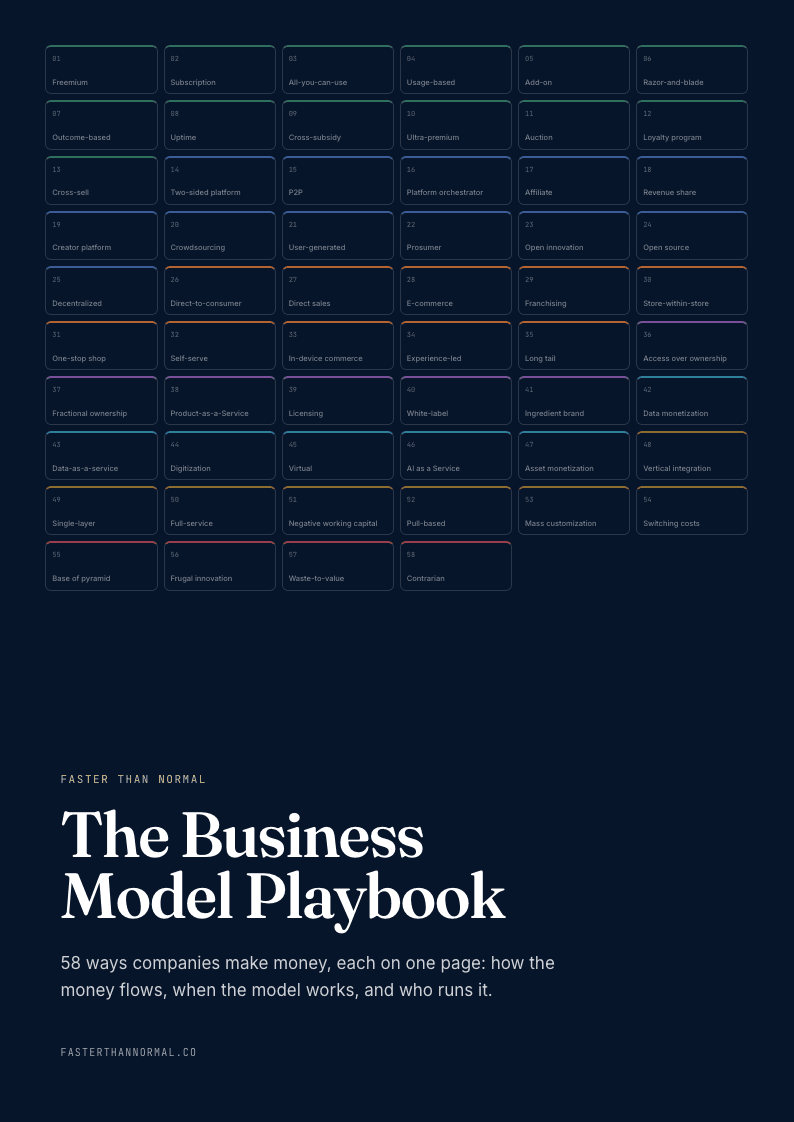
Get The Business Model Playbook
58 business models, one visual page each: how the money flows, the metrics that matter, and who runs it. Free when you join the Faster Than Normal email.
Free. No spam. Unsubscribe anytime.