

Contents
Book summary
Driven: An Autobiography
by Larry Miller
The Core Premise
Most business autobiographies follow a predictable arc of triumph over adversity, but Larry Miller's story reveals something more unsettling: how a successful executive can systematically destroy every relationship and opportunity through unchecked ambition and emotional volatility. Miller, who built a retail empire spanning car dealerships, movie theaters, and sports teams—including a stint as CEO of the Utah Jazz—doesn't soft-pedal his failures or rationalize his destructive behavior. Instead, he dissects his own psychological machinery with the same analytical precision he brought to corporate turnarounds.
Miller's central framework revolves around what he calls "success addiction"—the compulsive need to win that becomes increasingly divorced from any rational business objective. He traces this pattern through his transformation of a small Toyota dealership into a billion-dollar enterprise, showing how each victory fed an internal engine that demanded ever-greater conquests. The mechanics of this addiction mirror substance dependency: tolerance builds, requiring bigger deals to achieve the same psychological payoff, while the collateral damage—broken partnerships, family estrangement, employee turnover—accumulates invisibly in the background. Miller's acquisition of the Utah Jazz exemplifies this dynamic perfectly. What appeared to be a crown jewel investment was actually the culmination of a decades-long pattern where each business success had to be bigger, more visible, more validating than the last.
The book's most valuable insight lies in Miller's analysis of what he terms "operational schizophrenia"—the ability to maintain extraordinary business discipline while exercising zero emotional self-regulation. Miller could execute flawless market analysis, negotiate complex deals, and optimize supply chains, yet routinely sabotaged these achievements through explosive confrontations with partners, employees, and family members. His account of nearly destroying the Jazz franchise through a series of public feuds with players and coaches illustrates this split perfectly: brilliant strategic thinking undermined by complete tactical emotional incompetence. This isn't the familiar story of work-life balance; it's a clinical examination of how high-functioning business skills can coexist with profoundly dysfunctional interpersonal behavior.
Miller introduces the concept of "relationship bankruptcy" as a business metric that most executives ignore until it's too late. He argues that entrepreneurs naturally focus on financial statements while remaining blind to their "relationship balance sheet"—the accumulated trust, goodwill, and social capital that actually enables long-term business success. His detailed accounting of partnerships lost, key employees driven away, and family relationships destroyed reads like a cautionary case study in hidden organizational costs. The quantifiable business impact becomes clear: deals that fell through because of personal animosity, key hires who refused to work with him, strategic opportunities that evaporated due to reputation damage.
What makes Miller's framework immediately applicable is his development of early warning systems for executives prone to similar patterns. His "relationship audit" methodology involves systematically cataloging key business relationships and honestly assessing their trajectory—not just their current utility, but whether they're strengthening or deteriorating over time. Miller's "success addiction test" provides concrete behavioral markers: the inability to delegate meaningful decisions, compulsive deal-making that exceeds strategic necessity, and the gradual replacement of trusted advisors with yes-men. These aren't abstract psychological concepts but practical diagnostic tools that can be implemented in quarterly business reviews alongside traditional financial metrics.
Written during the months before his death, Miller tells his inspiring story, sharing lessons--painful as well as joyful lessons--he has learned from his experiences. Includes a moving foreword by Utah Jazz great John Stockton and an epilogue written by Gail Miller, Larry's wife.
Driven: An Autobiography by Larry Miller belongs on the short shelf of books that change how you notice decisions in the wild. Whether you agree with every claim or not, the frame it offers is portable: you can apply it in meetings, investing, hiring, and personal trade-offs without carrying the whole volume.
Many readers return to this book because it names patterns that felt familiar but unnamed. Naming is leverage: once you can point to a mechanism, you can design around it. One through-line is “Success Addiction: The compulsive need to achieve bigger victories that becomes divorced from rational business objectives. Miller demonstrates how each business triumph fed an internal engine demandi” and its implications for judgment under uncertainty.
If you are reading for execution, translate each chapter into a testable habit: one prompt before a big decision, one review question after a project, one constraint you will respect next quarter. Theory becomes useful when it shows up in calendars, not only in margins.
Finally, pair this book with opposing voices. The strongest readers stress-test the thesis against cases where the advice fails, note the boundary conditions, and keep a short list of when not to use this lens. That discipline is how summaries become judgment.
Long-form books reward spaced attention: read a chapter, sleep, then write a half-page memo titled “What would I do differently on Monday?” If you cannot answer with specifics, the idea has not yet landed.
Use Driven: An Autobiography as a conversation starter with peers who have different incentives. The disagreements often reveal which parts of the book are robust and which are fragile when power, risk, and time horizons change.
Key Ideas and Arguments
Success Addiction: The compulsive need to achieve bigger victories that becomes divorced from rational business objectives. Miller demonstrates how each business triumph fed an internal engine demanding ever-greater conquests, leading to increasingly irrational decision-making despite continued financial success.. This idea shows up repeatedly in Driven: An Autobiography: separate the definition from the examples, then ask where the author's evidence is strongest and where anecdotes do most of the work. Consider writing a counterexample: a situation where applying the idea literally would misfire, and what guardrail you would add.
Operational Schizophrenia: The ability to maintain extraordinary business discipline while exercising zero emotional self-regulation. Miller could execute flawless strategic analysis yet routinely sabotaged achievements through explosive interpersonal confrontations.. This idea shows up repeatedly in Driven: An Autobiography: separate the definition from the examples, then ask where the author's evidence is strongest and where anecdotes do most of the work. Consider writing a counterexample: a situation where applying the idea literally would misfire, and what guardrail you would add.
Relationship Bankruptcy: A business metric measuring accumulated trust, goodwill, and social capital that enables long-term success. Miller argues most executives ignore this balance sheet until partnership failures and reputation damage create quantifiable business costs.. This idea shows up repeatedly in Driven: An Autobiography: separate the definition from the examples, then ask where the author's evidence is strongest and where anecdotes do most of the work. Consider writing a counterexample: a situation where applying the idea literally would misfire, and what guardrail you would add.
Emotional Leverage: Miller's term for how uncontrolled emotional reactions compound business problems exponentially. Small interpersonal conflicts escalate into major strategic setbacks when personal volatility meets high-stakes business negotiations.. This idea shows up repeatedly in Driven: An Autobiography: separate the definition from the examples, then ask where the author's evidence is strongest and where anecdotes do most of the work. Consider writing a counterexample: a situation where applying the idea literally would misfire, and what guardrail you would add.
Victory Tolerance: The psychological phenomenon where successful outcomes provide diminishing satisfaction, requiring increasingly ambitious projects to achieve the same emotional payoff. Miller traces this pattern through his progression from small dealerships to major franchise ownership.. This idea shows up repeatedly in Driven: An Autobiography: separate the definition from the examples, then ask where the author's evidence is strongest and where anecdotes do most of the work. Consider writing a counterexample: a situation where applying the idea literally would misfire, and what guardrail you would add.
Trust Arbitrage: Miller's framework for understanding how personal reliability becomes a competitive business advantage. Executives who consistently honor commitments and manage relationships gain access to opportunities unavailable to more volatile competitors.. This idea shows up repeatedly in Driven: An Autobiography: separate the definition from the examples, then ask where the author's evidence is strongest and where anecdotes do most of the work. Consider writing a counterexample: a situation where applying the idea literally would misfire, and what guardrail you would add.
Deeper Themes and Context
Driven: An Autobiography is not only a catalogue of claims; it is a stance on how to interpret success, failure, and ambiguity. Readers who engage charitably still ask: which recommendations are universal, which are culturally situated, and which require institutional support you do not have?
Comparing the book's prescriptions to your own context is part of the work. A strategy that assumes abundant capital, patient stakeholders, or long feedback loops will read differently if you are resource-constrained, early in a career, or operating under regulatory pressure. Translation beats transcription.
The book also invites you to notice what it does not say. Silences can be instructive: topics the author avoids, counterexamples that never appear, or metrics that are praised without definition. A serious reader keeps a missing-evidence note alongside a to-try note.
Historically, the most influential business and biography titles survive because they double as vocabulary. Teams that share a phrase from Driven: An Autobiography move faster only when they also share a definition and a worked example, otherwise they talk past each other with the same words.
How to Apply the Lessons
Connected Mental Models
Who Should Read This
Start here if you want a serious, book-length argument rather than a thread of bullet points. Driven: An Autobiography rewards readers who will sketch their own examples, argue back in the margins, and connect chapters to decisions they are facing this quarter.
It is also useful as a shared vocabulary for teams: a common chapter reference can shorten debate if everyone agrees what the term means in practice. If your team only shares the title, not the definition, expect confusion.
Skip or skim if you need a narrow tactical recipe with no theory; this summary preserves the ideas, but the book's value is often in the extended case material and the author's sequencing.
Analyst's Take
Test Yourself
Check your grasp of the book’s moves
A colleague quotes Driven: An Autobiography to justify a risky decision. What should you verify first?
You finished Driven: An Autobiography and want behaviour change this week.
Further Reading
Continue exploring


Free playbook
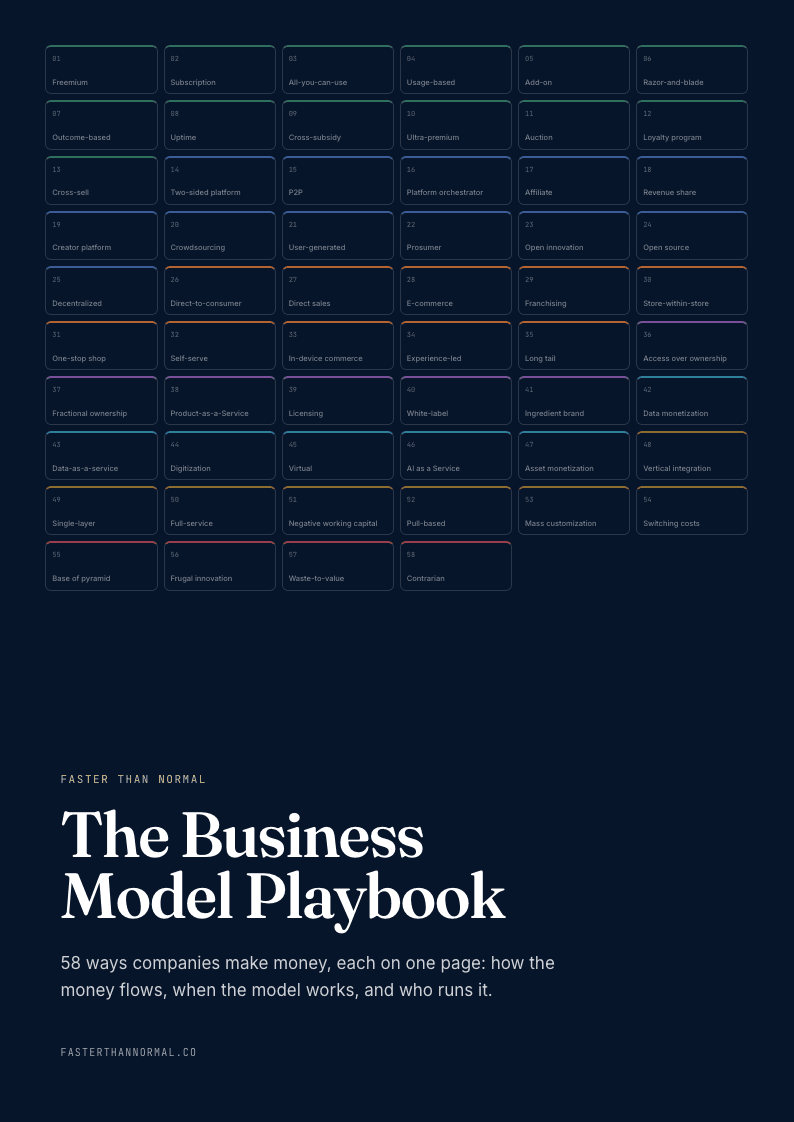
Get The Business Model Playbook
58 business models, one visual page each: how the money flows, the metrics that matter, and who runs it. Free when you join the Faster Than Normal email.
Free. No spam. Unsubscribe anytime.