

Contents
Book summary
Business @ the Speed of Thought
by Bill Gates
The Core Premise
Bill Gates declared in 1999 that the nervous system of corporations would determine their survival in the digital age. His prediction that companies would need to process information as reflexively as humans process thought proved prophetic, anticipating everything from real-time analytics to AI-driven decision making two decades before these became business imperatives.
Gates built his argument around what he called the "digital nervous system" — an integrated network of digital processes that connects every part of an organization and enables instantaneous information flow. This isn't mere connectivity; it's about creating reflexive organizational intelligence. Companies with effective digital nervous systems don't just collect data faster; they develop what Gates termed "digital reflexes" that allow them to respond to market changes, customer needs, and operational problems with the speed of thought itself. Microsoft exemplified this when it pivoted from primarily packaged software to web-based services in the late 1990s, using real-time customer usage data and competitive intelligence to make strategic decisions in weeks rather than quarters.
The book's most radical insight centers on "information velocity" — Gates' framework for measuring how quickly actionable intelligence moves through an organization. Traditional companies suffer from what he diagnosed as "information friction," where critical insights get trapped in departmental silos or lost in bureaucratic processes. Gates demonstrated this through Coca-Cola's transformation of its global operations, where real-time sales data from vending machines and retail partners enabled the company to adjust product mix and marketing strategies locally while maintaining global brand consistency. The velocity principle doesn't just apply to data movement; it fundamentally reshapes organizational structure, decision rights, and competitive strategy.
Twenty-five years later, Gates' frameworks have become the operating principles of digital-native companies like Amazon and Netflix, but most traditional enterprises still struggle with information friction. His "Web Lifestyle" concept — where digital tools become as natural as picking up a telephone — now manifests in everything from Slack workflows to automated supply chain management. The companies that survived digital disruption were those that internalized Gates' central thesis: competitive advantage flows not from having better information, but from processing that information faster than competitors can react. This speed differential compounds over time, creating what Gates called "positive spirals" where better information leads to better decisions, which generate better information, creating an accelerating cycle of competitive advantage.
Bill Gates is the founder of Microsoft. He thinks that businesses use computers in the same way we use our nervous system. In this book, he describes his idea of a 'Digital Nervous System' - a way for companies to get as much as possible from all the money they have spent on computers.
Business @ the Speed of Thought by Bill Gates belongs on the short shelf of books that change how you notice decisions in the wild. Whether you agree with every claim or not, the frame it offers is portable: you can apply it in meetings, investing, hiring, and personal trade-offs without carrying the whole volume.
Many readers return to this book because it names patterns that felt familiar but unnamed. Naming is leverage: once you can point to a mechanism, you can design around it. One through-line is “Digital Nervous System: An integrated network of digital processes connecting every organizational function to enable instant information flow. Unlike simple IT systems, this creates organizational re” and its implications for judgment under uncertainty.
If you are reading for execution, translate each chapter into a testable habit: one prompt before a big decision, one review question after a project, one constraint you will respect next quarter. Theory becomes useful when it shows up in calendars, not only in margins.
Finally, pair this book with opposing voices. The strongest readers stress-test the thesis against cases where the advice fails, note the boundary conditions, and keep a short list of when not to use this lens. That discipline is how summaries become judgment.
Long-form books reward spaced attention: read a chapter, sleep, then write a half-page memo titled “What would I do differently on Monday?” If you cannot answer with specifics, the idea has not yet landed.
Use Business @ the Speed of Thought as a conversation starter with peers who have different incentives. The disagreements often reveal which parts of the book are robust and which are fragile when power, risk, and time horizons change.
Key Ideas and Arguments
Digital Nervous System: An integrated network of digital processes connecting every organizational function to enable instant information flow. Unlike simple IT systems, this creates organizational reflexes that respond automatically to market signals, similar to how human nervous systems process stimuli without conscious thought.. This idea shows up repeatedly in Business @ the Speed of Thought: separate the definition from the examples, then ask where the author's evidence is strongest and where anecdotes do most of the work. Consider writing a counterexample: a situation where applying the idea literally would misfire, and what guardrail you would add.
Information Velocity: The speed at which actionable intelligence moves through an organization from collection to decision to implementation. Gates measured this in hours or days rather than weeks, arguing that velocity matters more than volume when processing competitive intelligence.. This idea shows up repeatedly in Business @ the Speed of Thought: separate the definition from the examples, then ask where the author's evidence is strongest and where anecdotes do most of the work. Consider writing a counterexample: a situation where applying the idea literally would misfire, and what guardrail you would add.
Digital Reflexes: Automated organizational responses to market changes that occur without manual intervention or lengthy approval processes. These reflexes develop when companies embed decision-making logic directly into their digital nervous systems, enabling real-time competitive responses.. This idea shows up repeatedly in Business @ the Speed of Thought: separate the definition from the examples, then ask where the author's evidence is strongest and where anecdotes do most of the work. Consider writing a counterexample: a situation where applying the idea literally would misfire, and what guardrail you would add.
Information Friction: The organizational resistance that slows information flow between departments, systems, or decision-makers. Gates identified friction as the primary barrier preventing companies from achieving thought-speed responses to market opportunities and threats.. This idea shows up repeatedly in Business @ the Speed of Thought: separate the definition from the examples, then ask where the author's evidence is strongest and where anecdotes do most of the work. Consider writing a counterexample: a situation where applying the idea literally would misfire, and what guardrail you would add.
Web Lifestyle: The seamless integration of digital tools into daily work processes until they become as natural as basic human activities. This concept extends beyond simple software adoption to fundamental changes in how people communicate, collaborate, and make decisions.. This idea shows up repeatedly in Business @ the Speed of Thought: separate the definition from the examples, then ask where the author's evidence is strongest and where anecdotes do most of the work. Consider writing a counterexample: a situation where applying the idea literally would misfire, and what guardrail you would add.
Positive Spirals: Self-reinforcing cycles where better information leads to better decisions, which generate more accurate information, creating accelerating competitive advantages. Companies that achieve positive spirals become increasingly difficult for competitors to match over time.. This idea shows up repeatedly in Business @ the Speed of Thought: separate the definition from the examples, then ask where the author's evidence is strongest and where anecdotes do most of the work. Consider writing a counterexample: a situation where applying the idea literally would misfire, and what guardrail you would add.
Deeper Themes and Context
Business @ the Speed of Thought is not only a catalogue of claims; it is a stance on how to interpret success, failure, and ambiguity. Readers who engage charitably still ask: which recommendations are universal, which are culturally situated, and which require institutional support you do not have?
Comparing the book's prescriptions to your own context is part of the work. A strategy that assumes abundant capital, patient stakeholders, or long feedback loops will read differently if you are resource-constrained, early in a career, or operating under regulatory pressure. Translation beats transcription.
The book also invites you to notice what it does not say. Silences can be instructive: topics the author avoids, counterexamples that never appear, or metrics that are praised without definition. A serious reader keeps a missing-evidence note alongside a to-try note.
Historically, the most influential business and biography titles survive because they double as vocabulary. Teams that share a phrase from Business @ the Speed of Thought move faster only when they also share a definition and a worked example, otherwise they talk past each other with the same words.
How to Apply the Lessons
Connected Mental Models
Who Should Read This
Start here if you want a serious, book-length argument rather than a thread of bullet points. Business @ the Speed of Thought rewards readers who will sketch their own examples, argue back in the margins, and connect chapters to decisions they are facing this quarter.
It is also useful as a shared vocabulary for teams: a common chapter reference can shorten debate if everyone agrees what the term means in practice. If your team only shares the title, not the definition, expect confusion.
Skip or skim if you need a narrow tactical recipe with no theory; this summary preserves the ideas, but the book's value is often in the extended case material and the author's sequencing.
Analyst's Take
Test Yourself
Check your grasp of the book’s moves
A colleague quotes Business @ the Speed of Thought to justify a risky decision. What should you verify first?
You finished Business @ the Speed of Thought and want behaviour change this week.
Further Reading
Continue exploring


Free playbook
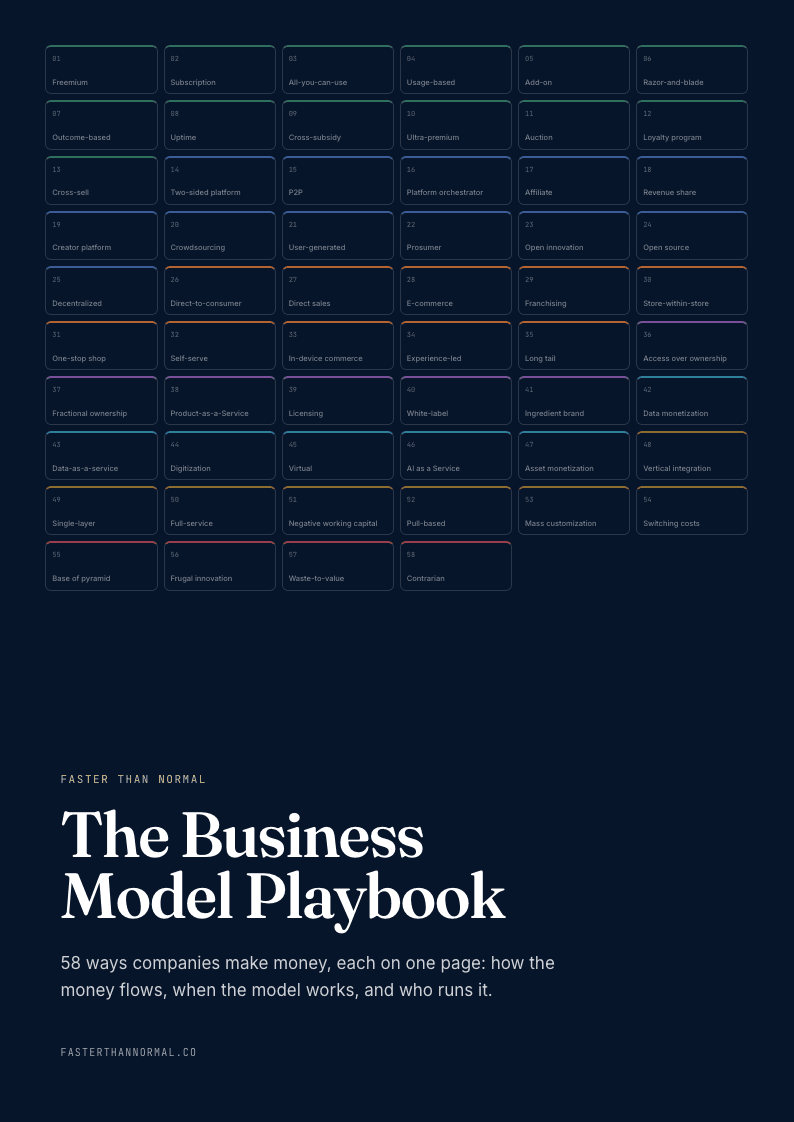
Get The Business Model Playbook
58 business models, one visual page each: how the money flows, the metrics that matter, and who runs it. Free when you join the Faster Than Normal email.
Free. No spam. Unsubscribe anytime.