

Contents
Book summary
Branson: Behind the Mask
by Tom Bower
The Core Premise
Richard Branson built a billion-dollar empire while cultivating the image of a risk-taking maverick who puts employees first and customers second. Tom Bower's forensic investigation reveals this carefully crafted persona masks a ruthless operator who systematically exploits legal loopholes, abandons failing ventures without regard for stakeholders, and weaponizes his charm to extract maximum value from every relationship. The Virgin founder didn't stumble into success through happy accidents—he engineered it through what Bower calls "calculated recklessness" and an almost pathological ability to reframe disasters as publicity opportunities.
Bower exposes Branson's core operating philosophy: the "Virgin Model" of brand extension without operational responsibility. Rather than building businesses from scratch, Branson licenses the Virgin name to partners who provide capital and expertise while he retains marketing control and upside potential with limited downside risk. When Virgin Cola failed to dent Coca-Cola's market share, Branson simply walked away, leaving his beverage partner holding worthless inventory. When Virgin Brides collapsed, he blamed market conditions rather than strategic missteps. This pattern—what Bower terms "entrepreneurial Darwinism"—allows Branson to maintain his winner's aura while systematically offloading business risk.
The book's most damning revelations center on Virgin Atlantic's survival strategy during its early years competing against British Airways. Bower documents how Branson exploited regulatory gaps, used political connections to secure favorable routes, and orchestrated media campaigns that painted Virgin as David fighting Goliath—all while Virgin's actual service quality lagged behind established carriers. When BA launched predatory pricing to crush Virgin, Branson didn't compete on operational excellence. Instead, he sued for damages, using legal victories to fund expansion that his airline's fundamentals couldn't support.
Bower argues that Branson's genius lies not in building superior businesses but in mastering what he calls "perception arbitrage"—the gap between public image and private reality. Branson understood that modern capitalism rewards storytellers more than operators, brands more than products. His "aw-shucks" public persona and willingness to perform publicity stunts created a media narrative that insulated Virgin from scrutiny that would destroy conventional executives. When Virgin Trains became synonymous with delays and cancellations, Branson's personal brand remained untouchable because he had successfully separated Virgin-the-promise from Virgin-the-performance.
For executives building companies in Branson's wake, Bower's analysis offers a sobering lesson about the difference between sustainable value creation and masterful brand theater. Branson's approach works only for operators with his specific combination of political savvy, media intuition, and shameless opportunism. Most leaders lack both the skill and stomach for Branson's brand of calculated exploitation. The book suggests a more honest path: building operational excellence first, then crafting narratives that amplify rather than obscure your actual competitive advantages. Branson succeeded by making his personal brand bigger than any individual business failure. Few leaders can or should attempt to replicate that model.
'Bower's book is a devastating indictment' Sunday Times 'Explosive ... Bower reveals a remarkable and sinister picture of the man who likes to appear as the ever-smiling hero' Daily Mail A sensational critical biography of the man and his business practices.
Branson: Behind the Mask by Tom Bower belongs on the short shelf of books that change how you notice decisions in the wild. Whether you agree with every claim or not, the frame it offers is portable: you can apply it in meetings, investing, hiring, and personal trade-offs without carrying the whole volume.
Many readers return to this book because it names patterns that felt familiar but unnamed. Naming is leverage: once you can point to a mechanism, you can design around it. One through-line is “Virgin Model of Brand Extension: Branson licenses the Virgin name to partners who provide capital and operations while he retains marketing control and upside with limited downside risk. When Virgin C” and its implications for judgment under uncertainty.
If you are reading for execution, translate each chapter into a testable habit: one prompt before a big decision, one review question after a project, one constraint you will respect next quarter. Theory becomes useful when it shows up in calendars, not only in margins.
Finally, pair this book with opposing voices. The strongest readers stress-test the thesis against cases where the advice fails, note the boundary conditions, and keep a short list of when not to use this lens. That discipline is how summaries become judgment.
Long-form books reward spaced attention: read a chapter, sleep, then write a half-page memo titled “What would I do differently on Monday?” If you cannot answer with specifics, the idea has not yet landed.
Use Branson: Behind the Mask as a conversation starter with peers who have different incentives. The disagreements often reveal which parts of the book are robust and which are fragile when power, risk, and time horizons change.
Key Ideas and Arguments
Virgin Model of Brand Extension: Branson licenses the Virgin name to partners who provide capital and operations while he retains marketing control and upside with limited downside risk. When Virgin Cola failed, he walked away while partners absorbed losses, maintaining his success narrative.. This idea shows up repeatedly in Branson: Behind the Mask: separate the definition from the examples, then ask where the author's evidence is strongest and where anecdotes do most of the work. Consider writing a counterexample: a situation where applying the idea literally would misfire, and what guardrail you would add.
Calculated Recklessness: Branson's approach to risk-taking that appears spontaneous but follows systematic patterns of maximum publicity with minimal personal exposure. His publicity stunts generated media value that exceeded the cost of potential business failures.. This idea shows up repeatedly in Branson: Behind the Mask: separate the definition from the examples, then ask where the author's evidence is strongest and where anecdotes do most of the work. Consider writing a counterexample: a situation where applying the idea literally would misfire, and what guardrail you would add.
Entrepreneurial Darwinism: Bower's term for Branson's practice of launching multiple ventures knowing most will fail, then using survivors to fund the next wave while abandoning losers without reputational damage. Success covers the cost of failures.. This idea shows up repeatedly in Branson: Behind the Mask: separate the definition from the examples, then ask where the author's evidence is strongest and where anecdotes do most of the work. Consider writing a counterexample: a situation where applying the idea literally would misfire, and what guardrail you would add.
Perception Arbitrage: The strategic gap Branson creates between his public image as a customer-focused maverick and his private reality as a profit-maximizing operator. This disconnect allows Virgin to charge premium prices while delivering commodity services.. This idea shows up repeatedly in Branson: Behind the Mask: separate the definition from the examples, then ask where the author's evidence is strongest and where anecdotes do most of the work. Consider writing a counterexample: a situation where applying the idea literally would misfire, and what guardrail you would add.
Political Capitalism: Branson's systematic exploitation of regulatory gaps and government relationships to secure competitive advantages unavailable through pure market competition. Virgin Atlantic's route acquisitions exemplify this approach.. This idea shows up repeatedly in Branson: Behind the Mask: separate the definition from the examples, then ask where the author's evidence is strongest and where anecdotes do most of the work. Consider writing a counterexample: a situation where applying the idea literally would misfire, and what guardrail you would add.
Reputation Insulation: Branson's technique of separating his personal brand from Virgin's operational performance, allowing him to remain untouchable even when Virgin businesses fail spectacularly. The brand promise becomes independent of business delivery.. This idea shows up repeatedly in Branson: Behind the Mask: separate the definition from the examples, then ask where the author's evidence is strongest and where anecdotes do most of the work. Consider writing a counterexample: a situation where applying the idea literally would misfire, and what guardrail you would add.
Deeper Themes and Context
Branson: Behind the Mask is not only a catalogue of claims; it is a stance on how to interpret success, failure, and ambiguity. Readers who engage charitably still ask: which recommendations are universal, which are culturally situated, and which require institutional support you do not have?
Comparing the book's prescriptions to your own context is part of the work. A strategy that assumes abundant capital, patient stakeholders, or long feedback loops will read differently if you are resource-constrained, early in a career, or operating under regulatory pressure. Translation beats transcription.
The book also invites you to notice what it does not say. Silences can be instructive: topics the author avoids, counterexamples that never appear, or metrics that are praised without definition. A serious reader keeps a missing-evidence note alongside a to-try note.
Historically, the most influential business and biography titles survive because they double as vocabulary. Teams that share a phrase from Branson: Behind the Mask move faster only when they also share a definition and a worked example, otherwise they talk past each other with the same words.
How to Apply the Lessons
Connected Mental Models
Who Should Read This
Start here if you want a serious, book-length argument rather than a thread of bullet points. Branson: Behind the Mask rewards readers who will sketch their own examples, argue back in the margins, and connect chapters to decisions they are facing this quarter.
It is also useful as a shared vocabulary for teams: a common chapter reference can shorten debate if everyone agrees what the term means in practice. If your team only shares the title, not the definition, expect confusion.
Skip or skim if you need a narrow tactical recipe with no theory; this summary preserves the ideas, but the book's value is often in the extended case material and the author's sequencing.
Analyst's Take
Test Yourself
Check your grasp of the book’s moves
A colleague quotes Branson: Behind the Mask to justify a risky decision. What should you verify first?
You finished Branson: Behind the Mask and want behaviour change this week.
Further Reading
Continue exploring


Free playbook
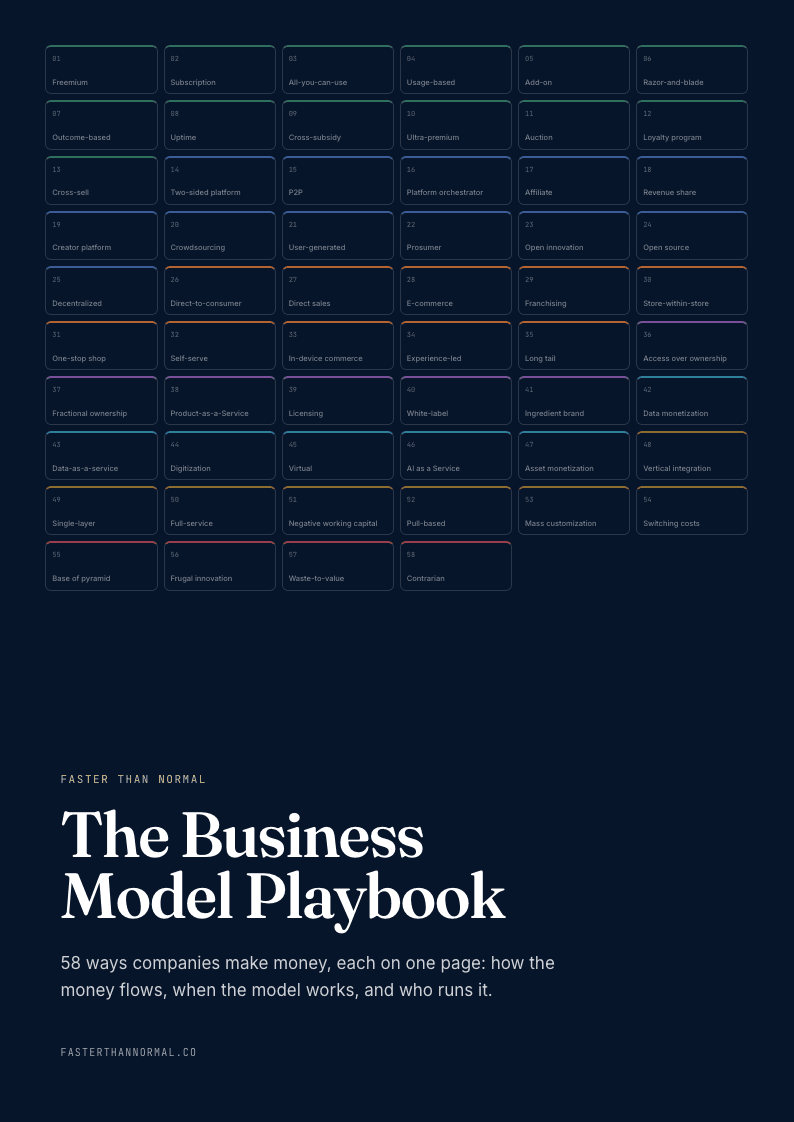
Get The Business Model Playbook
58 business models, one visual page each: how the money flows, the metrics that matter, and who runs it. Free when you join the Faster Than Normal email.
Free. No spam. Unsubscribe anytime.