

Contents
Book summary
Ancient Greece: From Prehistoric to Hellenistic Times
by Thomas R. Martin
The Core Premise
Ancient Athens built the world's first democracy on a foundation most modern leaders would consider impossible: giving direct political power to thousands of ordinary citizens while simultaneously creating history's most influential military and economic empire. Thomas R. Martin reveals how Greek city-states developed organizational principles that solved problems every leader faces today—how to balance individual excellence with collective action, how to maintain innovation while preserving stability, and how to scale influence without losing core values.
Martin's analysis centers on what he calls the "Greek Paradox"—the tension between fierce individualism (agon) and communal responsibility (polis). Greek leaders mastered this through the concept of arete (excellence), which demanded both personal achievement and service to the community. The Athenian statesman Pericles exemplified this balance, using his rhetorical skills not for personal gain but to convince citizens to fund the Parthenon and expand Athenian naval power. Meanwhile, Spartan society solved the same paradox differently, subordinating individual desires entirely to collective military effectiveness through their agoge training system. Both models produced extraordinary results: Athens dominated Mediterranean trade and created lasting intellectual innovations, while Sparta built the ancient world's most feared military force.
The book's most valuable framework for modern leaders is Martin's "Hellenistic Adaptation Model"—how Greek organizational principles evolved as city-states gave way to vast empires under Alexander and his successors. When Alexander conquered territories from Egypt to India, he couldn't simply impose Greek culture. Instead, he created hybrid institutions that preserved local customs while introducing Greek administrative efficiency and intellectual methods. The Ptolemaic dynasty in Egypt demonstrates this perfectly: they maintained traditional pharaonic rituals to legitimize their rule among Egyptians while simultaneously funding the Library of Alexandria and adopting Greek military tactics.
Martin proves that Greek political innovations succeeded because they institutionalized productive conflict rather than trying to eliminate it. Athenian democracy worked through structured debate in the ecclesia (citizen assembly), where speakers competed to propose better policies. This wasn't chaos—it was systematic disagreement with clear rules and measurable outcomes. The ostracism process allowed citizens to remove potentially dangerous leaders without trials or executions, preventing the kind of factional violence that destroyed other ancient republics. Modern leaders can apply this by creating formal mechanisms for dissent, ensuring that organizational conflicts produce better decisions rather than destructive politics.
"First edition 1996. Updated in 2000 with new suggested readings and illustrations"--Title page verso.
Ancient Greece: From Prehistoric to Hellenistic Times by Thomas R. Martin belongs on the short shelf of books that change how you notice decisions in the wild. Whether you agree with every claim or not, the frame it offers is portable: you can apply it in meetings, investing, hiring, and personal trade-offs without carrying the whole volume.
Many readers return to this book because it names patterns that felt familiar but unnamed. Naming is leverage: once you can point to a mechanism, you can design around it. One through-line is “Agon (Competitive Excellence): The Greek principle that individuals achieve their highest potential through direct competition with peers. Athenian poets, athletes, and politicians constantly competed” and its implications for judgment under uncertainty.
If you are reading for execution, translate each chapter into a testable habit: one prompt before a big decision, one review question after a project, one constraint you will respect next quarter. Theory becomes useful when it shows up in calendars, not only in margins.
Finally, pair this book with opposing voices. The strongest readers stress-test the thesis against cases where the advice fails, note the boundary conditions, and keep a short list of when not to use this lens. That discipline is how summaries become judgment.
Long-form books reward spaced attention: read a chapter, sleep, then write a half-page memo titled “What would I do differently on Monday?” If you cannot answer with specifics, the idea has not yet landed.
Use Ancient Greece: From Prehistoric to Hellenistic Times as a conversation starter with peers who have different incentives. The disagreements often reveal which parts of the book are robust and which are fragile when power, risk, and time horizons change.
Key Ideas and Arguments
Agon (Competitive Excellence): The Greek principle that individuals achieve their highest potential through direct competition with peers. Athenian poets, athletes, and politicians constantly competed in public contests, driving innovation and maintaining high performance standards throughout society.. This idea shows up repeatedly in Ancient Greece: From Prehistoric to Hellenistic Times: separate the definition from the examples, then ask where the author's evidence is strongest and where anecdotes do most of the work. Consider writing a counterexample: a situation where applying the idea literally would misfire, and what guardrail you would add.
Polis System: The organizational structure of independent city-states that balanced local autonomy with shared Greek identity. Each polis developed specialized advantages—Athens in naval power and trade, Sparta in land warfare, Corinth in manufacturing—while maintaining common religious and cultural practices.. This idea shows up repeatedly in Ancient Greece: From Prehistoric to Hellenistic Times: separate the definition from the examples, then ask where the author's evidence is strongest and where anecdotes do most of the work. Consider writing a counterexample: a situation where applying the idea literally would misfire, and what guardrail you would add.
Hellenistic Synthesis: The administrative approach developed by Alexander's successors that combined Greek organizational methods with local traditions to govern diverse populations. This created stable hybrid institutions that lasted for centuries across multiple cultures.. This idea shows up repeatedly in Ancient Greece: From Prehistoric to Hellenistic Times: separate the definition from the examples, then ask where the author's evidence is strongest and where anecdotes do most of the work. Consider writing a counterexample: a situation where applying the idea literally would misfire, and what guardrail you would add.
Ostracism Mechanism: Athens' annual process allowing citizens to exile prominent individuals for ten years without trial or property confiscation. This prevented the rise of tyrants while avoiding the violence typically associated with political transitions in ancient societies.. This idea shows up repeatedly in Ancient Greece: From Prehistoric to Hellenistic Times: separate the definition from the examples, then ask where the author's evidence is strongest and where anecdotes do most of the work. Consider writing a counterexample: a situation where applying the idea literally would misfire, and what guardrail you would add.
Arete Leadership Model: The Greek conception of excellence that required both individual achievement and service to the community. Leaders gained authority through demonstrated competence in war, politics, or intellectual pursuits, but maintained it only by advancing collective interests.. This idea shows up repeatedly in Ancient Greece: From Prehistoric to Hellenistic Times: separate the definition from the examples, then ask where the author's evidence is strongest and where anecdotes do most of the work. Consider writing a counterexample: a situation where applying the idea literally would misfire, and what guardrail you would add.
Sacred Truce (Ekecheiria): The diplomatic innovation that suspended all warfare during Olympic Games and other pan-Hellenic festivals. This created regular opportunities for peaceful interaction between normally hostile city-states, facilitating trade and cultural exchange.. This idea shows up repeatedly in Ancient Greece: From Prehistoric to Hellenistic Times: separate the definition from the examples, then ask where the author's evidence is strongest and where anecdotes do most of the work. Consider writing a counterexample: a situation where applying the idea literally would misfire, and what guardrail you would add.
Deeper Themes and Context
Ancient Greece: From Prehistoric to Hellenistic Times is not only a catalogue of claims; it is a stance on how to interpret success, failure, and ambiguity. Readers who engage charitably still ask: which recommendations are universal, which are culturally situated, and which require institutional support you do not have?
Comparing the book's prescriptions to your own context is part of the work. A strategy that assumes abundant capital, patient stakeholders, or long feedback loops will read differently if you are resource-constrained, early in a career, or operating under regulatory pressure. Translation beats transcription.
The book also invites you to notice what it does not say. Silences can be instructive: topics the author avoids, counterexamples that never appear, or metrics that are praised without definition. A serious reader keeps a missing-evidence note alongside a to-try note.
Historically, the most influential business and biography titles survive because they double as vocabulary. Teams that share a phrase from Ancient Greece: From Prehistoric to Hellenistic Times move faster only when they also share a definition and a worked example, otherwise they talk past each other with the same words.
How to Apply the Lessons
Connected Mental Models
Who Should Read This
Start here if you want a serious, book-length argument rather than a thread of bullet points. Ancient Greece: From Prehistoric to Hellenistic Times rewards readers who will sketch their own examples, argue back in the margins, and connect chapters to decisions they are facing this quarter.
It is also useful as a shared vocabulary for teams: a common chapter reference can shorten debate if everyone agrees what the term means in practice. If your team only shares the title, not the definition, expect confusion.
Skip or skim if you need a narrow tactical recipe with no theory; this summary preserves the ideas, but the book's value is often in the extended case material and the author's sequencing.
Analyst's Take
Test Yourself
Check your grasp of the book’s moves
A colleague quotes Ancient Greece: From Prehistoric to Hellenistic Times to justify a risky decision. What should you verify first?
You finished Ancient Greece: From Prehistoric to Hellenistic Times and want behaviour change this week.
Further Reading
Continue exploring


Free playbook
Get The Business Model Playbook
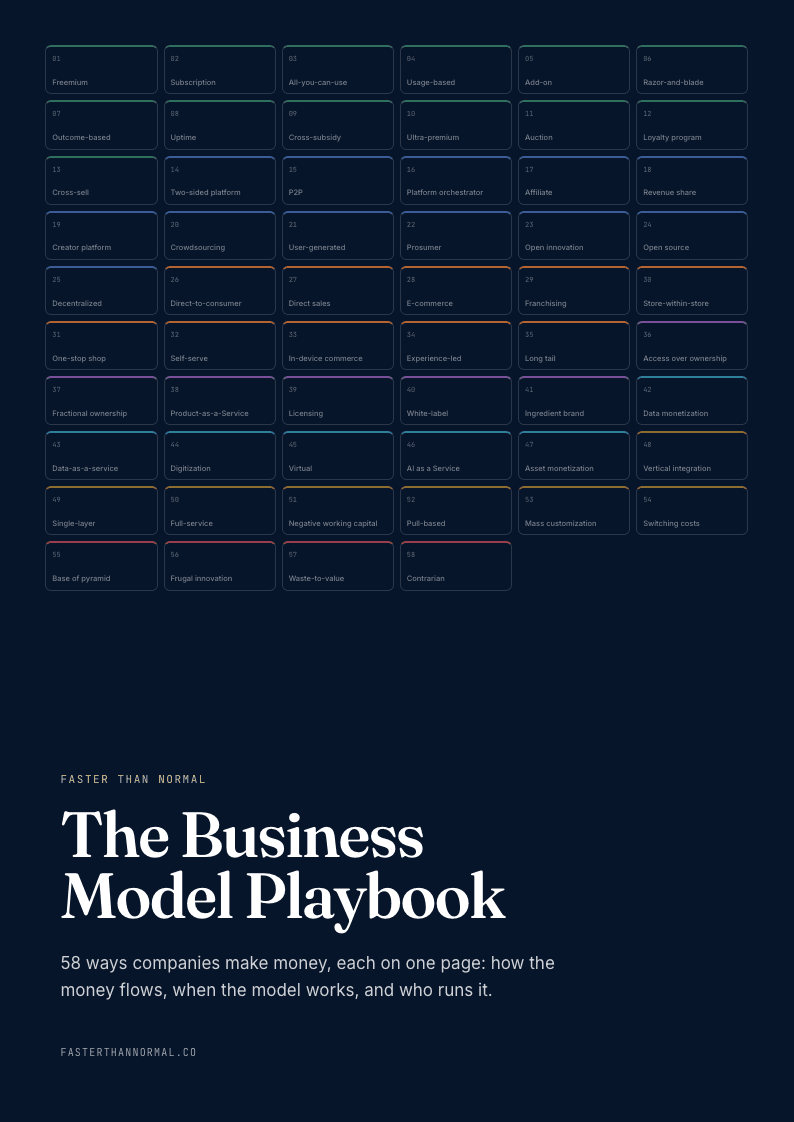
58 business models, one visual page each: how the money flows, the metrics that matter, and who runs it. Free when you join the Faster Than Normal email.
Free. No spam. Unsubscribe anytime.