

Tilt, Do/Say Something Syndrome, Availability Bias, & More
Mental models aren't abstract philosophy. They're operating systems for decision-making — the difference between founders who scale and those who stagnate, between investors who compound returns and those who chase momentum. This week's collection focuses on psychological biases: the systematic errors in thinking that separate amateurs from professionals.
Understanding these patterns isn't about memorizing definitions. It's about recognizing when your own cognition is working against you, then building systems to compensate. The best operators know their blind spots and design around them.
Emotional Regulation and Decision Quality
Tilt represents the catastrophic breakdown of rational decision-making under emotional stress. Originally from poker, the concept applies everywhere: a frustrated CEO making acquisition decisions after a bad quarter, a venture partner doubling down on thesis confirmation after missing a breakout deal. Tilt degrades skill execution, meaning those who manage emotional volatility operate closer to their cognitive ceiling more consistently than technically superior competitors who lack emotional discipline.
Do/Say Something Syndrome manifests as the compulsion to act when inaction would be optimal. Warren Buffett's greatest returns often came from opportunities he didn't pursue. Jeff Bezos institutionalized this thinking at Amazon with "disagree and commit" — sometimes the best decision is to make no decision until clarity emerges. Activity and results operate in different domains.
Stress-Influence Bias follows an inverted U-curve: moderate stress enhances performance, but excessive stress amplifies every other cognitive bias. Naval Ravikant schedules important decisions when he's well-rested and unstressed, understanding that decision quality correlates with emotional state. The implication is tactical — delay major choices when operating under duress.
Statistical Thinking and Pattern Recognition
Availability Bias explains why founders over-index on recent events when making strategic decisions. The latest competitor announcement feels more threatening than it statistically should be; the most recent customer churn feels like a trend rather than noise. Paul Graham warns against this in startup advice — the vivid failure story carries more weight than the boring statistics about what actually kills companies.
The Representativeness Heuristic creates multiple failure modes. Base Rate Neglect causes investors to ignore the fundamental odds — the base rate of startup success — when evaluating a compelling pitch. Sample Size Insensitivity leads to premature scaling decisions based on limited customer feedback. Regression to the Mean gets overlooked when attributing causation to random performance variations.
Reid Hoffman's approach to network effects demonstrates sophisticated statistical thinking: he focuses on sustainable engagement patterns across large samples rather than getting distracted by outlier user behaviors or short-term metrics spikes.
Incentive Systems and Human Behavior
Incentives and Reinforcement Bias represents perhaps the most predictive model for organizational behavior. Charlie Munger's maxim — "Show me the incentives and I'll show you the outcome" — explains everything from Wells Fargo's fake accounts scandal to Google's focus on user engagement metrics over user satisfaction.
The most successful leaders design incentive systems that align individual optimization with organizational goals. Amazon's ownership culture works because individual career advancement requires long-term thinking about customer value creation. Traditional quarterly bonus structures often incentivize precisely the wrong behaviors.
Self-Serving Bias creates asymmetric attribution: success stems from skill, failure from circumstance. This pattern destroys learning loops. Ray Dalio's radical transparency at Bridgewater attempts to systemically counter this bias through institutionalized feedback mechanisms and outcome tracking separated from ego protection.
Social Dynamics and Group Decision Making
Social Proof Bias explains both market manias and missed opportunities. When everyone is investing in SaaS companies, contrarian value emerges in overlooked sectors. When everyone is avoiding crypto, exceptional risk-adjusted returns become available. The crowd provides information, but crowd following eliminates edge.
Groupthink destroys decision quality in high-stakes environments. Andy Grove's constructive confrontation at Intel institutionalized dissent to prevent consensus bias. Jeff Bezos's written memos requirement forces individual thinking before group discussion. The goal isn't harmony — it's optimal decisions.
Authority Bias causes deference to expertise in inappropriate domains. A successful entrepreneur's opinions on monetary policy carry the same weight as their insights on customer acquisition, despite completely different competency domains. Evaluate ideas independent of their source's general credibility.
Memory and Information Processing
Confirmation Bias represents the mother of all biases because it corrupts the input layer of decision-making. We seek information that confirms existing beliefs and ignore disconfirming evidence. Charlie Munger systematically seeks disconfirming evidence for investment theses. Jeff Bezos institutionalized this through Amazon's "disagree and commit" culture.
Peak-End Theory explains why customer experience design focuses disproportionately on onboarding and support resolution rather than steady-state usage. Users remember the most intense moment and the ending — not the average experience. This insight drives everything from product design to employee offboarding processes.
Hindsight Bias destroys learning from decisions by retroactively inflating our predictive accuracy. Decision journals, maintained by investors like Howard Marks, capture reasoning at the time of decision to enable honest post-mortems separated from outcome knowledge.
Structural Thinking About Bias
Lollapalooza Effect occurs when multiple biases compound in the same direction, creating extreme outcomes. Auction dynamics demonstrate this: social proof (others are bidding), loss aversion (fear of missing out), commitment consistency (public bidding behavior), and action bias (pressure to do something) combine to drive irrational pricing.
Understanding these confluences enables both defensive recognition and offensive application. The best marketers and negotiators engineer situations where multiple psychological forces align with their desired outcome.
Extremeness Aversion explains why product managers position three pricing tiers with the middle option designed to appear optimal. It's why negotiators anchor with extreme positions to make their actual target seem reasonable. The pattern is exploitation of predictable cognitive shortcuts.
The practical application of these models isn't perfectionism — it's systems thinking. Build decision-making processes that assume these biases will occur, then create structural corrections. Jeff Bezos's written memos counter groupthink. Ray Dalio's radical transparency counters self-serving bias. Warren Buffett's 10-year investment horizon counters availability bias.
The goal isn't eliminating bias — it's competing against people who don't understand their own cognitive limitations. In a world of systematic thinking errors, rational process design becomes sustainable competitive advantage.
Free playbook
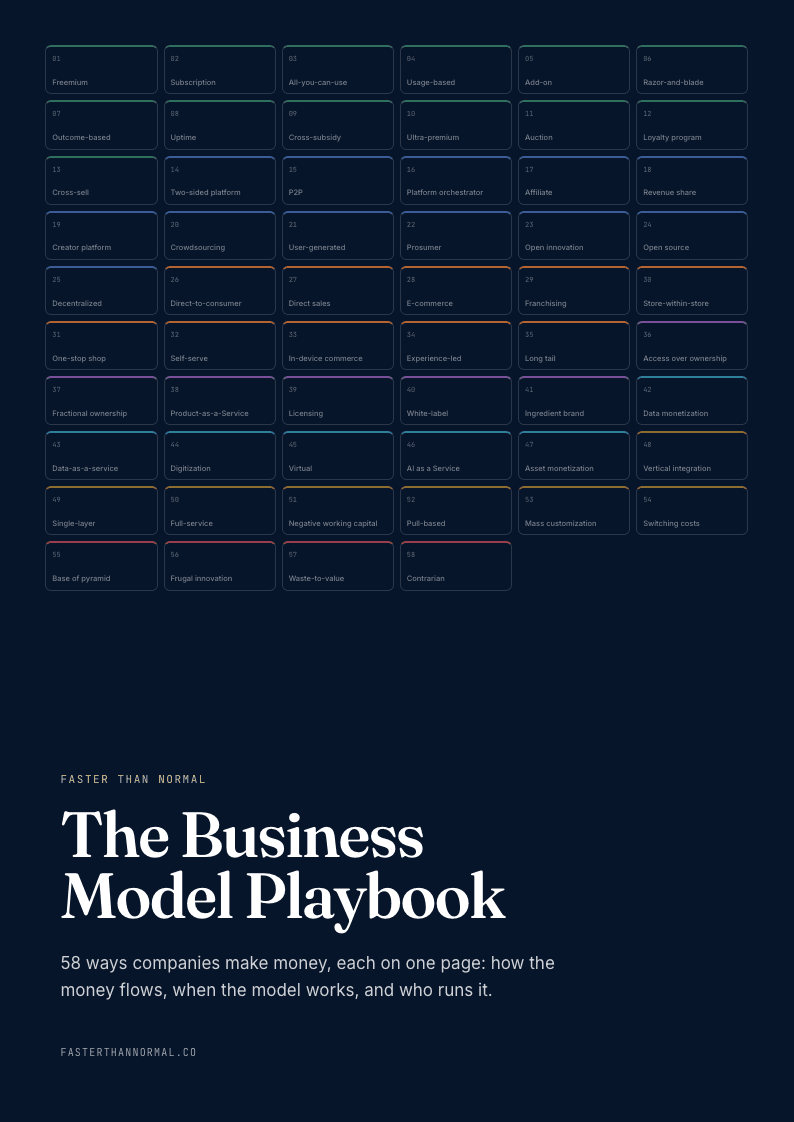
Get The Business Model Playbook
58 business models, one visual page each: how the money flows, the metrics that matter, and who runs it. Free when you join the Faster Than Normal email.
Free. No spam. Unsubscribe anytime.