

How To Be More Effective In 2023? These Will Help
Effectiveness begins with a counterintuitive insight: the problems that feel most complex rarely require complex solutions. The productivity industry has built empires selling artificial complexity—elaborate systems for simple challenges. Weight loss isn't about complicated meal plans. It's calories in, calories out. Productivity isn't about the perfect app. It's about doing fewer things better.
Most high performers discover this through painful experience. They accumulate systems, tools, and frameworks until the meta-work of managing productivity eclipses the work itself. The breakthrough comes when they strip everything back to fundamentals.
The Subtraction Advantage
When facing any challenge, your instinct is to add something new. A habit. A tool. A framework. But the highest leverage often comes from subtraction.
Via Negativa—improving life by removing rather than adding—operates across every domain. The foods you avoid matter more than the foods you eat. Productivity emerges more from eliminating distractions than from optimizing workflows. Investment returns come more from avoiding bad decisions than making brilliant ones.
This runs counter to how we're wired. Addition feels like progress. Subtraction feels like giving up. But Warren Buffett and Charlie Munger built Berkshire Hathaway primarily by saying no. Their skill wasn't identifying great investments—it was avoiding terrible ones.
The practical implication: Before adding anything to solve a problem, first ask what you can remove.
Time as Your Primary Currency
Elite performers develop an almost pathological awareness of time value. They calculate their Hourly Aspirational Rate—not what they currently earn per hour, but what their time should be worth given their goals.
This rate becomes a filter for every decision. Task worth less than your rate? Outsource, automate, or delete it. The math is unforgiving: if your time is worth $500 per hour, spending 30 minutes on tasks worth $20 per hour costs you $230 in opportunity cost.
But here's where most people get this wrong: they calculate based on current income rather than aspirational income. If you want to build a $10M company, price your time like someone who runs a $10M company. The constraint becomes the strategy.
Shreyas Doshi captured this in his observation about calendars versus to-do lists: "Your to-do list is the ideal Sunday evening theory. Your calendar is the brutal Monday to Friday practice." Your calendar reveals your actual priorities. If deep work isn't blocked on your calendar, it won't happen.
The Speed Paradox
James Somers identified a counterintuitive productivity principle: Speed matters more than most people realize. The faster you work, the less activation energy required for any individual task.
This seems backwards. Shouldn't quality suffer at higher speeds? In practice, the opposite often occurs. When you work quickly, you maintain momentum. The friction of starting and stopping—what researchers call [Attention Residue](/mental-models/attention-residue)—disappears. Each task flows into the next.
The Cognitive Switching Penalty is real. Every time you switch contexts, your brain spends cycles thrashing, loading, and reloading mental models. Working quickly within a single context prevents this waste.
Speed also combats procrastination. The Procrastination Equation shows that we delay tasks when the reward feels distant or the probability of success feels low. Speed collapses both dimensions. Quick execution brings rewards forward and makes success feel achievable.
The Leverage Question
Keith Rabois frames productivity around a simple question: What activities have the highest leverage on your output?
The more frequently you perform an activity, or the more it affects everything else you do, the higher the leverage on perfecting that activity. This is why successful people obsess over morning routines, communication templates, and decision-making frameworks. Small improvements compound across hundreds of iterations.
Most people optimize low-leverage activities because they're easier to measure. You can quantify inbox zero. You can't easily quantify the quality of your strategic thinking. But strategic thinking might be 100x more valuable per hour invested.
The Productivity Frontier concept from Scott Young clarifies this distinction. Below the frontier, productivity comes from optimization—better tools, cleaner workflows, fewer distractions. But at the frontier, further gains require making hard trade-offs about what you work on, not how you work on it.
Mental Load Management
Your brain operates with finite processing capacity. Paul Graham's insight about The Top Idea In Your Mind—the topic you think about in the shower—reveals where your mental cycles actually go.
If your shower thoughts aren't aligned with your most important problems, something is wrong. Either you're not focused on the right problems, or lower-priority concerns are consuming mental bandwidth.
Attention Residue makes this worse. Part of your attention remains with the previous task every time you switch. This is why context-switching feels exhausting even when individual tasks are easy. Your brain never fully commits to any single task.
The solution isn't just single-tasking—it's cognitive batching. Group similar tasks to minimize context switches. Process all emails at once rather than throughout the day. Make all your calls in a block. Write in dedicated sessions rather than between meetings.
Flow State Architecture
Flow states—periods of effortless concentration where time seems to disappear—aren't random. They emerge from specific conditions you can engineer:
Challenge-skill balance: Tasks must challenge you without overwhelming you. Too easy creates boredom. Too hard creates anxiety. The sweet spot is about 4% beyond your current skill level.
Clear goals with immediate feedback: You need to know what success looks like and how you're tracking against it in real-time.
Elimination of distractions: Flow requires complete mental commitment. Even minor interruptions break the state.
Deadlines: Time pressure focuses attention and prevents perfectionism from derailing momentum.
The deeper insight: Flow isn't about the task itself, but about the relationship between your skills and the challenge. This is why successful people constantly seek harder problems as their capabilities grow.
Time Boxing Reality
Three laws govern how work expands or contracts based on time allocation:
Hofstadter's Law: Projects always take longer than expected, even when accounting for Hofstadter's Law. We systematically underestimate complexity and overestimate our future productivity.
Parkinson's Law: Work expands to fill available time. Allocate four weeks and it takes four weeks. Allocate ten days and it takes ten days.
Elon's Law (our term): Combat both by setting ridiculously ambitious deadlines. Even if you miss them, you're ahead of where conservative estimates would place you.
The Pomodoro Technique—25-45 minute focused work blocks separated by short breaks—leverages Parkinson's Law at the micro level. Artificial scarcity drives focus.
Effectiveness Versus Efficiency
Peter Drucker's distinction remains critical: Effectiveness is doing the right things. Efficiency is doing things right.
Effectiveness must come first. Being efficient at the wrong tasks is worse than being inefficient at the right ones. Yet most productivity advice focuses on efficiency—better tools, faster workflows, cleaner systems.
The 2-Minute Rule exemplifies this tension. If something takes less than two minutes, do it immediately rather than adding it to a system. This is efficient for task management but potentially ineffective if those two-minute tasks aren't high-leverage activities.
Systems Versus Goals
James Clear's insight deserves emphasis: "Goals determine your direction. Systems determine your progress."
Goals create binary outcomes—you either achieve them or you don't. Systems create continuous improvement. A goal is writing a book. A system is writing for one hour every morning.
But here's the nuance: Systems without clear directional goals become busy work. Goals without supporting systems become wishful thinking. You need both, but the system does the daily work.
Jocko Willink's paradox applies here: "Discipline equals freedom." The constraints of a good system create the freedom to make progress on what matters most.
The Calendar Truth
Your calendar speaks more truth than any productivity system. It shows where your time actually goes, not where you think it goes or where you wish it went.
This is why time-blocking for deep work is non-negotiable. If it's not on the calendar, it's competing with every other demand for your attention in real-time. And real-time decisions consistently favor urgent over important.
The Maker's versus Manager's Schedule distinction from Paul Graham matters here. Managers work in hour-long blocks, switching contexts constantly. Makers need long, uninterrupted periods. Most knowledge workers need both schedules but fail to separate them clearly.
These aren't isolated techniques—they're components of a unified approach to effectiveness. The meta-principle: Start by subtracting complexity, then build systems around your highest-leverage activities, protect them with time-boxing, and optimize for sustained focus rather than brief bursts of productivity.
The goal isn't to do more things. It's to do fewer things that matter more, and to do them at a level that compounds over time.
Free playbook
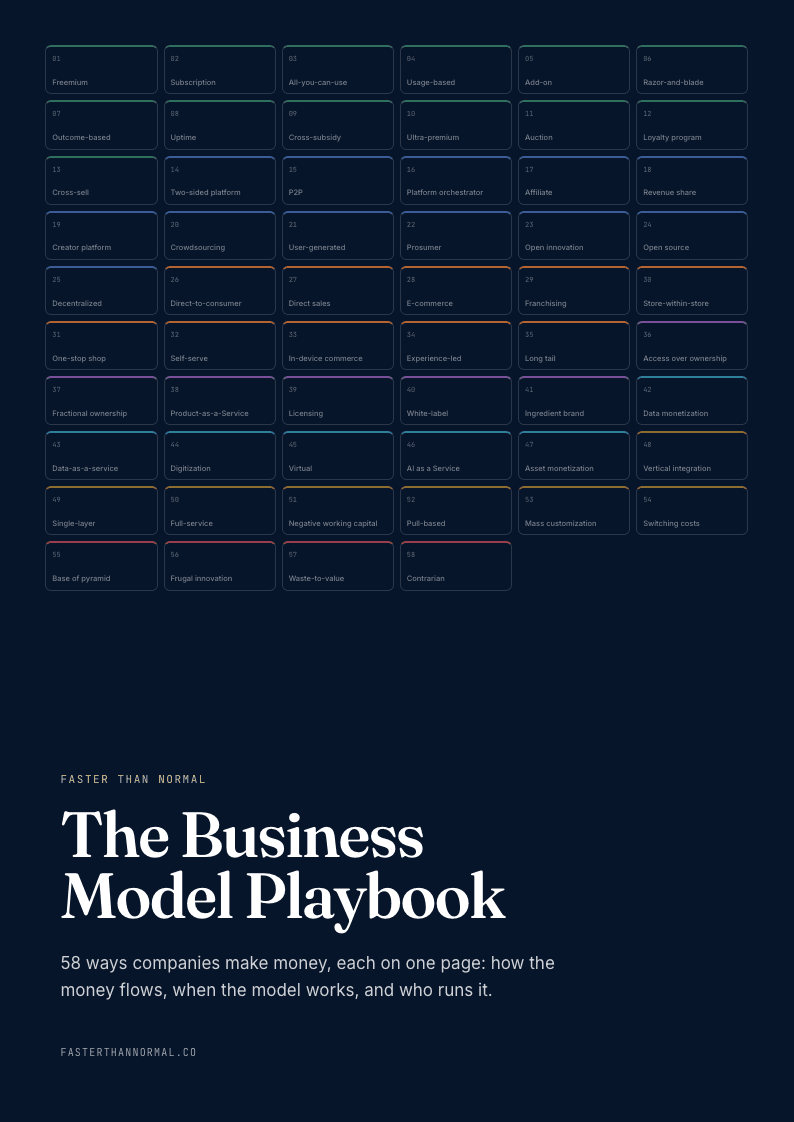
Get The Business Model Playbook
58 business models, one visual page each: how the money flows, the metrics that matter, and who runs it. Free when you join the Faster Than Normal email.
Free. No spam. Unsubscribe anytime.