Culture is not a mission statement on the wall, a set of values on the careers page, or a foosball table in the break room. Culture is the set of behaviours that get rewarded, tolerated, and punished when nobody in authority is watching. It is the unwritten operating system of an organisation — the patterns of interaction, decision-making, and conflict resolution that employees absorb through observation and experience, not through onboarding decks.
Edgar Schein, the MIT organisational psychologist who defined the modern concept, put it precisely in 1985: culture is "the pattern of basic assumptions that a group has invented, discovered, or developed in learning to cope with its problems of external adaptation and internal integration." The key word is "assumptions." Culture lives below the surface — beneath the stated values, beneath the formal processes, beneath the org chart. It is the collection of beliefs about how things actually work here, transmitted through behaviour rather than documentation.
The distinction between stated culture and actual culture is the first thing any honest leader must confront. Enron's stated values were "Integrity, Communication, Respect, Excellence" — printed on the lobby wall at corporate headquarters. The actual culture rewarded aggressive risk-taking, tolerated accounting fraud, and punished anyone who questioned the numbers. The stated values were aspirational fiction. The actual culture was what people did when the annual report wasn't watching. Every organisation has this gap. The question is how wide it is.
Netflix's Reed Hastings published the Netflix Culture Deck in 2009 and it spread through Silicon Valley like a manifesto — over 20 million views on SlideShare. The deck's power was not in its originality but in its honesty. It codified the behaviours Netflix actually rewarded (radical candour, high performance, context over control) and the behaviours it actually punished (brilliant jerks, adequate performers, information hoarding). Hastings understood that culture is not built through aspiration. It is built through selection and enforcement: who you hire, who you promote, who you fire, and what behaviour triggers each decision.
Amazon's Leadership Principles operate on the same logic. "Customer Obsession," "Disagree and Commit," "Have Backbone; Disagree" — these are not inspirational posters. They are operating criteria embedded in every hiring decision, every performance review, and every promotion committee. Amazon's culture is unusually legible because the Leadership Principles are used as a literal evaluation framework: candidates are assessed against them in interviews, employees are reviewed against them annually, and leaders are expected to invoke them when explaining decisions. The principles convert abstract culture into concrete, measurable behaviour.
Ray Dalio built Bridgewater Associates into the world's largest hedge fund ($150 billion in assets under management at its peak) on a culture he called "radical transparency." Every meeting is recorded. Every employee rates every other employee's performance in real time using an app called "Dots." Disagreement is expected, mandatory, and public. The system is uncomfortable, occasionally brutal, and has produced some of the highest risk-adjusted returns in hedge fund history. Dalio's logic is that most organisations fail because people prioritise politeness over truth — and the accumulated cost of unspoken disagreements, hidden information, and avoided conflicts eventually destroys the organisation's ability to make good decisions.
Tony Hsieh at Zappos took a different approach: he offered every new hire $2,000 to quit during training. The logic was pure selection pressure. If a new employee would leave for $2,000, they weren't committed enough to absorb and reinforce the culture Hsieh was building — one centred on extraordinary customer service, personal connection, and happiness as a business metric. The offer filtered for cultural fit with a precision that no interview question could match. By 2010, fewer than 3% of new hires took the money. The 97% who stayed self-selected into a workforce that had literally bet money on the culture's value.
Culture scales through what you tolerate. A leader who tolerates passive-aggressive behaviour in senior meetings has created a culture of passive aggression, regardless of what the values poster says. A leader who fires a top performer for undermining a colleague has created a culture where collaboration outranks individual output, regardless of the short-term cost. The tolerance signal is louder than any written policy because employees learn to read it fluently: they watch what happens to people who behave badly and what happens to people who behave well, and they calibrate their own behaviour accordingly. Culture is the cumulative output of a thousand tolerance decisions.
Free playbook
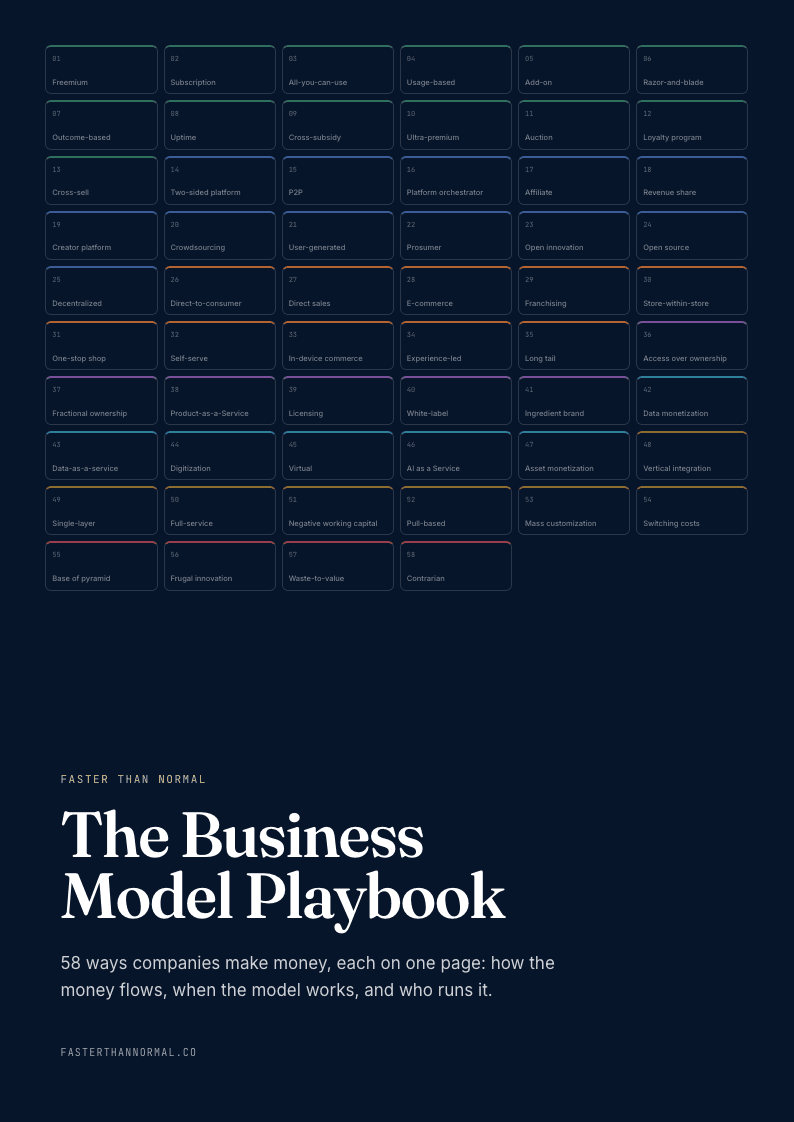
Get The Business Model Playbook
58 business models, one visual page each: how the money flows, the metrics that matter, and who runs it. Free when you join the Faster Than Normal email.
Free. No spam. Unsubscribe anytime.
Section 2
How to See It
Culture reveals itself not in what the company says but in what the company does when the stakes are real. The diagnostic is the gap between stated values and observed behaviour — and the speed with which the organisation corrects deviations when they occur.
The clearest signal is what happens to someone who violates the stated culture. If the violation is tolerated — especially when the violator is a high performer — the stated culture is fiction and the actual culture is "results justify behaviour." If the violation is corrected swiftly and visibly, the culture is real.
Technology
You're seeing Fostering Culture when Netflix fires a senior engineer who delivers exceptional code but consistently undermines team collaboration. Hastings codified this as the "brilliant jerk" rule: no individual contribution justifies cultural toxicity because the downstream cost — other employees disengaging, withholding feedback, or leaving — exceeds the individual's output. The firing is the culture. It communicates to every remaining employee that the stated values are enforced even at direct cost to engineering velocity.
Retail & Consumer
You're seeing Fostering Culture when Patagonia closes all stores on Black Friday and tells customers to "Don't Buy This Jacket" (2011). Yvon Chouinard's environmental values were embedded so deeply in Patagonia's culture that the company could sacrifice its highest-revenue day of the year to reinforce its identity. The decision was not marketing. It was culture made visible — the organisation's actual beliefs expressed through actual sacrifice. Revenue dipped temporarily. Brand loyalty compounded permanently.
Finance
You're seeing Fostering Culture when a new analyst at Bridgewater criticises a senior partner's analysis in a public meeting and receives praise rather than retaliation. Dalio's radical transparency works only if the power hierarchy does not override the truth-telling norm. The moment a junior employee is punished for honest disagreement, the culture reverts to the organisational default: say what the boss wants to hear. Bridgewater's architecture — recorded meetings, public ratings, algorithmic feedback — exists to prevent that reversion by making every interaction transparent and every evaluation auditable.
Enterprise
You're seeing Fostering Culture whenSatya Nadella walks into Microsoft in 2014 and replaces "know-it-all" with "learn-it-all" as the cultural operating system. Under Ballmer, Microsoft's culture had calcified around internal competition, stack ranking, and defending existing products. Nadella reoriented the culture toward growth mindset — a concept borrowed from Carol Dweck's research — and embedded it in hiring, performance reviews, and leadership development. The stock price when Nadella took over: $36. By 2024: over $400. The culture shift made Microsoft capable of embracing cloud computing and AI partnerships (OpenAI) that the prior culture would have killed in committee.
Section 3
How to Use It
Decision filter
"Before any hiring decision, promotion, or termination, ask: what behaviour does this decision reward or punish — and is that behaviour consistent with the culture we say we have? If the answer is no, the decision is rewriting the culture, whether you intend it to or not."
Culture is not built through declarations. It is built through the accumulation of personnel decisions, resource allocation choices, and tolerance patterns that tell employees what actually matters. The gap between intention and execution is where most culture efforts die.
As a founder
Define culture early and explicitly — not through values exercises but through behavioural norms. "We value innovation" is meaningless. "Engineers can ship experiments to 1% of users without approval from a product manager" is a culture. The specificity converts aspiration into behaviour. Write down the five to seven behaviours you want to define the company, and enforce them through every hiring decision, every performance review, and every firing. The enforcement is the culture. The document is the reminder.
The hardest cultural decision a founder makes is firing a high performer who violates the culture. The temptation to tolerate the violation — "she closes the most deals," "he writes the best code" — is the moment the culture is tested. Every employee is watching. If the high performer stays despite the violation, the culture is dead; employees learn that results exempt you from cultural norms. If the high performer leaves, the culture survives and strengthens — because the signal is unmistakable: no one is above the operating system.
As an investor
Culture is the leading indicator that financial metrics cannot capture. A company with a strong culture retains its best people, attracts talent at below-market cost, makes faster decisions, and recovers from setbacks more quickly. A company with a toxic culture loses talent silently — the best employees leave first because they have the most options — and the financial impact shows up twelve to eighteen months later in declining execution quality. The investor's diagnostic: Glassdoor reviews, employee NPS, voluntary turnover rates, and — most importantly — how the company's best people describe the decision-making environment. Culture is the variable that determines whether a great strategy gets executed or dies in implementation.
As a decision-maker
Audit culture by observing behaviour in three specific moments: disagreements, failures, and departures. How does the team resolve disagreements? (Consensus, authority, data, avoidance?) How does the organisation respond to failures? (Blame, learning, cover-up?) How does the company treat people who leave? (Gracefully, punitively, indifferently?) The answers to these three questions describe the actual culture more accurately than any survey, offsite exercise, or values workshop. If the answers don't match the stated culture, the stated culture is the fiction and the observed behaviour is the fact.
Common misapplication: Confusing perks with culture. Free lunch, unlimited PTO, and office dogs are benefits, not culture. WeWork had extraordinary perks and a culture that rewarded excess, discouraged dissent, and enabled the CEO to extract personal wealth from a company losing $1.6 billion per quarter. The perks attracted people. The culture destroyed value. Perks and culture are orthogonal — a company can have outstanding culture with mediocre perks (Bridgewater) or outstanding perks with toxic culture (Uber under Kalanick).
A second misapplication is treating culture as static. Culture drifts. The behaviours that defined the culture at ten employees are not the behaviours that define it at a thousand. The intimacy and speed of a ten-person startup cannot survive scaling without deliberate reinforcement mechanisms — rituals, hiring criteria, promotion standards, onboarding practices — that transmit the culture to people who never met the founders. Companies that don't actively maintain culture during hyper-growth discover that the culture they built was replaced by the culture they tolerated.
Section 4
The Mechanism
Section 5
Founders & Leaders in Action
Culture is invisible until a leader makes it visible — through the decisions they make, the behaviours they tolerate, and the sacrifices they accept to enforce the norms they've declared. The leaders below didn't just talk about culture. They built systems to sustain it at scale.
Hastings turned culture into a competitive weapon by codifying it with a precision that most companies reserve for financial models. The 2009 Culture Deck laid out seven core behaviours and ten operating principles, each with specific, observable definitions. "Courage" didn't mean "be bold" — it meant "you say what you think even if it is controversial." "Impact" didn't mean "work hard" — it meant "you accomplish amazing amounts of important work." The specificity forced accountability. Managers could evaluate employees against concrete behaviours rather than abstract values. Hastings then enforced the culture through what he called the "Keeper Test": if an employee were leaving, would the manager fight to keep them? If the answer was no, the employee received a generous severance immediately. The result was a workforce where every person was there because their manager would fight for them — a standard that compressed the performance distribution by removing the middle. Netflix's revenue per employee exceeded $2.6 million in 2023, roughly 3x the tech industry average. The culture didn't just feel good. It compounded.
Nadella executed the most consequential culture change in technology history. When he took over in 2014, Microsoft's culture was defined by internal competition: the stack-ranking system (abandoned the year before Nadella arrived, but its effects lingered) had trained employees to compete against each other rather than against external threats. Product teams hoarded information. Collaboration across divisions was punished implicitly because helping a colleague meant risking your own ranking. Nadella replaced the competitive culture with what he called a "growth mindset" — borrowing directly from Carol Dweck's research. The operational change was specific: performance reviews were restructured to reward collaboration and learning from failure. "How did you help others succeed?" became a literal evaluation criterion. The results were structural. Microsoft embraced cloud computing (Azure grew from $5B to $96B in revenue under Nadella), partnered with former rivals (Linux, Salesforce, Oracle), and invested $13 billion in OpenAI — a bet the old culture would have vetoed because it empowered a potential competitor. Microsoft's market capitalisation grew from $300 billion in 2014 to over $3 trillion by 2024. The product strategy was important. The culture change made the strategy possible.
Catmull built the most consistently successful creative organisation in film history by engineering a culture that protected candid feedback from the hierarchy that normally kills it. Pixar's Braintrust — a group of senior directors and storytellers who review every film in progress — operates on two rules: feedback must be honest, and it must carry no authority. The director receives the Braintrust's notes but is not obligated to follow any of them. The separation of feedback from authority creates a space where radical candour is safe because it is advisory rather than directive. The result: Pixar released fifteen consecutive films that grossed over $200 million each, a streak unmatched in film history. Catmull's insight was that the default mode of creative organisations is self-censorship — people withhold criticism to avoid conflict with powerful colleagues — and that the only countermeasure is a structural mechanism that makes candour safe and expected. The Braintrust is not a meeting format. It is a culture technology.
Section 6
Visual Explanation
Fostering Culture — The three layers of organisational culture (Schein's model) and the enforcement loop that builds, reinforces, or erodes culture through daily decisions.
The left side maps Schein's three layers — artefacts (visible but superficial), espoused values (stated but not always practised), and basic assumptions (invisible but determinative). The actual culture lives in the third layer, beneath what most culture diagnostics measure. The right side shows the enforcement loop that builds culture: leadership decisions (hiring, firing, promoting) signal what is rewarded, employees observe and replicate the rewarded behaviours, and the replicated behaviours reinforce the culture that produced them. The bottom strips the process to its essentials: culture is what you hire for, promote for, fire for, and — most revealingly — tolerate. The "tolerate" box in red marks the gap where most cultures fail. What you say doesn't matter. What you tolerate does.
Section 7
Connected Models
Culture intersects with every model that governs how organisations communicate, make decisions, and handle conflict. It is the operating system on which all other organisational models run — and the one most likely to override them when they conflict. A company can install any decision-making framework, communication protocol, or performance system it likes. If the culture is hostile to the framework's requirements, the culture will win.
Reinforces
[Radical Candor](/mental-models/radical-candor)
Radical Candor requires a culture that makes honest feedback safe and expected. Kim Scott's framework — care personally, challenge directly — can only function in an environment where employees believe that giving direct feedback will be rewarded rather than punished. Netflix's culture of radical candour works because Hastings built enforcement mechanisms (the Keeper Test, 360 reviews, the "sunshining" practice of discussing mistakes publicly) that reward honesty. A company that adopts Radical Candor as a framework without building the cultural safety net will find that employees continue self-censoring because the incentive structure rewards silence over truth.
Reinforces
[Feedback](/mental-models/feedback)
Culture determines whether feedback is a gift or a weapon. In a high-trust culture, feedback flows freely because employees believe it is intended to improve performance, not to undermine status. In a low-trust culture, feedback is withheld (to avoid conflict), weaponised (to gain political advantage), or filtered (to tell the boss what they want to hear). The feedback loop and the culture loop reinforce each other: frequent, honest feedback strengthens the culture by surfacing problems early. A strong culture encourages feedback by making it psychologically safe. The absence of feedback is the canary in the cultural coal mine — if people aren't giving honest feedback, the culture is broken regardless of what the values poster says.
Reinforces
[Trust](/mental-models/trust)
Trust is both an input to and an output of strong culture. A culture of transparency and accountability builds trust between employees and leadership. Trust enables the vulnerability required for honest disagreement, risk-taking, and admitting mistakes. The reinforcement loop is powerful: trust enables the behaviours that strong cultures require (candour, collaboration, accountability), and those behaviours deepen trust. The loop is also fragile: a single betrayal of trust — a leader who punishes honesty, a company that lays off employees after promising stability — can collapse years of accumulated cultural capital. Trust compounds slowly and collapses quickly.
Leads-to
Directly Responsible Individual
Clear ownership requires a culture that supports it. Apple's DRI model — one person accountable for every deliverable — works because Apple's culture empowers individual ownership and holds the DRI accountable for outcomes rather than managing them through process. In a culture of diffused responsibility or consensus-seeking, assigning a DRI creates friction: the individual is held accountable but lacks the cultural authority to make decisions without committee approval. Culture determines whether the DRI model produces clarity or frustration.
Tension
[Groupthink](/mental-models/groupthink)
Strong culture creates the conditions for groupthink if not deliberately counterbalanced. A cohesive culture with strong in-group identity and a charismatic leader is exactly the environment Irving Janis identified as groupthink-prone: members suppress dissent to maintain group harmony, alternative viewpoints are filtered out, and the illusion of unanimity replaces genuine debate. Dalio's radical transparency and Catmull's Braintrust are structural countermeasures — mechanisms that force dissent into the open despite the cultural pressure to conform. The tension is permanent: every strong culture must invest in mechanisms that protect disagreement from the conformity pressure the culture itself generates.
Servant leadership — the model where the leader's primary role is enabling the success of their team — creates tension with cultures that require top-down enforcement. A servant leader who prioritises employee autonomy and comfort may struggle to enforce cultural norms that require firing high performers, demanding radical candour, or making people uncomfortable. Hastings was not a servant leader in the traditional sense — he was a cultural architect who enforced demanding standards with precision. The tension is between the servant leader's instinct to support and the culture-builder's duty to enforce. Both are necessary. The balance depends on which cultural values are non-negotiable and which are aspirational.
Section 8
One Key Quote
"Culture eats strategy for breakfast."
— Peter Drucker, attributed
The quote, often attributed to Drucker (though the exact source is disputed), captures a truth that every CEO discovers eventually: a brilliant strategy implemented by a dysfunctional culture will fail, while a decent strategy implemented by a strong culture will adapt and succeed. The mechanism is execution. Strategy is a document. Culture is the behaviour of every employee, in every interaction, every day. The strategy sets the direction. The culture determines whether the organisation is capable of moving in that direction — whether it can coordinate, adapt, resolve conflicts, surface problems, and sustain effort through the years of execution that separate a strategic plan from a strategic outcome.
The quote's most important implication is about the sequence of priorities. Most leaders spend 80% of their time on strategy and 20% on culture. The ratio should be inverted during the company's formative years and rebalanced as the culture matures. Nadella's first act at Microsoft was not a new product strategy — it was a cultural intervention. The product strategy (cloud, AI, partnerships) followed because the culture change made it possible. Hastings invested years in codifying Netflix's culture before the company could execute the pivot from DVD shipping to streaming to content creation. The culture was the prerequisite. The strategy was the application.
Section 9
Analyst's Take
Faster Than Normal — Editorial View
Culture is the most undervalued variable in business analysis because it cannot be measured on a spreadsheet. Revenue is visible. Margins are visible. Culture is invisible until it produces visible results — and by then, the analyst is attributing the results to strategy, execution, or market conditions rather than to the cultural substrate that made all three possible.
The pattern I track most closely: culture as a predictor of crisis response. How a company behaves during a crisis reveals its actual culture with perfect clarity. Johnson & Johnson's Tylenol recall in 1982 — pulling 31 million bottles from shelves at a cost of $100 million because seven people in Chicago died from tampered capsules — was a cultural act. The decision was not made by consultants or lawyers. It was made by leaders whose cultural instinct was to protect customers first and shareholders second. The company recovered market share within a year. Compare this to Boeing's response to the 737 MAX crisis: delayed accountability, defensive communication, and a culture that had shifted from engineering safety to production speed under pressure from Wall Street. The crisis didn't create Boeing's cultural problem. It revealed it.
The most common cultural failure I see in technology: values that describe aspiration, not behaviour. "We value transparency" means nothing if the CEO withholds information from the board. "We value diversity" means nothing if the leadership team is homogeneous. "We value innovation" means nothing if the budget committee kills every experimental project. Cultural values are only real when they cost something — when upholding them requires sacrificing revenue, speed, comfort, or a high-performing employee who violates them. Zappos' pay-to-quit offer cost real money. Netflix's brilliant-jerk rule cost real engineering talent. Patagonia's Black Friday closure cost real revenue. Each sacrifice proved the culture was real.
The culture shift that matters most right now: from performance-at-all-costs to sustainable performance. The 2010–2021 era of zero-interest-rate growth optimised for speed, scale, and intensity. The culture rewarded 80-hour weeks, aggressive goal-setting, and "move fast and break things." The correction arrived in 2022–2023 through mass burnout, talent exodus, and layoffs that disproportionately hit companies whose cultures had been hollowed out by a decade of unsustainable intensity. The companies adapting fastest — Microsoft, Shopify, Stripe — are the ones whose leaders recognised that a culture of sustainable high performance compounds more effectively over a decade than a culture of sprint-and-crash.
My operational rule: judge a company's culture by its three most recent firings. Not its values poster. Not its CEO's LinkedIn posts. Its firings. Who was fired, and why? If the most recent firings were for cultural violations by high performers, the culture is alive. If the most recent firings were for poor performance with no cultural dimension, the culture is secondary to output. If there have been no firings — or only quiet ones with no visible lesson — the culture is a document that no one enforces.
The founder's paradox: the culture you build reflects who you are, not who you aspire to be. Hastings is naturally analytical and direct — Netflix's culture is analytical and direct. Bezos is naturally customer-obsessed and data-driven — Amazon's culture is customer-obsessed and data-driven. Chouinard is naturally environmental and anti-corporate — Patagonia's culture is environmental and anti-corporate. Founders who try to build cultures that contradict their own instincts create a gap between their behaviour and their stated values — and the employees will always follow the behaviour, not the statement.
Section 10
Test Yourself
Culture is claimed by every company and practised by few. The scenarios below test whether you can distinguish genuine culture-building from the performative culture exercises that most organisations mistake for the real thing. The diagnostic in each case: does the behaviour match the stated value — especially when matching is costly?
Is this mental model at work here?
Scenario 1
A fast-growing startup declares 'radical transparency' as a core value. The CEO sends a weekly all-hands email with revenue numbers, burn rate, and strategic priorities. When a product launch fails, the CEO writes a detailed post-mortem shared company-wide, naming the decisions that led to the failure and the lessons learned. However, compensation data remains confidential, and two employees who publicly questioned the CEO's strategy in Slack were quietly moved to less visible roles.
Scenario 2
A consulting firm's managing partner discovers that the firm's highest-billing partner has been systematically underpaying junior associates and taking credit for their work in client presentations. The behaviour violates the firm's stated values of 'collaboration' and 'developing our people.' The managing partner fires the highest-billing partner despite the immediate revenue impact of approximately $4M annually. The decision is communicated firm-wide with a brief explanation.
Scenario 3
A 200-person software company hires a 'Chief Culture Officer' and launches a culture programme: monthly team-building events, a Slack channel for employee appreciation, a new set of five core values designed by an external branding agency, and an annual culture survey. Employee satisfaction scores increase by 8 points in the first year. Meanwhile, two senior directors continue to run their teams through intimidation, engineering turnover in those teams is 35%, and the CEO describes the directors as 'intense but effective.'
Scenario 4
Pixar's Braintrust reviews a film in development that the director has spent two years creating. The feedback is blunt: the second act doesn't work, the antagonist's motivation is unclear, and the emotional climax falls flat. The director is visibly upset. The Braintrust members offer specific suggestions but make clear the final decisions belong to the director. Six months later, the director delivers a revised film that addresses every major criticism and becomes Pixar's highest-grossing release in five years.
Section 11
Top Resources
The culture literature spans organisational psychology, management practice, and founder memoirs. Start with Schein for the theoretical framework, move to Hastings for the most actionable implementation guide, and extend to Catmull and Dalio for radically different approaches to solving the same problem: how to make an organisation's actual behaviour match its stated values.
The most operational culture book ever written. Hastings and Meyer document how Netflix built a culture of radical candour, high performance, and context-over-control — with specific mechanisms (the Keeper Test, 360 feedback, pay top-of-market, unlimited vacation with modelled behaviour) that other companies can adapt. The book's honesty about trade-offs — the anxiety of the Keeper Test, the brutality of firing adequate performers — makes it more credible than the typical culture book that promises transformation without acknowledging cost.
The foundational academic text on organisational culture. Schein's three-layer model (artefacts, espoused values, basic assumptions) provides the diagnostic framework for separating performative culture from actual culture. The book is dense but essential — without understanding that culture lives in the unconscious assumptions layer, not in the visible artefacts or stated values, every culture intervention targets the wrong level.
Catmull's memoir of building Pixar's creative culture is the best book on protecting candour from the hierarchy that normally kills it. The Braintrust, the "Ugly Baby" concept (all new ideas are ugly and need protection), and the practice of post-mortems that focus on process rather than blame — each is a structural mechanism for sustaining a culture of honest feedback in an organisation where ego and authority constantly threaten it.
Dalio codifies Bridgewater's radical transparency culture into 210 principles for work and life. The book is polarising — some readers find the transparency culture inspiring, others find it dystopian — but the systematic approach to cultural design is unmatched. Dalio's insistence on recording every meeting, rating every interaction, and making every evaluation public represents the most extreme experiment in cultural engineering ever attempted at scale.
Nadella documents the cultural transformation of Microsoft from a know-it-all culture to a learn-it-all culture — the most consequential corporate culture change of the last decade. The book describes how Nadella replaced internal competition with collaboration, fixed-mindset evaluation with growth-mindset development, and defensive market positioning with open-platform partnership. The financial results ($300B to $3T in market cap) provide the most compelling evidence available that culture change produces economic value.
Fostering Culture is a mental model used for better thinking and decision-making.
How do you apply Fostering Culture?+
To apply Fostering Culture, identify situations where this framework is relevant, then use it as a lens to evaluate your options and decisions. The model is most useful when combined with other complementary mental models.
What category does Fostering Culture fall under?+
Fostering Culture falls under the Business & Strategy category of mental models. Other models in this category can be found on the Business & Strategy hub page.
Why is Fostering Culture important?+
Fostering Culture is important because it provides a structured way to think about problems that would otherwise be approached with intuition alone. Understanding this model helps you avoid common reasoning errors and make better decisions.
Where does Fostering Culture come from?+
Fostering Culture is discussed in the tradition of Edgar Schein.
58 business models, one visual page each: how the money flows, the metrics that matter, and who runs it. Free when you join the Faster Than Normal email.
We use cookies to run the site, remember your preferences, and for analytics and visitor identification. Where the law requires it, these only run with your consent; everywhere else you can opt out here. See our Cookie Policy.