
What is Asymmetric Risk?
Not all risks are equal. Some decisions carry small downside with enormous upside; others carry catastrophic downside with modest upside. The shape of the risk matters more than its probability.
Free playbook
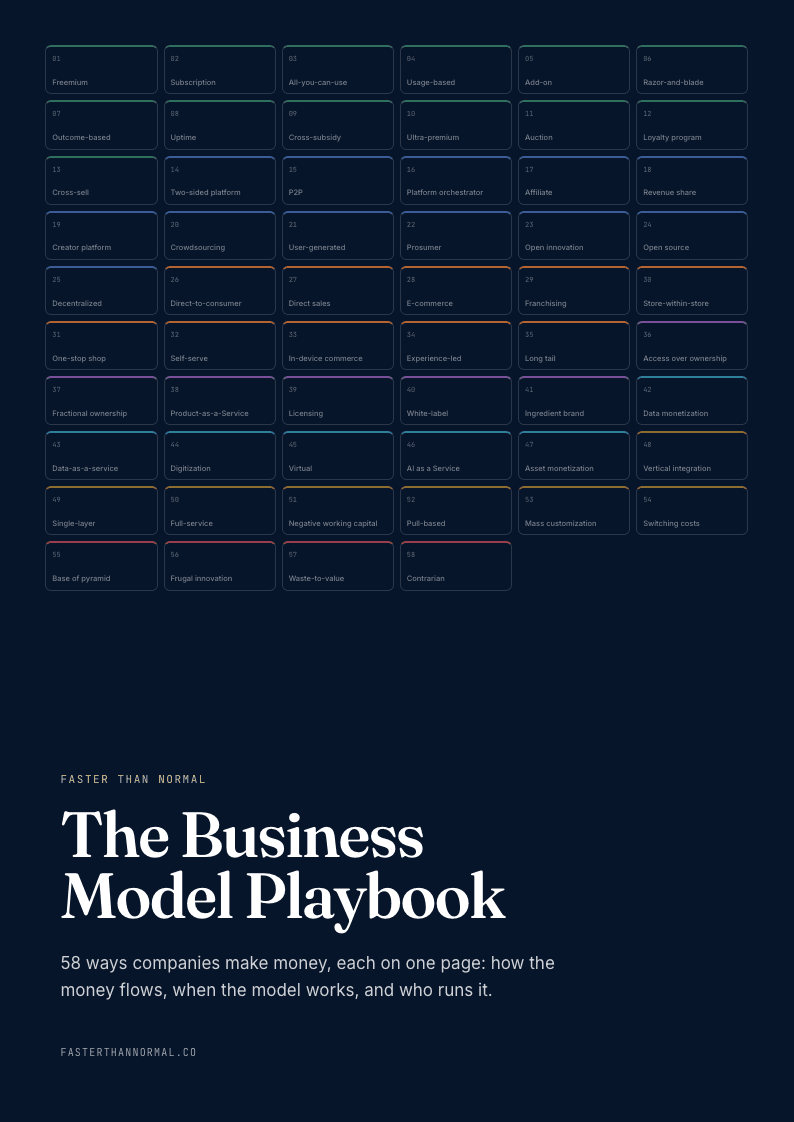
Get The Business Model Playbook
58 business models, one visual page each: how the money flows, the metrics that matter, and who runs it. Free when you join the Faster Than Normal email.
Free. No spam. Unsubscribe anytime.
Related guides
Reading lists
Frequently asked questions
What is Asymmetric Risk?
Not all risks are equal. Some decisions carry small downside with enormous upside; others carry catastrophic downside with modest upside. The shape of the risk matters more than its probability.
How do you apply Asymmetric Risk?
To apply Asymmetric Risk, identify situations where this framework is relevant, then use it as a lens to evaluate your options and decisions. The model is most useful when combined with other complementary mental models.
What category does Asymmetric Risk fall under?
Asymmetric Risk falls under the Business & Strategy category of mental models. Other models in this category can be found on the Business & Strategy hub page.
Why is Asymmetric Risk important?
Asymmetric Risk is important because it provides a structured way to think about problems that would otherwise be approached with intuition alone. Understanding this model helps you avoid common reasoning errors and make better decisions.
Where does Asymmetric Risk come from?
Asymmetric Risk is discussed in the tradition of Nassim Nicholas Taleb.
Continue exploring
Mental model
100 People Love
Build something 100 people love rather than something 1 million people kind of l
Mental model
7 Powers (Hamilton Helmer)
The seven — and only seven — sources of durable competitive advantage: Scale Eco
Mental model
BATNA
Best Alternative to a Negotiated Agreement — your power in any negotiation comes
Mental model
Competition is for Losers
Peter Thiel's thesis: every moment spent competing is a moment not spent buildin
Mental model
Disagree and Commit
Once a decision is made after genuine debate, everyone — including dissenters —
Mental model
Disruptive Innovation
Inferior products that start in niche markets and improve until they overtake in
Free playbook
Get The Business Model Playbook
58 business models, one visual page each: how the money flows, the metrics that matter, and who runs it. Free when you join the Faster Than Normal email.
Free. No spam. Unsubscribe anytime.