The Norfolk Fatherless
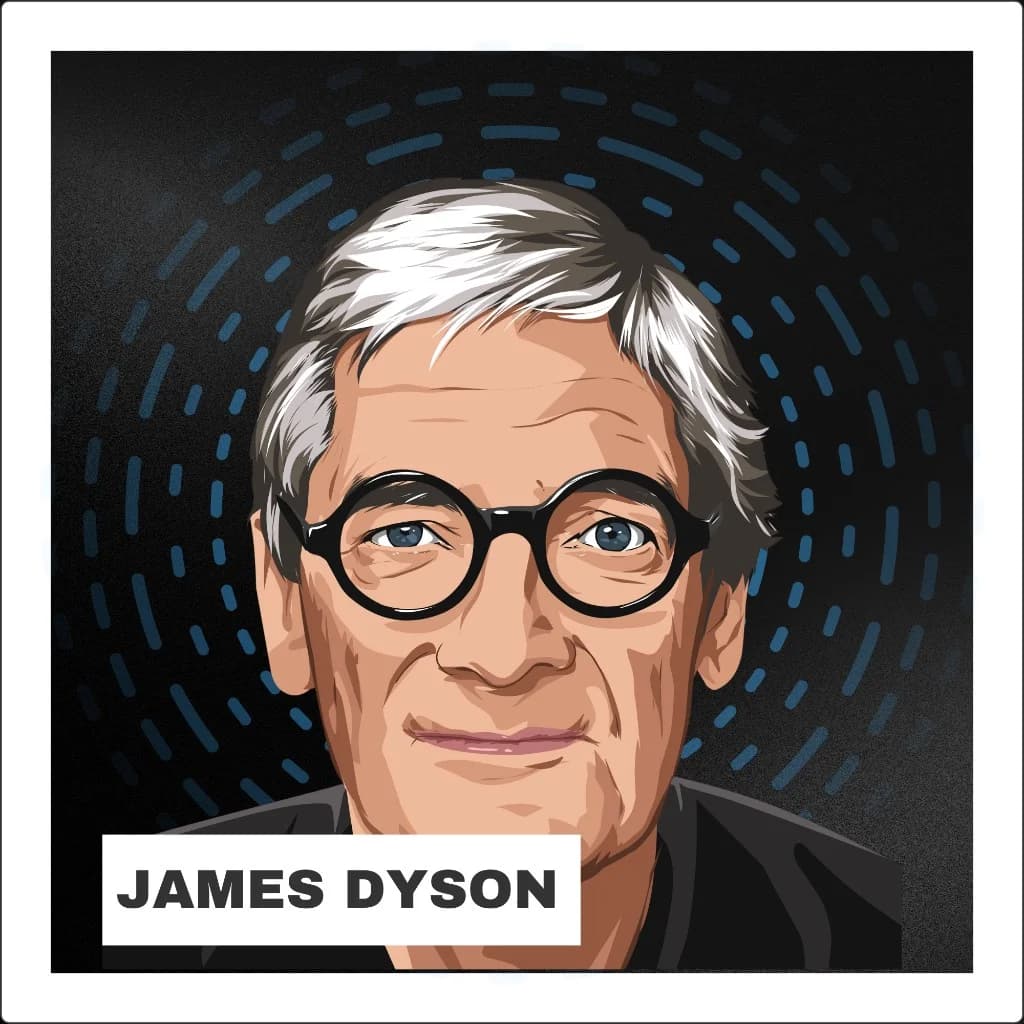
James Dyson was born on May 2, 1947, in Cromer, a small town on the North Norfolk coast where nothing stands between the shore and the Arctic in one direction, Siberia in the other. His father, Alec, taught classics at Gresham's School in nearby Holt — a boarding school whose alumni include the poet W.H. Auden and the composer Benjamin Britten. The family kept hens, grew vegetables, had no television, never enough heating, no new toys. It was, Dyson has said, idyllic: the children of the school's teachers formed "a kind of tribe," running free across the grounds during holidays, sailing at Blakeney Pit, sliding through the creeks and mud of the marshes. His first memory is of being thrown into a swimming pool by his father while it was still filling with freezing water. "A pretty chilling experience," he has called it, with characteristic understatement.
Alec Dyson was diagnosed with cancer when James was six. He left for treatment in London when James was still a boy — walking out the back door holding a small suitcase, waving goodbye with what his son, more than sixty years later, would describe as "brave cheerfulness." James never saw him again. Alec died in 1956, at forty-three. James was nine.
The loss did something irreversible. "Not having a father, particularly at that time, was very unusual," Dyson has reflected. "I felt different. I was on my own. I can't quite explain it, but I think subconsciously I felt a need to prove myself." He has cited a statistic: roughly eighty percent of British prime ministers since Walpole lost a parent before the age of ten. "So there's something in it. I'm certainly quite driven." The phrase "quite driven" is one of the great English euphemisms. What Dyson describes elsewhere — the compulsive need to prove himself, the fear of failure that functions as fuel, the preference for solitude and self-reliance, the deep suspicion of depending on anyone for anything — all of it traces back to a nine-year-old watching his father wave from the back door with a small suitcase.
Gresham's headmaster, Logie Bruce-Lockhart — a man whose key mantra, Dyson recalls, was to "throw yourself into everything" — offered the brothers a full bursary. Without it, their education would have ended. Dyson would later recognize the debt: first with an £18.75 million donation to build the Dyson STEAM Building at Gresham's, then with a further £35 million for a new preparatory school. The money was enormous. The gesture was specific. He was paying back a headmaster who, in 1956, had decided that a classics teacher's orphaned sons deserved to keep their place.
At Gresham's, Dyson threw himself into everything that was not classics. Long-distance running became his obsession — a solitary, punishing discipline that taught him, he has said, about the pain barrier: the point three-quarters of the way through a race "where it's really starting to hurt and you can't see the end and you want to give up." He would later apply the metaphor, with eerie precision, to every development project he undertook. He also studied art, which he enjoyed far more than his father's beloved Latin and Greek, and which eventually pointed him toward a future that Alec Dyson, had he lived, might have found bewildering.
The Education of an Amateur
In 1965, Dyson left Norfolk for London and enrolled at the Byam Shaw School of Art to study painting. He lasted a year. Not because he failed, but because the principal, Maurice de Sausmarez, told him about something called "design" — a discipline that, in mid-1960s Britain, barely existed as a public concept. "In the mid-'60s, 1965, design was not something that was talked about or publicized in the press or magazines," Dyson told Ferriss. "And there was no good design in shops either. So I didn't know what it was."
He transferred to the Royal College of Art, nominally to study furniture design. ("I'd sat on chairs!" he later explained to a WIRED interviewer, cheerfully admitting the logic was "a bit haphazard.") He quickly switched to architecture, drawn by its greater intellectual ambition, and it was there that the two forces that would define his career converged. The first was the work of Buckminster Fuller — the American architect-engineer-polymath who created geodesic domes, tensegrity structures, and a philosophy of doing more with less. "Here was an engineer creating this engineering structure which was incredibly beautiful, without even trying to be beautiful," Dyson told the BBC. "Its elegance came not from its styling but from its engineering and I latched on to that." The sentence contains, in embryo, the entire Dyson aesthetic: beauty as a by-product of function, never its purpose.
The second force was a person. At the RCA, Dyson designed a mushroom-shaped theatre building for the theatrical impresario Joan Littlewood — a structure inspired by Fuller's principles. He needed funding and cold-called Jeremy Fry, a British inventor and industrialist who had used a similar architectural system in his own factory roof.
Fry was the scion of the Fry's chocolate family, a dynasty whose fortune had been considerably diminished by the time it reached him. He was also an inventor of enormous restlessness and intuition, the chairman and founder of Rotork Controls Ltd. in Bath, and — crucially — a man with zero interest in experts or credentials. When Dyson came to him asking for money for the theatre, Fry refused. What he said instead altered the trajectory of Dyson's life: "I'm not going to give you any money at all, but I can see you're an ambitious designer. Why don't you design some things for me?"
Fry's approach to engineering was radical in its simplicity. When Dyson had an idea, Fry would say: "You know where the workshop is. Go and do it." No committees. No feasibility studies. No consultants. "Here was a man who was not interested in experts," Dyson wrote in
Against the Odds. "He meets me. He thinks to himself, 'Here's a bright young kid. Let's employ him.' And he does. He risks little with the possibility of gaining much. It is exactly what I now do at Dyson."
Fry offered Dyson a job after graduation: head of a new Marine
Division at Rotork, tasked with manufacturing the Sea Truck, a high-speed flat-bottomed fiberglass landing craft that Dyson had designed based on Fry's original concept. The young designer-turned-engineer had no relevant experience. He had never run a manufacturing operation. He had never, in any formal sense, been an engineer at all. "I have to stress that I am an amateur engineer, I'm not a trained engineer," Dyson has said repeatedly. "And I hope I think like an engineer."
The distinction mattered to him. Thinking like an engineer meant looking at everything — a trolley, a shoe, a vacuum cleaner bag — and asking: How does it work? How could it work better? Is there a radical breakthrough possible through lateral thinking? "It could be said to be rather irritating to analyze every single thing you look at and reject it because it's horrid or it doesn't work very well," he admitted to Ferriss, "but that's how I'm built."
The Ballbarrow and the Betrayal
The Sea Truck succeeded, but Dyson, after five years at Rotork, was restless. He was twenty-seven, tired of enriching shareholders through his efforts, and ready to go out on his own. His first solo invention was magnificently unglamorous: a wheelbarrow.
The existing design was, by Dyson's analysis, an affront to engineering. Metal bodies that rusted and dented walls. Narrow wheels that sank into soft ground, punctured, and lost stability. Dyson replaced the wheel with a large spherical plastic ball that distributed weight more evenly and glided over mud, and molded the body from bright red plastic. He called it the Ballbarrow. It looked absurd. It worked beautifully.
He formed a 50/50 partnership with his wealthy brother-in-law, Stuart Kirkwood, borrowed £24,000 against his house, and launched Kirk-Dyson Designs. Early sales were difficult — the construction industry resisted anything unfamiliar — but a newspaper advertisement aimed directly at consumers produced a flood of checks. A gardening journalist tried the product, loved it, and published a glowing review. Dyson learned a lesson he would never forget: one journalist's honest endorsement was worth a thousand ads.
The Ballbarrow eventually captured a 50% market share in the UK, selling 45,000 units annually. But growth required capital, capital required investors, and investors required board seats. Dyson's stake was diluted to a third. He became a minority shareholder in his own company. And when the board decided to sell the rights to the Ballbarrow — over his vehement objection — he could do nothing. In January 1979, they sold the product and fired him.
The experience was devastating and clarifying in equal measure. "I found that an uncomfortable position," Dyson said of holding a minority stake. "You're not actually running the company, you're sharing the running of the company." He would never allow it to happen again. From that point forward, control — total, uncompromised, sometimes lonely control — became not merely a preference but a survival mechanism. The Ballbarrow taught him to invent. Its aftermath taught him to own.
The Bag and Its Enemies
The cyclonic vacuum cleaner did not begin with a vacuum cleaner. It began with a clogged cloth filter in the Ballbarrow factory.
Dyson had installed a dry powder coating system to spray paint his wheelbarrow frames. A cloth filter trapped the excess powder, but every hour it clogged with particles, forcing the entire machine to shut down for cleaning. He asked around the industry for a better solution and was told that intelligent factories used cyclones — industrial-scale centrifugal separators that spun particles out of the airstream without any filter at all. The quote for a commercial cyclone was enormous. So Dyson built one himself over two weekends. It was thirty feet tall. The chimney stuck through the factory roof. It ran beautifully all day without clogging, collecting reusable powder at the bottom.
The connection was instant. If a cyclone could replace a clogging cloth filter in a factory, why couldn't a miniature version replace the clogging bag in a vacuum cleaner? Dyson rushed home, fashioned a crude cardboard cyclone about a foot high, taped it to the back of his old upright vacuum cleaner, and pushed it around the room.
It worked. Sort of.
"I didn't know the efficacy," he told Ferriss. "I didn't know how well it collected the fine dust. All I knew was that it was collecting the dog hairs and the dust that was on the floor." What followed — the years of prototyping, the 5,127 iterations, the debt, the doubt — has already been told. What matters here is the nature of the problem he was solving and why every incumbent in the industry refused to solve it.
The vacuum cleaner bag was not merely a design flaw. It was a business model. The global market for replacement bags was worth hundreds of millions of pounds annually. Every major manufacturer — Hoover, Electrolux, Eureka, Black & Decker — depended on that recurring revenue stream. A vacuum cleaner that didn't need bags was not just an engineering challenge; it was an existential threat to the razor-blade economics of the entire industry. "The people who rejected it did so for no good reason," Dyson told Fortune, "which told me they were not interested in technological advances. That gave me the courage to keep going."
The more people that turned me down, the more excited I got because why were they turning it down? Well, they're probably turning it down because they rather like selling bags, and mine didn't have a bag and they made a lot of money.
He spent roughly six years trying to license the technology. He visited every major vacuum manufacturer in Europe and America. Hamilton Beach gave him two minutes. Electrolux said a vacuum without a bag wouldn't sell. Black & Decker showed initial interest, then killed it when in-house patent counsel objected. "I saw them all," Dyson wrote in a piece for Newsweek. "No. No. Yes. I mean no." One dealer's assessment of the threat Dyson posed to Hoover, quoted in Forbes when Dyson finally entered the US market: "Dyson? Who's he? If I were Hoover, I wouldn't be quaking in my boots."
The G-Force and the Japanese Detour
The breakthrough, when it came, arrived from the one country where a $2,000 vacuum cleaner could be sold as a luxury design object: Japan.
A small Japanese company called Apex licensed Dyson's technology and manufactured the G-Force, a bright pink cyclonic vacuum that looked nothing like the eventual Dyson product but embodied all of its principles. It sold for roughly 250,000 yen — nearly $2,000 at the time — and won the 1991 International Design Fair prize in Japan. The licensing fees were modest but real: enough income to keep Dyson alive while he plotted his next move.
Meanwhile, his partnership with Jeremy Fry had dissolved. Fry's financial advisors, watching the parade of failed licensees, recommended he exit. Dyson bought out his mentor's stake for £45,000 — a number that, given what the technology would eventually be worth, ranks among the great bargains in the history of British commerce. "It's a very friendly parting," Dyson has said. "I quite understood it. The vacuum cleaner wasn't his life. It was my life, not his life."
Being alone suited him. "On the other hand, it actually made me feel better being completely on my own," he told Ferriss. "It suited me." The statement is revealing not for its content — many entrepreneurs prefer autonomy — but for its emotional register. Dyson describes solitude the way other people describe relief. The boy who lost his father at nine, who was fired from his own company, who watched his mentor walk away, had learned to draw strength from the absence of others. It is not sentimentality. It is architecture.
Betting the House
By the early 1990s, Dyson had changed his mind. He was done trying to license technology to people who didn't want it. He would manufacture and sell the vacuum cleaner himself. He was three engineers in a coach house with a machine shop underneath. He had no factory, no sales force, no brand, no money, and no market research confirming that anyone would actually buy this thing.
"I had no idea whether anyone wanted to buy this product," he told Ferriss. "No idea at all. I hadn't done any market research, and you can't really go and ask someone whether they want to buy a vacuum cleaner that doesn't have a bag." He invoked the
Henry Ford maxim about faster horses. "You've got to back your own instincts. You can't get help on this. You've got to take the risk."
The risk was literal. In the deep recession of the early 1990s — the worst, Dyson has said, since the 2008 crash and in many ways more brutal — banks were repossessing houses across Britain. The bank that Dyson used, Lloyds, initially refused to lend him the roughly £400,000 he needed for tooling. His bank manager, Mike Page, appealed internally, and — in one of those improbable human moments that business narratives depend on — was asked by his superiors why he believed in this inventor of a bagless vacuum cleaner. Page went home and asked his wife what she thought of a vacuum without a bag. "I hate bags," she said. Page also noted that Dyson had fought a long, expensive patent lawsuit in the United States and survived. He used both arguments to persuade Lloyds. The loan was approved. The house went up as collateral.
"I did ask the bank manager why he lent me the money," Dyson has recalled. "So it was actually really encouraging. I mean, it's a good bank story. There are very few good bank stories and this is one of them."
The first Dyson vacuum, the DC01, came off the production line in January 1993. Dyson was forty-five. He had started working on cyclonic technology in 1978. Fifteen years from first cardboard prototype to first manufactured product. And nobody knew who he was.
Seeing the Dirt
The DC01 retailed at just under £200 — three to four times the price of competing vacuum cleaners. It was made almost entirely of plastic in an era when plastic signaled cheapness. It wore its engineering on its skin: the clear plastic bin, positioned prominently in the machine's midsection, displayed your dirt as you collected it. Every retailer who saw it recoiled.
"When we went to see the retailers to try and sell the vacuum cleaners to retailers," Dyson told Ferriss, "most of them refused to stock it because it was strange looking. You could see the dust, and who on earth is Dyson? You're not Hoover or Electrolux or a big brand. So we're not interested in you."
The retailers were wrong. The transparent bin — "the most perverse design decision of all," as the New Yorker's John Seabrook described it — turned out to be exactly what consumers wanted. The thrill of watching your bin fill with filth, of seeing the evidence of your labor, of discovering what your old vacuum had been leaving behind — it was visceral, almost pornographic in its satisfaction. Best Buy's merchandise manager, David Kielly, took the DC07 home and underwent what would become a common conversion experience: the bin filling with dirt his previous vacuum had missed.
"As engineers, we liked seeing the dust," Dyson said. "It was incredibly satisfying and fun." The retailers who said consumers would be repulsed by visible dirt were applying conventional wisdom — the same conventional wisdom that had sustained the bag industry for a century. Dyson's first customers were mail-order catalog companies, not high-end department stores. "They're not the most highbrow of retailers," Dyson admitted. "They're quite lowbrow, which is a very interesting thing actually because what I discovered, and life has confirmed it since, is that the richer you are, the less interested you are in vacuuming. The poorer you are, the more important vacuuming is to you."
Within eighteen months, the DC01 was the best-selling vacuum cleaner in Britain. Revenue went from £3.5 million in 1993 to £85 million in 1996. Dyson became the fastest-growing manufacturing company in the United Kingdom. The slogan — "Say Goodbye to the Bag" — was not the product of a marketing agency. It was the irreducible fact of the technology. One message, repeated without dilution, until the market believed it.
Bankruptcy didn't worry me because I can make things, but I did worry about losing our house. My wife sold paintings and taught art classes, and we borrowed, and borrowed, and borrowed. We grew our own vegetables, and she made clothes for the children.
The Digital Motor and the Expanding Cyclone
If the story ended there — lone inventor triumphs over industry incumbents — it would be satisfying and incomplete. What distinguishes Dyson from the inventor-as-folk-hero archetype is what happened after the first success: not retirement, not complacency, but a systematic expansion into adjacent categories, each one driven by the same question that produced the cyclonic vacuum. How does this thing work? How could it work better?
The key technology was the digital motor. Dyson's engineers developed an electric motor that could spin at 120,000 RPM — compared to 30,000 RPM for conventional motors, 19,000 for a Formula 1 engine at maximum, and 15,000 for a jet engine. It was initially four times as expensive as the motors it replaced, but it was dramatically more efficient, lighter, and smaller. It used less electricity and fewer materials. It was, Dyson insisted, the future.
The motor's first commercial application was not in a vacuum cleaner. It was in the Airblade hand dryer, launched in 2006. The device didn't try to evaporate water from your hands, as conventional hot-air dryers did — a process that was slow, energy-intensive, and left hands chapped. Instead, it blew air at such velocity through a narrow aperture that it functioned like a squeegee, scraping water off your skin in about ten seconds. It used 700 watts instead of 3,500. The discovery, characteristically, was accidental: engineers testing air blades for an unrelated project noticed the air rippled their skin, shot water on their hands, and watched it scrape clean.
The Air Multiplier bladeless fan, introduced in 2009, was another exercise in making the invisible visible. Air drawn through the base was blown over the inner surface of an airfoil-shaped ring, inducing surrounding air to flow in an uninterrupted stream — no blades, no buffeting, no danger to children's fingers. The product looked like a portal to another dimension. It worked like a piece of aeronautical engineering. It cost far more than any desk fan had a right to cost, and it sold.
Then came hair care. The Supersonic hair dryer, developed by 103 engineers over approximately 600 prototypes at a cost of £55 million, used the digital motor's airflow to dry hair without extreme heat, reducing damage. The Airwrap styler used a vortex of air to wrap curls without direct contact. Both products became cult objects, particularly among a younger generation of consumers for whom "Dyson" meant not vacuum cleaners but high-performance personal care.
By 2024, the company was developing products Dyson himself described with bemused self-awareness. At the SoHo launch of Dyson Chitosan — a line of hair-styling "formulations" infused with oyster mushroom extract — the seventy-seven-year-old inventor demonstrated a serum bottle engineered to emit precisely 0.22 milliliters per press. "The oyster mushroom happens to have this rather complex macromolecule that has sort of a triodetic form," he explained to a New Yorker reporter, frowning at the inadequacy of conventional styling products. "It forms a net around whatever it touches." He ran the serum through his own hair. The hold was subtle, the scent pleasing. The venue was a decommissioned fire station on Mercer Street, originally built to shelter horse carriages. "A coach house, exactly," he noted. Full circle.
The Car That Never Was
In 2013, when only Tesla was seriously pursuing electric vehicles and industry forecasts predicted that just three percent of global cars would be electric by 2030, Dyson saw an opening. His company had the digital motor. It had expertise in air treatment — heating, cooling, purification — which is largely what a car's climate system does. It was developing new battery technology. And unlike every incumbent automaker, it was not committed to internal combustion engines.
The project, code-named N526, consumed four years, hundreds of engineers, and £2 billion. Dyson designed his own chassis — most startups, including early Tesla, used an existing platform — because no existing chassis could accommodate his vision: enormous wheels, nearly a meter in diameter, positioned at the four corners of the vehicle. The logic was Dysonian: larger wheels have less rolling resistance, which means greater energy efficiency, which is critical when your only power source is a battery. The big wheels also delivered unexpected benefits: better road holding, more comfort, superior performance in snow and mud.
The car was, by all accounts, excellent. It had a 600-mile range. Good off-road capability. A ride quality that surprised even its creators. And it was, Dyson concluded, commercially unviable.
The arithmetic was merciless. Electric vehicles were more expensive to produce than combustion-engine cars. Incumbent automakers — panicked by Dieselgate into a sudden pivot to EVs — were selling their electric models at a loss, subsidized by the fat margins on their gas-guzzling SUVs, whose fleet-wide emissions averages the EVs offset. Tesla, meanwhile, had burned through $25 billion in investor capital and supplemented revenue by selling carbon credits. "I don't have $25 billion," Dyson told Fortune. "I'm privately financed. I have to make the money I spend on product development."
On October 10, 2019, Dyson announced the project's cancellation. It was a rare public setback — he had promised a "radically different" vehicle by 2021 — and it stung. But he applied the same cold logic he had used on every prototype since number one: if the data says stop, stop. "It just wasn't commercially viable," he said. The washing machine had taught him the same lesson years earlier. The CR01, a dual-drum machine that washed better than anything on the market, had been priced too low on the marketing department's advice ("If you charge less, you will sell more"), had hemorrhaged money, and was discontinued. "That's the one and only time I've ever listened to the marketing department," Dyson said. "Actually, we charged less and sold fewer."
The Private Kingdom
Dyson Ltd. has never been publicly traded. The Dyson family — James, his wife Deirdre, and their three children, Emily, Jake, and Sam — owns 100% of the company. No outside shareholders. No quarterly earnings calls. No obligation to explain the gleam in your eye to analysts who cannot see five years ahead.
This is not an accident. It is the founding principle, born from two traumas: the Ballbarrow investors who sold his invention from under him, and the brief, unhappy period when Dyson served as a director of Fry's publicly traded Rotork. "The shareholders are always out of tune with what is actually happening in the company," he told Ferriss. "When we were doing well the share price was down and the share price was up, we were doing badly and it just seemed to be out of kilter."
He tried, in the early 1990s, to raise venture capital. He was, by his own account, "completely useless" at it. Every firm turned him down. The failure, in retrospect, was a gift. Forced to rely on a bank loan instead of equity investors, Dyson retained total ownership. "I hugely admire people who can go to these people and raise money," he said. "I was hopeless at it."
The result is a company that can spend £2 billion on R&D since 2021, invest in a four-year electric car project and walk away from it without answering to anyone, open a university, buy thirty-six thousand acres of farmland, and develop mushroom-based hair serums — all at the discretion of a single family. The trade-off is real: without external capital, Dyson cannot take the kind of existential bets that Tesla took. But the freedom is also real, and Dyson guards it with the ferocity of a man who learned, at twenty-seven, what happens when you don't.
Jake Dyson, now chief engineer and the designated heir to the empire, represents the next generation of this structure. The forty-seven-year-old shares responsibilities with his father — Jake handles headphones and some product lines; James handles beauty products "for some reason," as he put it with dry amusement in 2024. The transition is happening in the way Dyson things tend to happen: gradually, iteratively, without external pressure.
The University in the Hangar
In 2016, Jo Johnson — then Secretary of State for Universities, Science, Research and Innovation — grew tired of Dyson's persistent complaints about the shortage of engineers in Britain. "Stop complaining and start your own university," Johnson told him. New legislation allowed it. Dyson, characteristically, took the challenge literally.
The Dyson Institute of Engineering and Technology opened in 2017 on the Dyson Campus in Malmesbury, Wiltshire. Its model was radical: undergraduate engineers paid zero tuition, earned a full salary, and worked on live Dyson projects alongside the company's practicing engineers from day one. The first cohort of thirty-three students graduated in 2021. Every single one chose to stay at Dyson.
At my ripe old age, I should be able to pass on some advice. But I'm stumped. The world is moving so fast, tomorrow is so different from today. Experience is not necessarily the help it used to be. Be bold, be radical. The world needs radicals.
By 2022, the Institute had received the right to award its own degrees — the first higher education provider to do so under the New Degree Awarding Powers route established by the Higher Education and Research Act 2017. Dyson's investment in the Institute exceeded £40 million. Forty-one percent of the 2021 intake identified as female, compared to a national average of twenty-one percent for engineering undergraduates.
The university is part of a broader campaign that borders on obsession. The James Dyson Foundation, established in 2002, runs workshops, scholarships, and the annual James Dyson Award — an international student design competition. Dyson donated £18.75 million to Gresham's for its STEAM building. He donated £35 million more for a new prep school. He fought an eighteen-month bureaucratic battle with Wiltshire council and the Department for Education to donate £6 million to his local state primary school for a STEAM center and expansion. The council worried the expansion might draw students from neighboring schools. Dyson was incredulous. "It's incredibly depressing," he said. "It is a sorry example of how hard it is to get anything done in Britain."
Strawberries, Robots, and the Land
In 2013, Dyson established Dyson Farming, a commercial operation now spanning some thirty-six thousand acres of British farmland — making the Dyson family one of the largest landowners in England. The venture includes a twenty-six-acre greenhouse for strawberries, heated by waste energy from anaerobic digesters, where robots roll up and down rows deploying ultraviolet light to kill mold and bacteria. Bugs are released to kill other bugs. No chemicals. "They're perfect strawberries," Dyson told the New Yorker in 2024.
The farming operation sounds, at first, like the hobby of a restless billionaire. It is not. It is the application of the same engineering methodology to food production: identify the inefficiency, develop the technology, automate what humans do poorly, and measure everything. "We want to fuse our engineering knowledge with farming knowledge and make great, good, wholesome food," Dyson said. Drones survey the fields. Robots pick the fruit. The land itself is managed with an eye toward biodiversity and sustainability — not as buzzwords, but as engineering problems with engineering solutions.
The company now encompasses vacuum cleaners, hair dryers, hair care formulations, air purifiers, air-purifying headphones that monitor noise pollution, hand dryers, lighting, farming operations, a university, and a charitable foundation. It employs more than fourteen thousand people. Around half are engineers and scientists. Its research interests span robotics, AI, machine learning, solid-state battery development, material science, and high-speed electric motors. The headquarters moved to Singapore in recent years — a decision aimed at the company's growing Asian markets that generated controversy in Britain, where Dyson's vocal support for Brexit had already made him a polarizing figure.
And at the center of it all, a seventy-eight-year-old man who still runs long distances, still walks the factory floor, still picks up objects and mentally redesigns them. "Whenever I look at anything," Dyson told Ferriss, "I wonder how it works, and then I wonder how it could work better." He described this compulsion with a mixture of enthusiasm and resignation, the way a man might describe a condition he has learned to live with. His interviewer at the Telegraph once watched him study a broken sandal, then a hostess trolley, unable to resist mentally improving each. "Must be hell for your wife to live with," the journalist murmured. "She rather likes it," Dyson said, not in the least offended.
In that decommissioned fire station on Mercer Street — the one built in 1854 to house horse carriages, now filled with air purifiers shaped like oscillating zeros and bottles dispensing precisely 0.22 milliliters of mushroom-infused serum — James Dyson showed visitors an illustration from the building's original era. There was a statue of a fireman on the roof, long since removed. "This chap on the top here, with his fireman's hose," he said. "If you know anything about his whereabouts, please let me know."