
Part IThe Story
The Youngest Partner
The Gross Record
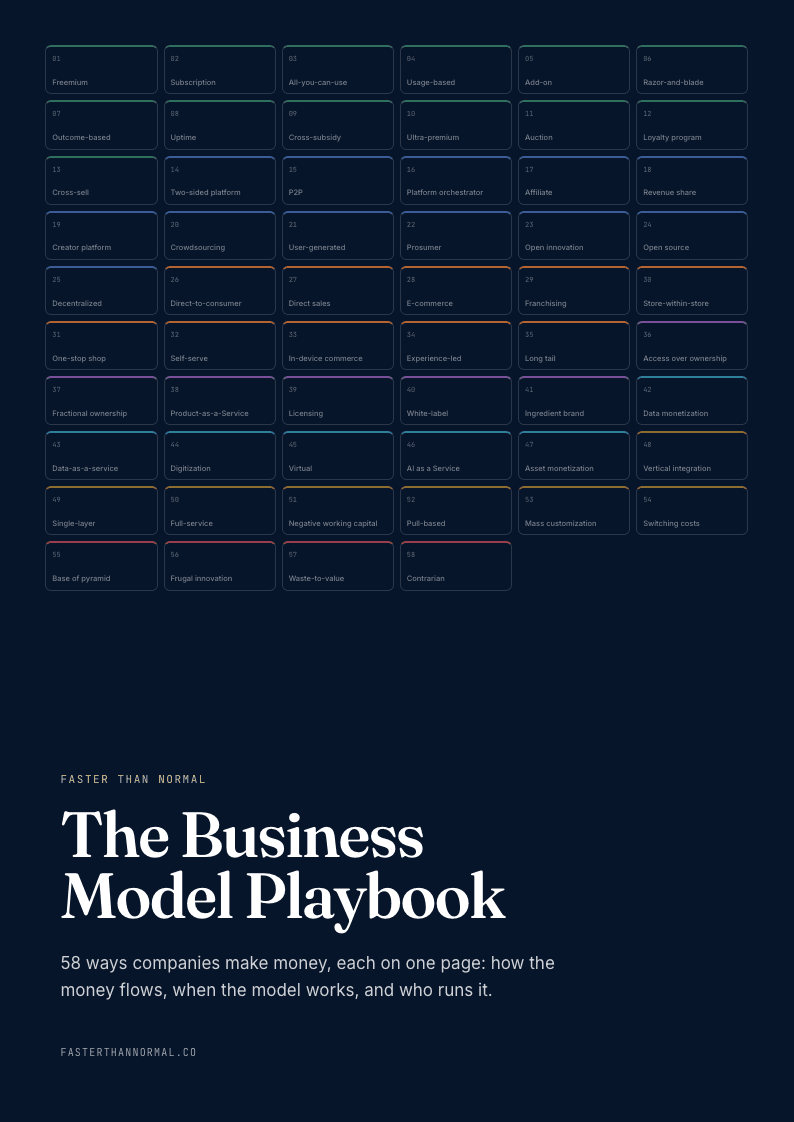
Free playbook
Get The Business Model Playbook
58 business models, one visual page each: how the money flows, the metrics that matter, and who runs it. Free when you join the Faster Than Normal email.
Free. No spam. Unsubscribe anytime.
Y Combinator and the Art of Founder Selection
Pioneer and the Global Talent Search
The AI Moment
Free playbook
Get The Business Model Playbook
58 business models, one visual page each: how the money flows, the metrics that matter, and who runs it. Free when you join the Faster Than Normal email.
Free. No spam. Unsubscribe anytime.
Part IIThe Playbook
Learning Rate Over Knowledge
— Daniel Gross"The most important thing you can do as a founder is increase the rate at which you learn."
Talent is Global, Opportunity is Local
Build the Tool, Not the Application
Conviction Without Dogma
Part IIIIn His Own Words
Quotes & Maxims
— Daniel Gross"The world is full of talented people who never get the chance to prove it. The job of technology is to find them."
— Daniel Gross"The best founders don't have the best ideas. They have the highest rate of iteration."
— Daniel Gross"If you want to find outlier talent, you have to look in outlier places."
— Daniel Gross"AI doesn't replace human judgment. It gives human judgment better inputs."
Frequently asked questions
Who is Daniel Gross?
Co-founder of Cue (acquired by Apple), former partner at Y Combinator, and co-founder of Pioneer. One of the youngest AI leaders, building at the intersection of machine intelligence and human potential.
What is Daniel Gross known for?
Daniel Gross is known for: Co-founder of Cue (acquired by Apple), former partner at Y Combinator, and co-founder of Pioneer. One of the youngest AI leaders, building at the intersection of machine intelligence and human potential..
What can you learn from Daniel Gross?
The Daniel Gross leadership playbook covers their core principles, mental models, and the key decisions that shaped their career. It offers actionable takeaways you can apply to your own work.
Continue exploring

Person
Alex Hormozi
Alex Hormozi is an entrepreneur known for transforming business strategies and mastering high-ticket sales through comp…

Person
Jeff Bezos
Founder of Amazon, which grew from an online bookstore to the world's largest e-commerce and cloud computing company.

Person
Andrew Carnegie
Steel magnate who built Carnegie Steel (later U.S.

Person
Coco Chanel
Founder of Chanel and revolutionary fashion designer who liberated women from corsets, popularized the little black dre…