

The World-Class Framework for Getting Luckier — From The Most Powerful Woman In Startups
The World-Class Framework — How the most powerful woman in startups created the ‘luck’ that launched her career
Ann Miura-Ko has been called the most powerful woman in startups by Forbes. The label fits: she's a co-founding partner at Floodgate Venture Capital, an early investor and board member in Lyft, a lecturer in entrepreneurship at Stanford, and a world-class debater. But the arc of her career pivots on a single question her father, a NASA rocket scientist, drilled into her from childhood: "Is this world-class?"
The question would seem absurd applied to photocopying. Yet it was photocopying that launched everything.
The Immigrant's Standard
Miura-Ko's parents arrived in America with almost no money, minimal English, and no support system. What they carried instead was post-war Japanese grit—the kind forged by scarcity and sustained by discipline. Her father pursued a PhD in mechanical and aerospace engineering, eventually joining NASA in a field where precision isn't aspirational but existential.
His work ethic was relentless. Up at 5 AM, full days at the lab, then stacks of papers brought home for evening sessions that stretched deep into the night. He loved the work, but more than that, he understood something about excellence that he wanted to pass down: it's not a destination but a daily practice.
From Ann's earliest years, he would interrupt her activities with the same pointed inquiry: "Is this world-class?" A five-year-old's handwriting. A school assignment. Any output, no matter how trivial. When young Ann would protest that yes, for a five-year-old, this was world-class, he'd push further: "Is this really the best that a five-year-old could ever do?"
The standard wasn't relative to her circumstances. It was absolute.
The Test Case
At Yale, Miura-Ko's financial aid package included a work-study requirement: 10 hours per week in the Dean of Engineering's office. Before her first day, she called home. Her father's advice was predictable: "Make sure you do a world-class job."
"I'm photocopying and filing," she responded. "There's no such thing as world-class there."
"I'd still think about it," he said.
Standing at the photocopying machine with her first stack of papers, Miura-Ko found herself genuinely contemplating the question. What would world-class photocopying look like? She decided: copies so perfect you couldn't distinguish them from originals. When assigned donut runs and file labeling, she applied the same framework. Each menial task became a miniature case study in excellence.
The work was invisible. For two years, she executed these responsibilities without recognition, asking herself the same question at every turn: "What does world-class look like here?"
The Moment Everything Changed
Dean Allan Bromley—a legendary physicist who had served under George H.W. Bush—emerged from his office one day to find his executive assistant away. He noticed Miura-Ko and asked, "Who are you?"
"I'm Ann Miura. I'm your student assistant in this office."
"Oh, I've heard of you," Bromley said. "I need you to give my friend a tour of the engineering facilities. I know you'll do a good job. Sarah has told me you're great."
The friend turned out to be Lew Platt, CEO of Hewlett-Packard. During the tour, they discovered shared roots in Palo Alto. Platt, impressed by their conversation, made an unexpected offer: "What are you doing for spring break? Would you want to shadow me and see what I do for a living?"
Miura-Ko realized she had spent the entire conversation talking about herself—a classic junior mistake. But Platt had already seen what he needed to see.
The Power of Proximity
That spring break, Miura-Ko shadowed the CEO of one of America's largest technology companies. She attended meetings, observed decision-making, and witnessed corporate power at its highest levels. When Bill Gates visited HP to announce a .NET partnership, Platt invited her to the meeting and arranged for a photographer to capture two specific images.
Months later, Miura-Ko received a package from Platt: a thank-you letter with two photographs. The first showed her sitting beside Platt in conversation. The second showed Bill Gates in the exact same seat, talking to the same CEO.
"He saw something in me and said, 'You know what? You have something and I see it. I'm going to show you something even greater,'" Miura-Ko recalls. "It was such a gift. It was so incredible because I hadn't ever thought about my own personal potential ever."
The images forced a cognitive shift. If she could sit in that chair once, she could sit there again. The gap between her current position and Gates's wasn't unbridgeable—it was a matter of trajectory and time.
The Architecture of Luck
The entire sequence hinged on a single moment: Bromley poking his head out of his office, needing someone reliable for an important task. He didn't recognize Miura-Ko by sight, but he knew her by reputation. More critically, he knew she could be trusted with something that mattered.
Two years of world-class photocopying had built a brand she didn't know she was building. The menial tasks she had approached with rigorous professionalism had created the conditions for extraordinary opportunity.
This is the paradox of early-career excellence: the work that feels most disconnected from your ambitions often proves most connected to your outcomes. Miura-Ko's father understood what most miss—that how you do anything becomes how you do everything. Your personal brand isn't built through grand gestures but through the accumulation of a thousand micro-acts performed when no one is watching.
The Compound Interest of Standards
Excellence in small things creates a reputation that precedes you into rooms you haven't entered yet. It builds the kind of trust that gets you selected for opportunities you didn't know existed. When Bromley needed someone for a critical task, he didn't hesitate. The choice was obvious because the pattern was established.
Most people want to skip the mundane to reach the meaningful. They treat boring work as an obstacle to overcome rather than a foundation to build upon. But this misunderstands how careers actually develop. The most consequential moments often emerge from the most inconsequential preparations.
Miura-Ko's story isn't about luck—it's about creating the conditions where luck can find you. Every photocopying session was an investment in a future she couldn't yet envision. Every perfectly filed document was a deposit in an account she didn't know she was building.
The Question That Changes Everything
The framework is deceptively simple: before executing any task, ask yourself what world-class performance would look like in that specific context. Then deliver it, regardless of whether anyone will notice.
This isn't perfectionism—it's professionalism applied consistently across all circumstances. It's the recognition that you're not just working for your current employer but for your future self. You are the CEO of your own luck, and every action either builds or erodes the foundation for what comes next.
The most powerful woman in startups built her power one perfect photocopy at a time. The question that guided her remains available to anyone willing to ask it: "Is this world-class?"
Your answer will determine what opportunities find you.
Free playbook
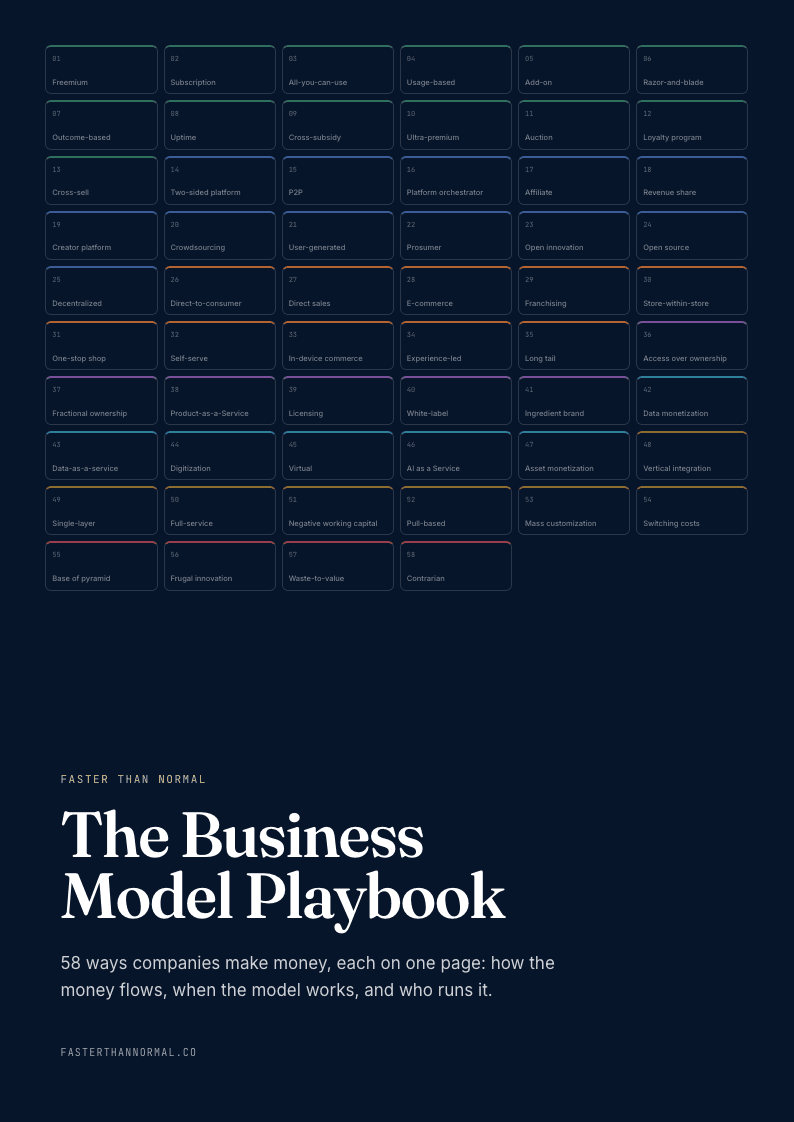
Get The Business Model Playbook
58 business models, one visual page each: how the money flows, the metrics that matter, and who runs it. Free when you join the Faster Than Normal email.
Free. No spam. Unsubscribe anytime.