

Winston Churchill, Richard Hamming On Learning To Sell and Social Dynamics & Status
On a winter evening in 1915, Winston Churchill sat in his study at Admiralty House, staring at maps of the Dardanelles. The operation he had championed — the ambitious assault on Gallipoli that would break the Ottoman Empire and open a second front — had collapsed into a bloodbath. Thirty-six thousand Allied casualties. His political career, once ascending toward the highest offices, lay in ruins. Churchill was forty-one years old, and by every reasonable measure, finished.
The man who would later defy Hitler across the airwaves had been reduced to defending a disastrous military gamble that killed thousands. But failure, for Churchill, became something else entirely: the forge where his wartime leadership was actually hammered into shape. The Gallipoli catastrophe didn't end his story — it taught him the weight of decisions made under impossible pressure, the cost of strategic miscalculation, and the necessity of standing upright when everything collapses around you.
— Winston ChurchillSuccess is not final, failure is not fatal: it is the courage to continue that counts.
Churchill's trajectory from 1915 to 1940 reveals something counterintuitive about resilience: the leaders who perform best in genuine crisis are often those who have already absorbed their worst failure and rebuilt from the wreckage. When Churchill took the helm as Prime Minister in May 1940 — with France falling, the British Expeditionary Force trapped at Dunkirk, and invasion looming — he wasn't operating from theoretical courage. He was drawing on twenty-five years of post-failure clarity about what collapse feels like and how to function through it.
The Architecture of Comeback
Churchill's post-Gallipoli years weren't a straight line to redemption. He spent time in the trenches of France as a lieutenant colonel, learning warfare from the ground up rather than from Whitehall war rooms. He published books, painted landscapes, built walls at his country estate — activities that look like hobbies but functioned as a systematic reconstruction of his capacity to create rather than merely react to crisis.
The writing was particularly crucial. Churchill produced six volumes on World War I, each one a careful analysis of strategic decision-making under pressure. He wasn't just rehabilitating his reputation; he was developing the analytical framework that would later allow him to see the Hitler threat clearly while his contemporaries pursued appeasement. The man who wrote "The farther backward you can look, the farther forward you are likely to see" had spent years looking backward at his own catastrophic miscalculations.
By 1939, when Churchill returned to the Admiralty as war loomed, he had transformed failure into intellectual capital. The politicians who had never experienced genuine collapse were unprepared for the speed and brutality of modern warfare. Churchill had already lived through strategic disaster and emerged with clearer judgment, not despite the failure but because of it.
— Winston ChurchillFear is a reaction. Courage is a decision.
The North Face: Building Identity From Authentic Use
In 1966, Douglas Tompkins and his wife Susie opened a small mountaineering store in San Francisco's North Beach district, selling equipment they actually used. Tompkins was a serious climber and skier; the store wasn't a business concept but an extension of his gear obsessions. The North Face's early success came from something that sounds simple but proves difficult to sustain: they sold only products they would trust with their own lives on actual mountains.
This wasn't marketing positioning — it was operational reality. When The North Face introduced their geodesic dome tent in 1975, it wasn't because dome tents tested well with focus groups. It was because Tompkins and his team needed shelters that could withstand genuine alpine conditions, and the geodesic design distributed stress more effectively than traditional A-frame tents. The product worked because the people designing it faced the actual problem the product was meant to solve.
The authenticity created a feedback loop that most consumer brands struggle to replicate. Serious mountaineers bought North Face gear because it was designed by people who understood their needs. The gear performed in extreme conditions. Word spread through the climbing and skiing communities — tight networks where product failures can literally kill you, so recommendations carry unusual weight.
The Expansion Paradox
The North Face's growth trajectory illustrates a paradox many successful companies face: how to scale without losing the authentic relationship with your core users that created your success in the first place. By the 1980s, The North Face faced financial pressures that pushed them toward broader consumer markets. The question was whether they could expand their customer base without diluting the hardcore functionality that defined their brand.
Their solution was to maintain a dual identity: technical gear for serious outdoor athletes, and outdoor-inspired lifestyle products for consumers who wanted to signal their adventurous aspirations. The key insight was that both customer segments valued the same thing — the knowledge that the brand was rooted in genuine performance requirements — even if only one segment would ever test those limits.
When VF Corporation acquired The North Face in 2000 for $25.4 million, they preserved this balance. VF understood that The North Face's value wasn't just in its product designs but in its relationship with the outdoor community. The brand's credibility with hardcore users gave it permission to sell to mainstream consumers, but only as long as that credibility was maintained through continued innovation in technical performance.
Today, The North Face generates over $2 billion in annual revenue while still producing gear that meets the requirements of polar expeditions and high-altitude climbs. The expansion worked because they never forgot that their authority in lifestyle markets depends on their competence in life-or-death markets.
Richard Hamming's Sales Imperative
Richard Hamming — mathematician, Bell Labs researcher, creator of error-correcting codes that underpin modern digital communication — faced a problem that torments many brilliant people: the world didn't automatically recognize the importance of his work. Great ideas, he discovered, don't sell themselves. They require active, skilled advocacy, even when that advocacy feels beneath the dignity of serious intellectual work.
— Richard HammingIt is not sufficient to do a job, you have to sell it. The world is supposed to be waiting, and when you do something great, they should rush out and welcome it. But the fact is everyone is busy with their own work.
Hamming's insight cuts against the romantic notion that merit alone drives recognition. He watched colleagues — "back room scientists" he called them — develop brilliant solutions that died in filing cabinets because those colleagues couldn't or wouldn't advocate for their ideas in real time. They would produce perfect reports three weeks after decisions had been made, when the moment for influence had already passed.
The ability to "sell" your work, Hamming argued, requires mastering three distinct communication modes: clear written presentation, formal oral presentation, and informal real-time persuasion. The last one — the capacity to stand up in a heated meeting and make your case on the spot — is often the most crucial and the least practiced.
This isn't about shameless self-promotion. It's about recognizing that good ideas face genuine competition for attention, and that attention is allocated through human processes that reward clarity, timing, and persuasive presentation as much as they reward underlying quality. The scientist who can't explain why their research matters will lose resources to the scientist who can, even if the first scientist's research is objectively superior.
Status operates through different games with different rules, and most people play without realizing which game they're in or how the scoring works. The entrepreneur competing for venture capital funding operates in a different status system than the academic competing for tenure, which operates differently than the artist competing for gallery representation. Mastering one game's rules doesn't automatically translate to success in another.
The most sophisticated players recognize that status isn't zero-sum within a given game, but it is scarce across games. You can't simultaneously optimize for academic credibility, entrepreneurial success, and artistic recognition — the behaviors and associations that build status in one domain often undermine it in others. This creates strategic choices most people make unconsciously.
J.K. Rowling's experience illustrates how failure can clarify these choices. When her first marriage collapsed, when she was living on welfare as a single mother, when her literary ambitions seemed delusional — the external status games became irrelevant. She had no choice but to focus on the one thing that mattered to her: finishing the book that would become Harry Potter.
— J.K. RowlingFailure meant a stripping away of the inessential. I stopped pretending to myself that I was anything other than what I was, and began to direct all my energy into finishing the only work that mattered to me.
The failure forced clarity about which status game she actually wanted to win. Had she achieved moderate success as a secretary or language teacher, she might never have discovered the determination to succeed in the arena where she truly belonged. Rock bottom became, in her words, "the solid foundation on which I rebuilt my life."
This suggests a counterintuitive relationship between failure and status: complete failure in the wrong game can be more valuable than partial success, because it forces you to identify the right game. The question becomes not how to avoid failure, but how to fail in ways that teach you where to direct your real effort.
The price of clarity, in other words, is often the temporary collapse of the identity you thought you wanted.
Free playbook
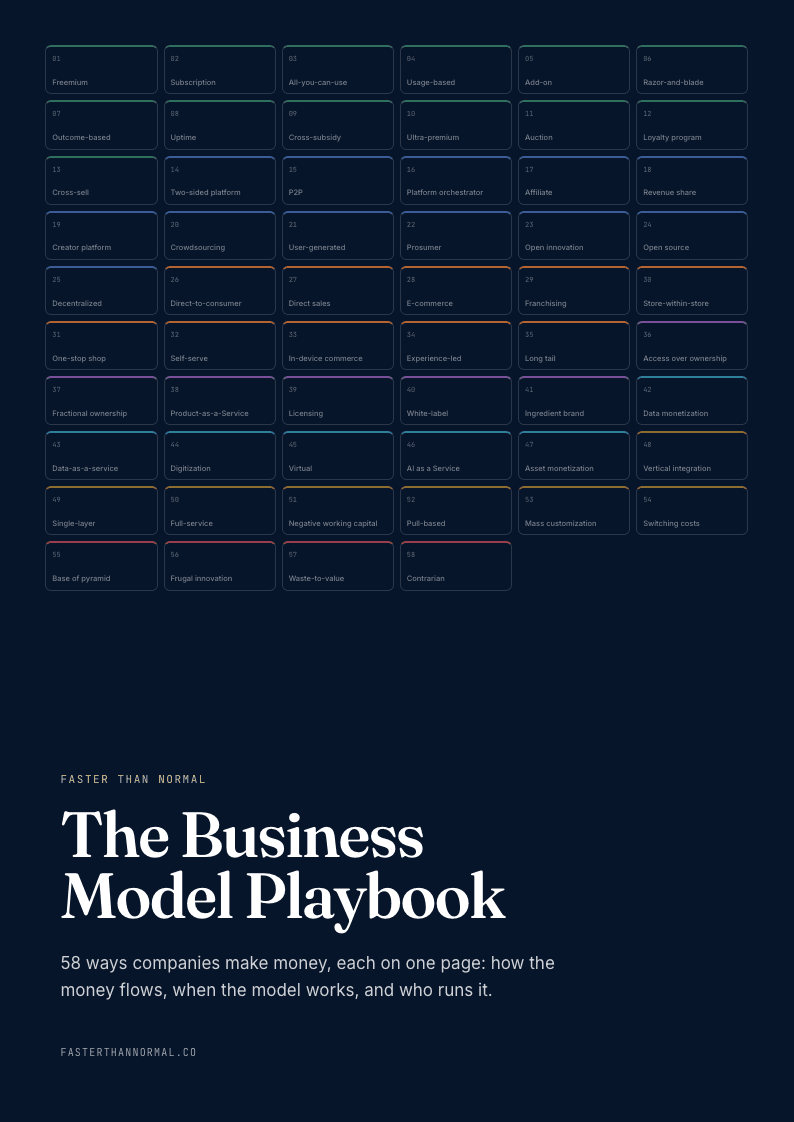
Get The Business Model Playbook
58 business models, one visual page each: how the money flows, the metrics that matter, and who runs it. Free when you join the Faster Than Normal email.
Free. No spam. Unsubscribe anytime.