

UPS
The United Parcel Service began as most American business legends do: with two teenagers, a hundred-dollar loan, and a willingness to pedal bicycles through Seattle's punishing hills for pocket change.
In 1907, Jim Casey and Claude Ryan weren't building a logistics empire. They were running errands. The American Messenger Company occupied a basement, employed kids on bikes, and competed for telegraph deliveries in a city where every message meant climbing another steep grade. No grand vision. Just grit and the immediate need to make money.
"We were just a couple of kids with a bike and a dream," Casey would later say, though the dream part came in retrospect.
The Retail Pivot
The breakthrough arrived in 1913, not through innovation but through observation. Department stores needed package delivery for their customers. The messenger business was fragmenting—telegrams gave way to telephones, but retail packages kept multiplying. Casey and Ryan shifted focus from messages to parcels. By 1919, they had expanded to California and rebranded as United Parcel Service.
The early UPS understood something their competitors missed: reliability mattered more than speed. While other services promised the impossible, UPS delivered the dependable. Brown trucks became brown because the color hid dirt—a practical decision that accidentally created one of America's most recognizable brand identities.
The company grew methodically through the 1920s and 1930s, but World War II tested every assumption. Fuel rationing, labor shortages, and reduced consumer spending forced radical adaptation. "We learned to do more with less," Casey noted. "It made us stronger." The constraint became capability—a lesson in operational efficiency that would define UPS for decades.
Post-War Expansion
The suburban boom of the 1950s and 1960s handed UPS its greatest opportunity. Shopping centers sprouted across America, but customers still wanted home delivery. UPS was positioned to capture this demand. By 1975, they served every address in the continental United States—a distribution network that had taken nearly seven decades to build.
But the company's greatest crisis arrived in 1997. A 16-day Teamsters strike brought operations to a standstill. Millions in daily losses. Customers defecting to competitors. The company's future balanced on labor negotiations that stretched through August heat while packages piled up in warehouses.
UPS didn't cave or break. They negotiated, compromised, and emerged battered but intact. More importantly, they learned. The strike exposed dangerous over-reliance on a single workforce model and forced diversification in both labor relations and operational structure.
Digital Transformation
The internet age demanded another reinvention. E-commerce growth exploded demand for residential deliveries while simultaneously enabling new competitors. UPS invested heavily in technology—package tracking, automated sorting, route optimization. They expanded internationally, entering markets where American logistics expertise provided competitive advantage.
The sustainability movement presented both challenge and opportunity. UPS greened their fleet, invested in alternative fuels, and discovered that environmental responsibility often aligned with operational efficiency. Lighter vehicles, optimized routes, and cleaner engines reduced both emissions and costs.
Today's UPS operates at staggering scale: $97 billion in revenue, 24.3 million packages delivered daily, operations in over 220 countries. The company that started with two bicycles now manages one of the world's most complex logistics networks.
Strategic Principles
Operational Obsession
Casey's fanaticism about driver appearance and service quality seems quaint until you recognize the competitive logic. UPS created a detailed policy manual that governed everything from uniform specifications to customer interaction protocols. This obsession with minutiae built the company's reputation for reliability—their primary competitive advantage in a commodity business.
The brown uniform wasn't just branding; it was operational psychology. Consistent appearance reinforced consistent service expectations. Customers knew what they were getting, and drivers understood they represented something larger than individual performance.
Adaptive Evolution
UPS survived for over a century by refusing to become comfortable. The progression from bicycles to trucks to automated sorting facilities to drone delivery represents continuous adaptation to technological and market shifts. Each transition required abandoning previous investments and retraining entire workforces.
Current CEO Carol Tomé captures this philosophy: "Our success comes from never forgetting where we started. We still approach each day with the hunger and hustle of a startup." The sentiment could sound manufactured, but UPS's track record supports it.
Decentralized Authority
Counterintuitively for a logistics company, UPS grew by spreading out control. Regional autonomy allowed faster decision-making and better local adaptation. Hub managers could respond to weather, traffic, or labor issues without waiting for corporate approval.
This structure created thousands of mini-entrepreneurs within the larger organization. Hub performance became a point of pride and competition. The model worked because it aligned individual incentives with corporate objectives while maintaining operational standards through training and technology.
Brand Through Function
The brown color choice exemplifies UPS's approach to brand building: solve real problems first, then leverage the solution as identity. They didn't choose brown for marketing reasons—they chose it because it hid dirt and reduced vehicle maintenance costs. The brand recognition came as a byproduct of practical thinking.
This principle extends throughout UPS operations. Their shield logo references protection and security, not because focus groups tested well, but because reliable delivery was their core promise. Form followed function, and function became the form.
Casey's assessment proved prescient: "Determined people, working together, can do anything." The company he started with Claude Ryan transformed a simple delivery service into global infrastructure. Not through revolutionary innovation, but through relentless attention to operational excellence and willingness to evolve when markets shifted.
The UPS story illustrates how sustainable competitive advantage emerges from consistency rather than brilliance. Two teenagers with bicycles became a logistics empire because they solved real problems, adapted when necessary, and never lost sight of what made them useful in the first place.
Free playbook
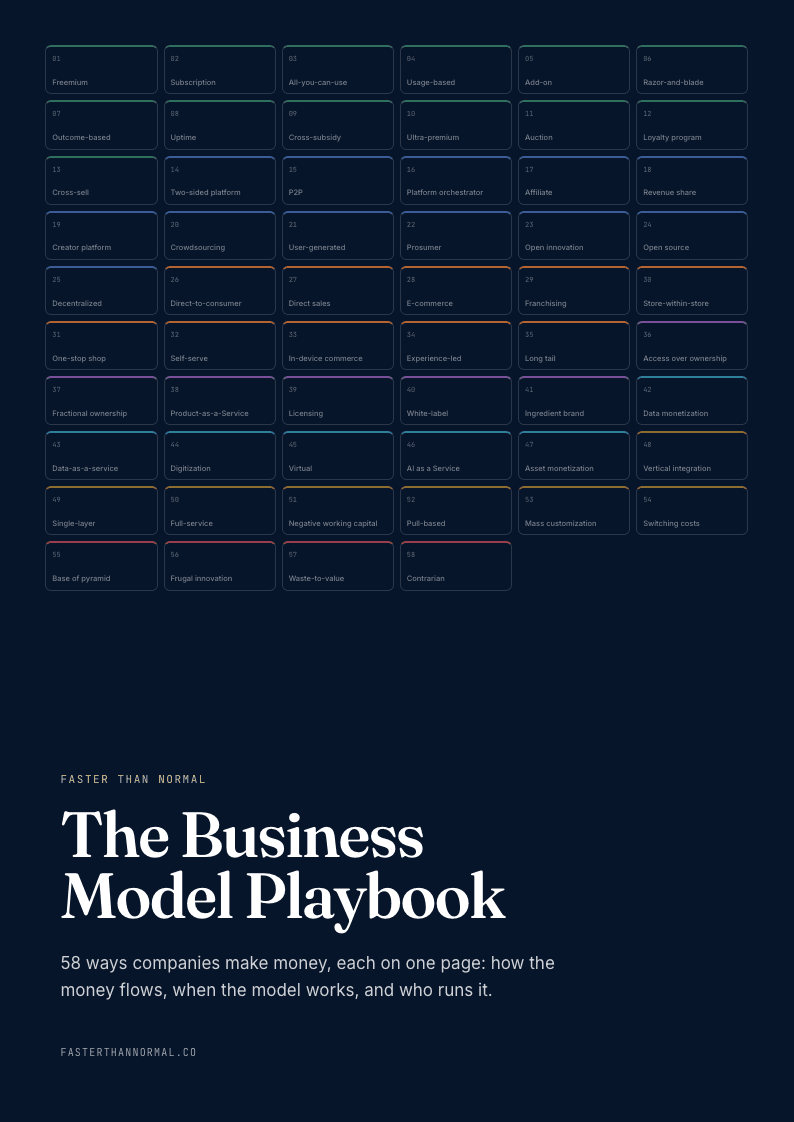
Get The Business Model Playbook
58 business models, one visual page each: how the money flows, the metrics that matter, and who runs it. Free when you join the Faster Than Normal email.
Free. No spam. Unsubscribe anytime.